This will be our only response to the uDAC-2 measurement. We received the email about your measurement on Friday afternoon. And our measurement lab is in Taiwan, close to our contract manufacturer. That's why we have to travel to another company's lab to take measurement, in order to check out your claim. We have design staff in US and Taiwan and the engineer who is responsible for uDAC-2 works in Taiwan, which is already Saturday.
After all the drama as you called it, we reached the following conclusion. And I am copying it directly from our email without any change.
Again, this is the way we have decided to design uDAC-2 and overwhelming majority of customers love and rave about the sound quality. If someone choose to listen with their measurement equipment, there is nothing we can do. I will conclude with another example such as our OPPO BDP-93 Nuforce Edition. We designed it so that it sounded like solid state triode, with a FR curve that looks WORST than the original BDP-93 and some people were also complaining about it. Our BDP-93NE has other measurements that are much better and I won't go into it here. My point is that we can not simply rely on measurement to make decision for good sounding audio products.
uDAC-2 volume imbalance at low level is a big issue for a few people and they complained loudly to us. A digital volume control would fix this problem. But we insist on using this rather expensive volume pot imported from Japan because IT SOUNDED GOOD! Believe me, we have tried to switch volume pot, but to us, better sounding product still win hands down over better measured product.
------------------------------------------------------------ from email exchange ------------------------------------
Your uDAC-2 is within spec, and both of our measurements are correct, just that we are looking at different part of the plot. Please read the response below (there are many questions so if we missed anything, please let us know). If you are going to publish your report, I appreciate that you also publish our response, which you will find that we did not dispute your finding, but it makes a compelling case why we TUNED uDAC-2 this way.
> Thanks for the response and running some tests. A PC should not clip a 0 dBFS signal. I think the uDAC-2 is the problem. Here is why:
>
> I can play a 0 dBFS signal on the PC in Foobar 2000, Windows Media Player, or let the dScope generate a "soundcard signal" where the uDac-2 is the "soundcard". Any of these 3 methods gives much higher distortion at 0 dBFS than at -1 dBFS.
>
I confirmed that we did this so we can have more dynamic and useful volume for practical use, such as listening to music. Our experience was that with MP3 or other format ripped music files, the output level could be very low, and there is not enough dynamic range.
At the end of the day, customer buys the uDAC2 to listen with their ear, not their scope. We are not being arrogant and disrespectful to your approach with your measurement, uDAC-2 is a product designed for general consumer use, so it has to work well for their most common use cases (there are more such cases below).
> I can play the exact same 0 dBFS test file as above with my Benchmark DAC1 Pre connected via USB and it is OK with very low distortion.
> I can play the exact same 0 dBFS test file as above even with my PC's internal sound chip and even it has lower distortion than the uDAC-2.
> So I believe the uDAC2 is doing something wrong with 0 dBFS signals. I also disagree that "nobody listens at 0 dBFS". When you turn down the volume on the PC with the Windows mixer the bitstream to the DAC is no longer bit accurate. You lose bit resolution (< 16 bits) as Windows is reducing the level in the digital domain. So many people DO listen with the mixer set to maximum. In fact, many DAC manufactures suggest you listen that way (including Benchmark) to avoid losing resolution and get the full 16 bit stream to the DAC.
>
For testing, I said that by having -1.3dB, it will go below clipping. In practice, there is no music recorded at 0dB. You are taking measurement at MAXIMUM digital volume. We maxed out exactly near 0dB, so the THD is around 1% as intended (hitting the voltage rail limit so that we have the loudest and un-distorted pracitical music playback. If we don't have 1% THD at 0dB, that means we are not fully using our voltage limit and we used 'less range' for music.
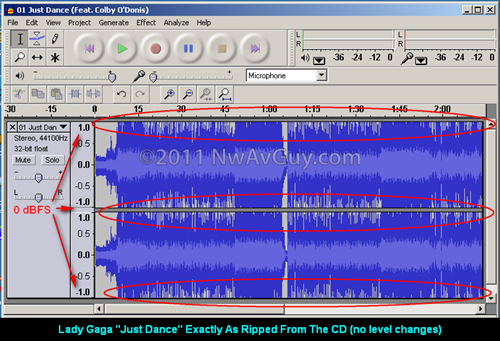
> And many pop recordings are now heavily compressed and the signal often hits 0 dBFS in regular music. And many people normalize their music to 0 dBFS when they rip CDs. So peaks of 0 dBFS are very common. And the uDAC-2 is going to perform poorly on those peaks.
>
And customers can just slide the volume on their PC if they are playing such a track.
There is no perfect optimization for such as entry level product (DAC1 cost almost 10X the price of uDAC-2 and it is linear powered with 30V for dynamics). But I think uDAC-2 is a better engineered product given the limitation (of USB powered device and cost).
> My uDAC-2 also clips at about 1 O'Clock and 0.9 volts (with 0 dBFS input) so at least we agree on that. That is OK.
> As for soundcards and RMAA those measurements usually cannot be trusted. Many things go wrong with RMAA and most people do not know how to properly test a USB DAC. Very few have any way to measure or set the levels, proper loads, etc.
> The channel balance is very bad on my sample. At some settings the error is more than 10 dB! Please see the attached screen shots of measurements showing different volume settings from 9 O'Clock to 12 O'Clock.
At 9 o'clock, there is hardly any signal, and analog pots do not behave well.
At 11 o'clock, your uDAC-2 slightly worse than our target, but 1dB is not unreasonable.
I will show you that a sample I had practically perfect L/R tracking (see attached file).
9 o'clock is off position.
11 o'clock is 1dB
Volume at 9 o'clock (-41.6 db below reference): Balance Error: 8.8 dB
Volume at 10 o'clock (10 9.6 db below reference): Balance Error: 0.6 dB
Volume at 11 o'clock (reference level ~ 300 mV output): Balance Error: 1.0 dB
We consider this within spec. I will emphasize again that listening test over and over again from so many people convinced us to adopt this current solution. I understand that recording engineer might need a different product so I will post such details and plot online so that there is no mistaken about the intended customers.
> You can't tell if it is new or old from the serial number? It's from Crutchfield. They are very good with returns so I know they will take it back when I am done testing it.
> The problem is not noise, I think the distortion is a design problem. And the channel balance is a very cheap volume pot with poor quality control.
> Here are 3 more screen shots this time with Line Out:
> 1 - uDAC-2 playing 0 dBFS 1 Khz at 1 volt into 100K Line Out 0.17% THD
I confirmed that the ESS DAC clips at 0dB digital signal. If we do not do that, then at typical music, the output could be very low. We learn this the hardway with Icon Mobile and Icon-1, where many people said the USB music lacked volume and dynamic. So we have to dial up the mid-level signal and let the extreme level clips. THD drops as long as the digital input is kept below -1.3dB.
Like I stated above, we tuned it for most common use cases as we learned from past experience with Icon Mobile and Icon1.
> 2 - Benchmark DAC1 Pre playing same file, same PC, same dScope settings, 0 dBFS 1 Khz 1 volt 100K 0.0007% THD
> 3 - uDAC-2 -115 dBFS (ref 1 volt) 1 Khz to show noise floor - noise is OK (< -120 dB)
> 4 - uDAC-2 Spectrum from 40 Khz to 50 Khz. Note the 48 Khz signal but I'm using 44.1 Khz input.
> Picture #1 shows high distortion even with Line Out at 100K. #2 shows it is not my PC or the USB connection--the Benchmark plays the same file OK. Picture #3 shows this problem is not noise. And #4 shows the uDAC-2 seems to be resampling 44.1 Khz to 48 Khz? You can also see a 48 Khz signal in #3. This is not good when most listen at 44.1 Khz.
The uDAC2 has no re-sampling capability. It throws out whatever is fed. If the Windows re-samples, it could be reflected. A lot of issues and difficulties because there is too many s/w possibilities.
Best regards,
Jason Lim
CEO, Nuforce