










average_joe
Headphoneus Supremus
- Joined
- Dec 5, 2008
- Posts
- 5,394
- Likes
- 299
Multi-Portable Amp Thread
[size=9pt]Amps mean different things to different people. It depends on your use, music, source, headphone, and ears to determine if an amp will make a difference, and if so how much. As primarily an IEM guy, I have had mixed results with amps through the years depending on the factors I mentioned, and while this review thread can’t possibly cover all the iterations of product combinations, it will compare the general performance of each amp. I do have more specific amp matching with headphones/sources in my [/size][size=9pt]custom IEM reviews[/size][size=9pt]. My Google+ page.[/size]


click images for full sized picture
[size=9.0pt]Portable amps reviewed:[/size]
[size=9.0pt]- [/size][size=9.0pt]Headphonia Arrow 12 HE[/size]
[size=9.0pt]- [/size][size=9.0pt]Headamp Pico Slim[/size]
[size=9.0pt]- [/size][size=9.0pt]Meier Audio Stepdance (original)[/size]
[size=9.0pt]- [/size][size=9.0pt]Neco Soundlab DUAL AMP portable headphone amplifier – V2[/size]
[size=9pt]- [/size][size=9pt]iQube V2 (with DAC)[/size]
[size=9pt]- [/size][size=9pt]Auzentech i.Fuzen HP-1[/size]
[size=9pt]- [/size][size=9.0pt]Furutech Cruise (with DAC)[/size]
[size=9pt]- [/size][size=9pt]Just Audio uHA-120[/size]
[size=9pt]- Portaphile 627[/size]
[size=9pt]- Epiphany Acoustics EHP-O2[/size]
[size=9pt]- Headphonia Arrow 12HE 4G[/size]
[size=9pt]- Shonyun 306[/size]
[size=9pt]- JDS Labs ODAC, O2, and ODAC + O2 combo (simulated)[/size]
[size=9pt]- Additional amps reviewed in the 2nd post due to the slow response of this post.[/size]
- Pre-review impressions can be found here.
[size=9.0pt]But, before reading further, here are my notes from testing:[/size]
[size=9.0pt]- I primarily review and listen to custom IEMs and some, such as the JH16, LS8, and Infinity X3 are not dependent on the quality of the amp and there are small to minimal differences between the amps to my ears.[/size]
[size=9.0pt]- These amps are fairly close in sound signatures and the differences between the amps is not as large as the difference between headphones/IEMs.[/size]
[size=9.0pt]- The differences between the amps in frequency response is very minimal.[/size]
[size=9.0pt]- A good amp can improve the sound of lower end headphones, but a good headphone from the headphone out of a relatively low end source (Clip+ or iPhone) can sound better. Which is better overall depends on the combo and what you want. I have heard what I consider huge improvements from some combinations such as the Ortofon e-Q7 and the ALO Rx amp or a MEElectronics CC51 and the Meier Audio Stepdance.[/size]
[size=9.0pt]- With lower end DACs the differences between amp performance is less than with higher end DACs such as the Anedio D1 and HiFiMan 801, as would be expect.[/size]
[size=9pt]- Using an amp from the headphone out of a player has marginal improvements for either output impedance mismatch reasons, or internal PMP amp limitations. For example an iPod/iPhone/Fuze sound better to me from a line out than when amping the headphone out.[/size]
Important notes about the charts and ratings: The relative differences between the rating numbers are not all that large. For example a score of an 8 in the bass isn't an overwhelming difference, but is very apparent in comparison with something rated at a 5. While I didn't list synergy with various headphones, some react differently with certain headphones, however the relative sound and technical ability is usually remains the about the same comparatively.
--------------------------------


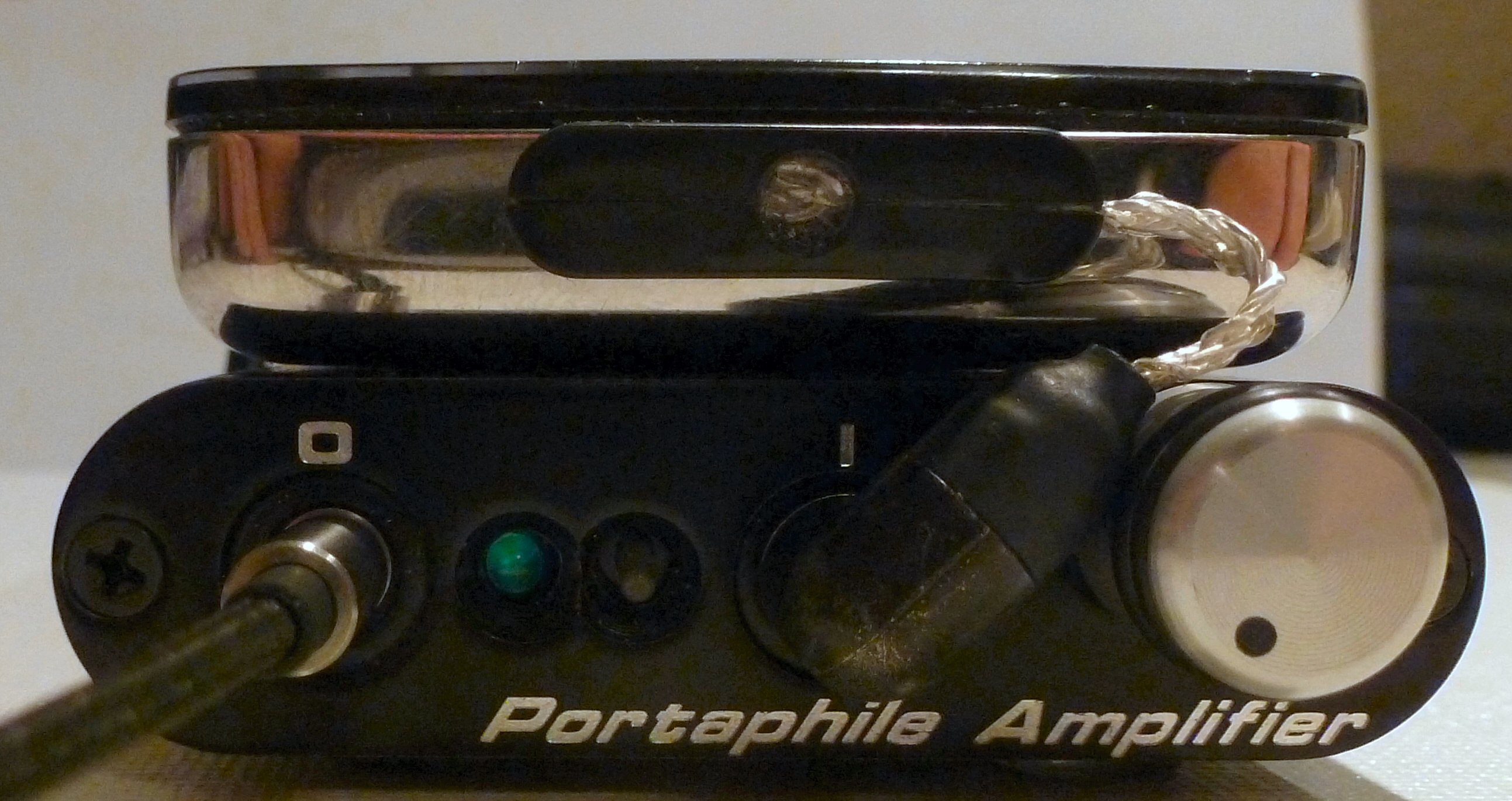
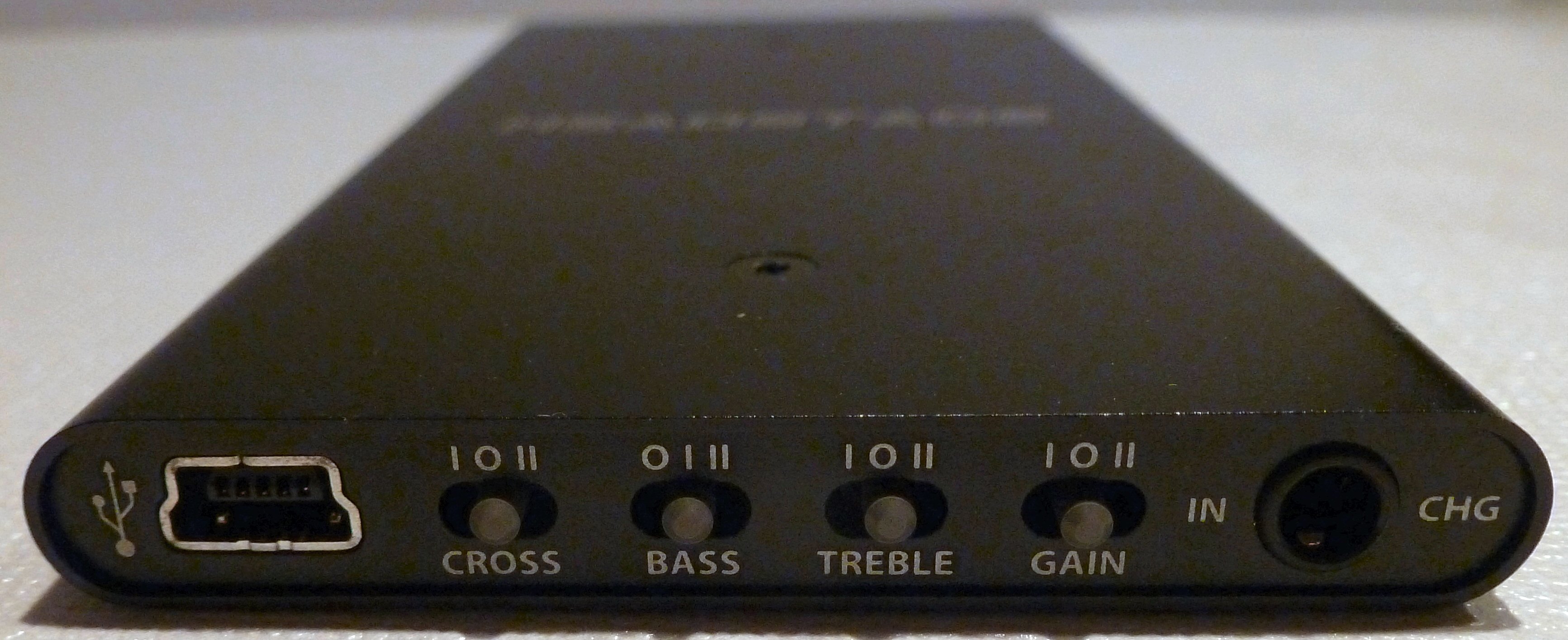
Manufacturer: Headfonia
Model: Arrow 12 HE
Price:$249
Product notes: discontinued, replaced by the 3G and soon to be replaced by the G4
Type: portable amp
Volume control: analog, wheel
Power connector: USB (mini B)
Features:
- gain switch [size=9pt](0, I, II)[/size]
[size=9pt]- bass switch [/size][size=9pt](0, I, II) - 0db, 6 dB, 12 dB[/size]
[size=9pt]- crossfeed [/size][size=9pt](0, I, II)[/size]
[size=9pt]- impedance switch [/size][size=9pt](0, I, II) 10 ohm, 70 ohm, 120 ohm[/size]
[size=9pt]- auto power off mode [/size][size=9pt](3 switch positions: on/off/auto - auto turns the amp off after 60 seconds of no input signal)[/size]
[size=9pt]- two input locations [/size]
- slim design
Works with 4 pin headphone plugs: Yes
Sound signature: A spacious and warm presentation that generally adds width to the presentation while not necessarily adding to the depth. The low through mid-bass is slightly elevated but the sub-bass is not. Due to the bass presentation and spaciousness, the midrange seems slightly more laid back and the treble is more neutral/laid back.
Sound quality: The quality of the Arrow 12 HE varies greatly depending on the IEM and headphone due to the high output impedance as with many custom IEMs that have crossovers the sound is on the flatter side while others such as the TS842 (and ER4P) improves quite a bit with the impedance switch turned on, adding smoothness to an edgy and analytical presentation. Overall, the resolution is a step below others such as the Pico Slim and Stepdance, but not always. Driving full sized cans, the Arrow 12 HE does an acceptable job but the slim portable design does show limitations in dynamics compared with something more powerful such as the iQube, Stepdance, or Neco. When paired with dynamic driver IEMs the sound is overall good and other than deep bass roll off for lower impedance headphones/IEMs, there is no effect of the output impedance.
Channel Imbalance: Yes, at very low volumes only with high sensitivity IEMs
Hiss: There is no appreciable hiss with the JH16 on low gain at max volume or below.
Interference: Slight clicking with the iPhone 3G when the phone is connecting to the internet. No interference with the Blackberry Bold.
Summary: The Arrow 12 HE was a great amp when it was released due to the combination of size, shape, performance, and features as well as the amazing driving ability due to the three gain settings. Still OK by today's standards, there have been other amps that have surpassed the performance of the Arrow 12 HE including the prototype G4 that I had a chance to audition. The Arrow 12 HE really is dependent on specific matches with balanced armature IEMs as the output resistor either helps, hurts, or doesn't affect the sound, but you won't know unless you either try or read about it from others. Dynamic driver armatures do respond well however as do lower end headphones.
[size=9pt]Preview: I had the opportunity to try a G4 prototype board and the improvement was anywhere from a decent amount to substantial depending on the headphones used. The G4 has more resolution and is closer to the performance of the Pico Slim and Stepdance and I am looking forward to hearing the G4 when it is ready.[/size]
[td=colspan:6]
[td=rowspan:2]
--------------------------------


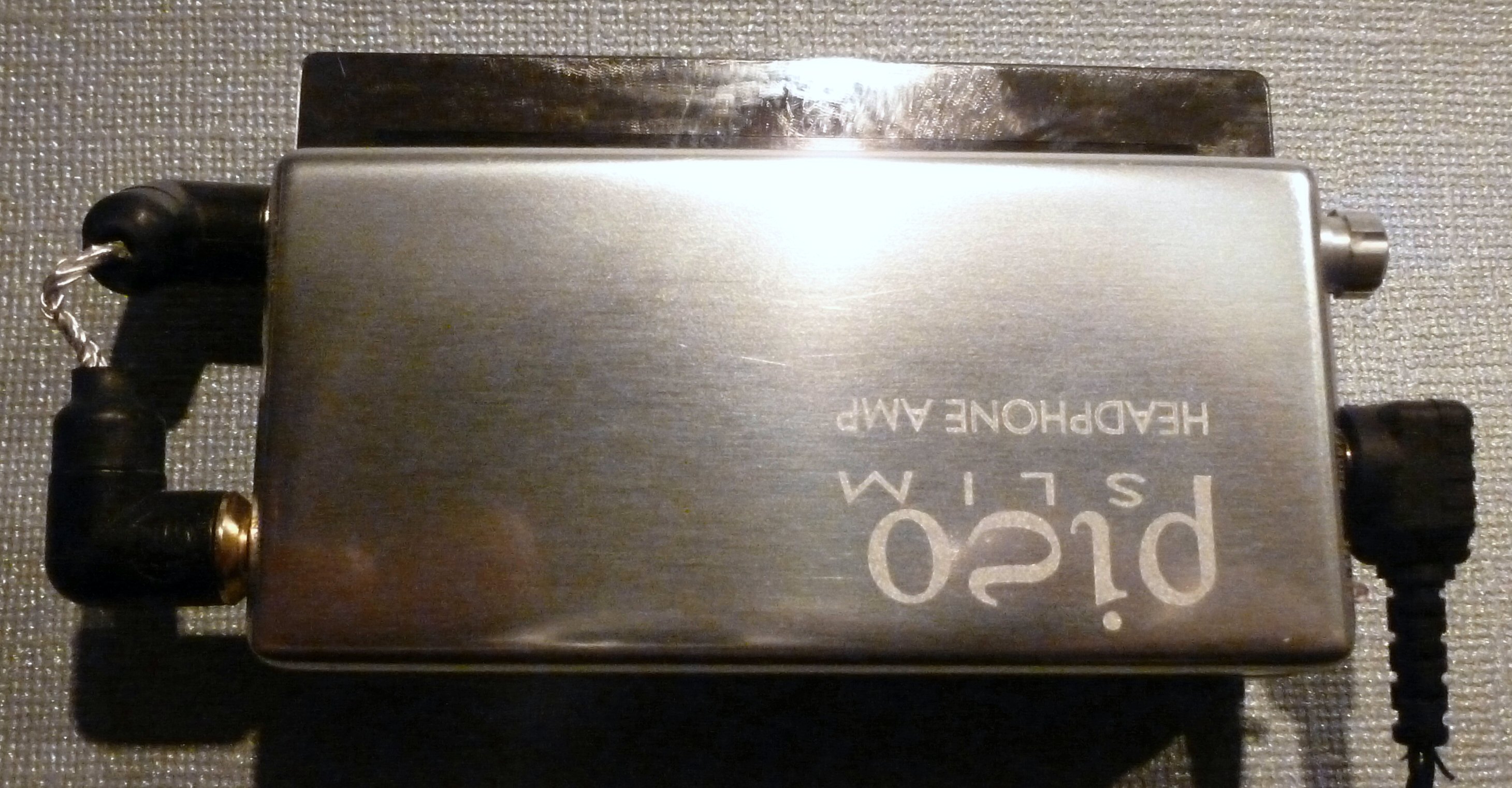
Manufacturer: Headamp
Model: Pico Slim
[size=9pt]Price[/size][size=9pt]: $399[/size]
[size=9pt]Product notes[/size][size=9pt]: The Pico Slim is the smallest high performance amp I know of and the size and shape make it perfect for on the go use with a minimal size addition to your source for powering IEMs and easy to drive portable cans.[/size]
[size=9pt]Type[/size][size=9pt]: portable amp[/size]
[size=9pt]Volume control[/size][size=9pt]: digital, knob[/size]
[size=9pt]Power connector[/size][size=9pt]: USB (Micro B)[/size]
[size=9pt]Battery life[/size][size=9pt]:[/size]
[size=9pt]Features[/size][size=9pt]:[/size]
[size=9pt]- Tiny size[/size]
[size=9pt]- On/off switch which allows you to leave the volume where you want it between listening sessions[/size]
[size=9pt]Works with 4 pin headphone plugs[/size][size=9pt]: Yes[/size]
[size=9pt]Sound signature[/size][size=9pt]: The Pico Slim has a very transparent and fairly neutral sound that is on the brighter side of the spectrum. It does not lack deep bass oomph, but the deep bass isn’t quite as accentuated and powerful as other amps such as the Stepdance or Cruise resulting in a slightly thinner sound. Overall the Pico Slim doesn’t add much coloration to the sound and offers very good transparency. The soundstage is on the average side but does offer very good depth and proportion to the sound resulting in a realistic yet somewhat intimate sound.[/size]
[size=9pt]Sound quality[/size][size=9pt]: With exceptional transparency and very high levels of resolution, the Pico Slim performs very well technically. The biggest issue I had with the Pico Slim with BA IEMs is that the notes can become slightly thinner than usual, and with some already thinner sounding BA IEMs this is not my ideal sound. However, overall the results are exceptional. With dynamic driver IEMs the Pico Slim performs quite well, however it doesn't have the bass control of some of the larger amps such as the Stepdance, iQube, and Cruise. The Pico Slim isn't great at driving harder to drive headphones except for fairly low volume listening, and then it is on par with the Arrow 12 HE; good but not great.[/size]
[size=9pt]Channel Imbalance[/size][size=9pt]: No[/size]
[size=9pt]Hiss[/size][size=9pt]: Turning the volume knob up past the halfway point with the JH16 results in audible hiss, however when music is playing that volume level is louder than I would listen. The hiss could be an issue with a low volume source, but I have not come across one that has caused an issue.[/size]
[size=9pt]Interference[/size][size=9pt]: No interference from both my Blackberry Bold and iPhone 3G[/size]
[size=9pt]Summary[/size][size=9pt]: For the size and shape the Pico Slim is a great little amp. It offers exceptional transparency and plays well with custom IEMs, including high sensitivity ones, as well as dynamic driver IEMs. Both the Arrow and Pico Slim are very easy to carry around with my modded iPod and the Pico Slim gives me consistently great sound, although in direct comparison the thinner and brighter sound if the Pico Slim doesn't always match well with brighter and thinner sounding IEMs. With absolutely no imbalance, no interference, and no hiss in my experience the Pico Slim is an excellent choice for high sensitivity custom IEMs. [/size]
[td=rowspan:2]
[td=colspan:6]
[td=rowspan:2]
--------------------------------


Manufacturer: Meier Audio
Model: Stepdance
[size=9pt]Price[/size][size=9pt]:$349[/size]
[size=9pt]Product notes[/size][size=9pt]: Discontinued; replaced by the 2stepdance. I have owned the Stepdance for a while and have noticed it is a great performer with a wide range of headphones and IEMs rarely having a poor match.[/size]
[size=9pt]Type[/size][size=9pt]: portable amp[/size]
[size=9pt]Volume control[/size][size=9pt]: digital, knob[/size]
[size=9pt]Power connector[/size][size=9pt]: Non-standard, for power only; unit does not charge battery[/size]
[size=9pt]Battery life[/size][size=9pt]: Up to 8 hours with 600 uHa rechargable in low gain, high current mode, but typically closer to 6[/size]
[size=9pt]Features[/size]:
[size=9pt]- Active ground that simulates balanced in a single ended design[/size]
[size=9pt]- Low and high gain switches[/size]
[size=9pt]- Low and high current switches[/size]
[size=9pt]Works with 4 pin headphone plugs[/size][size=9pt]: Yes[/size]
[size=9pt]Sound Signature[/size][size=9pt]: The sound is on the warm side, but not all that warm, however the deep bass region does have some extra kick to it to go with the superb control. The midrange disappears and is neutral while the upper mids and treble are slightly on the brighter side of neutral. The width of the space scales with better DACs a bit better than average amp I reviewed while the depth and imaging are average.[/size]
[size=9pt]Sound Quality[/size][size=9pt]: Bass control is the first thing that comes to mind when I think about the Stepdance, but it has so much more to offer. I was actually surprised by where the amp rated overall in my scoring system as it really doesn't do anything wrong. Resolution is very good with a slight liquidity to the presentation and better than average smoothness leading to a fairly transparent sound. The Stepdance can drive harder to drive cans quite well and to loud volumes, performing in the top half.[/size]
[size=9pt]Channel Imbalance[/size][size=9pt]: No[/size]
[size=9pt]Hiss[/size][size=9pt]: Hiss is dependent on the volume setting and turning up the volume will result in more hiss. I hear no hiss at normal listening volumes with any headphone/IEM I tried.[/size]
[size=9pt]Interference[/size][size=9pt]: None.[/size]
[size=9pt]Summary[/size][size=9pt]: The Stepdance has impressive sonic performance for the size and price with the ability to drive just about anything. The bass is one of the best I have heard in a portable amp with a combination of control, depth, and punch. This is the only portable amp that requires an external battery charger, but it can accept other external batteries of up to 15V if you choose to carry one. With an overall great performance the Stepdance would be a recommended amp, but now that the 2stepdance is out and uses different op amps I am not 100% sure how that amp performs.[/size]
[td=rowspan:2]
[td=colspan:6]
--------------------------------


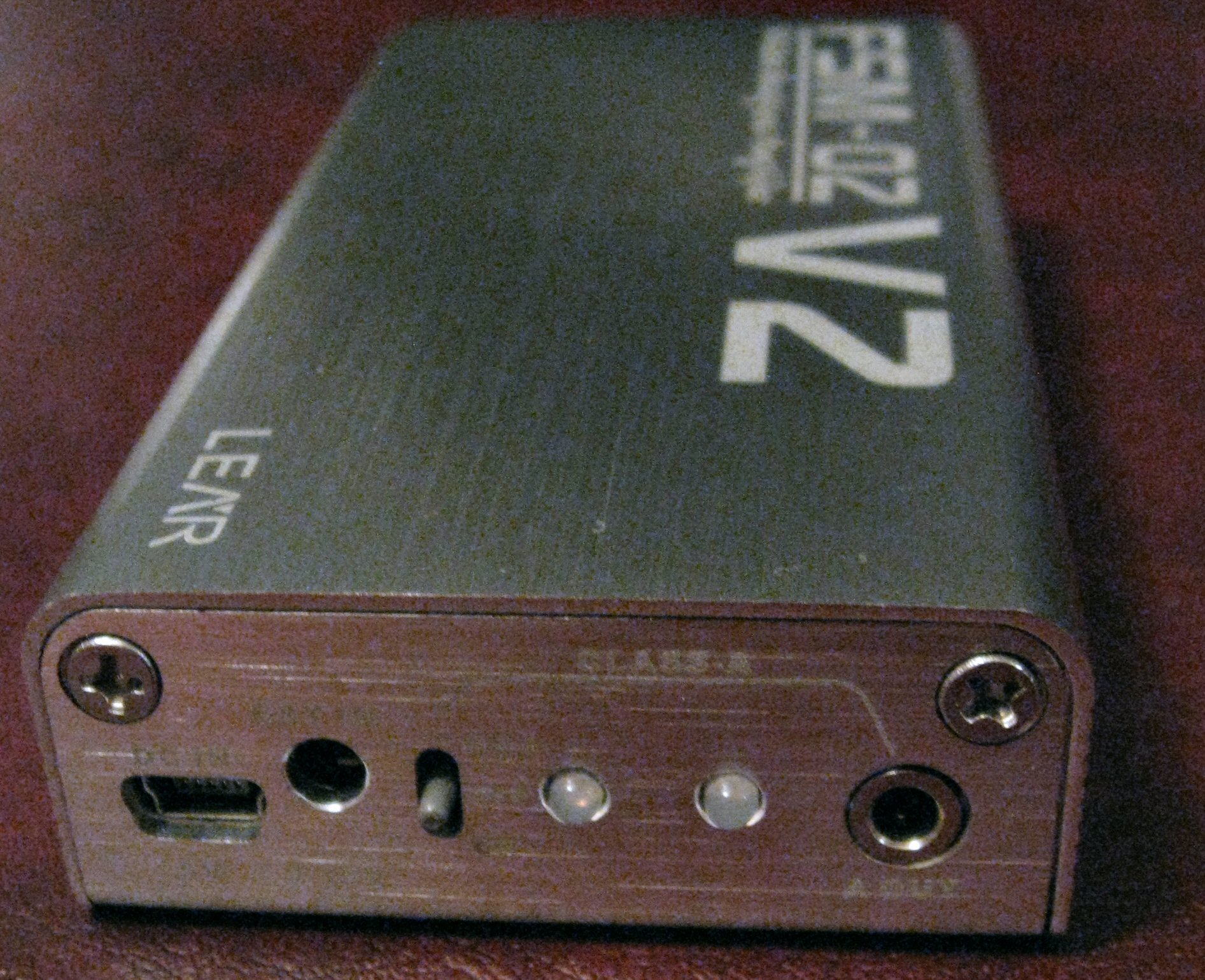
Manufacturer: Neco Soundlab
Model: DUAL AMP portable headphone amplifier – V2
[size=9pt]Price[/size][size=9pt]: $161 ($117 + $23 for AD8610 opamp + $21 for 600 mAH li-ion battery)[/size]
[size=9pt]Product notes[/size][size=9pt]: Neco, the amp designer, is a great guy and will be happy to work with you on your custom needs fot the amp. Thank you Neco! This is the lowest cost amp in this review, therefore it stands alone. I have owned a few amps in the same price range, but none have preformed to the level of my Arrow, yet the V2 does. [/size]
[size=9pt]Type[/size][size=9pt]: portable amp[/size]
[size=9pt]Volume control[/size][size=9pt]: analog, knob, logarithmic[/size]
[size=9pt]Power connector[/size][size=9pt]: Custom connector[/size]
[size=9pt]Battery life[/size][size=9pt]: 24 hours at low volumes[/size]
[size=9pt]Features[/size][size=9pt]:[/size]
[size=9pt]- On/off switch which allows you to leave the volume where you want it between listening sessions.[/size]
[size=9pt]- Logarithmic volume control for less low volume channel imbalance[/size]
[size=9pt]Works with 4 pin headphone plugs[/size][size=9pt]: Yes[/size]
[size=9pt]Sound signature[/size][size=9pt]: The V2 is a fairly neutral across the spectrum with an ever so slight bump in the midrange. If it weren't for the slight bump in the mids, the V2 would be flat. [/size]
[size=9pt]Sound quality[/size][size=9pt]: For the price the V2 performs quite well. While it isn't the best performer, it holds its own and is slightly better than the amp section of the D10 and does best some others in certain categories. It has very good dynamics while the soundstage and imaging are average. The V2 performed about average pushing the LCD-2, which is impressive for the price.[/size]
[size=9pt]Channel Imbalance[/size][size=9pt]: Yes, at low volumes with very high sensitivity custom IEMs such as the JH16. I initially received the amp with a standard volume control and the imbalance was much greater. Let Neco know what you want and he will make an amp specifically for you, including a lower gain if you want to use the amp with high sensitivity custom IEMs.[/size]
[size=9pt]Hiss[/size][size=9pt]: Hiss is dependent on the volume setting and turning up the volume will result in more hiss. I hear no hiss at normal listening volumes with any headphone/IEM I tried.[/size]
[size=9pt]Interference[/size][size=9pt]: None[/size]
[size=9pt]Summary[/size][size=9pt]: With the form factor similar to the Stepdance, an internal 9V battery with an internal charger and better battery life the V2 is a great performer for the price. If you use high sensitivity IEMs make sure to get the logarithmic volume and have Neco set the gain lower (mine is standard gain). For dynamic driver IEMs or headphone this shouldn't be an issue. While the V2 isn't quite a giant killer, it is a giant in its price range. [/size]
[td=rowspan:2]
[td=colspan:6]
[td=rowspan:2]
--------------------------------


Manufacturer: Quables
Model: iQube V2
[size=9pt]Price[/size][size=9pt]: $699[/size]
[size=9pt]Product notes[/size][size=9pt]: Class D amplifier[/size]
[size=9pt]Type[/size][size=9pt]: Portable DAC/amp[/size]
[size=9pt]Volume control[/size][size=9pt]: Analog, knob[/size]
[size=9pt]Power connector[/size][size=9pt]: USB (mini B)[/size]
[size=9pt]Battery life[/size][size=9pt]: (4 AAA batteries) [/size][size=9pt]Unfortunately I didn't have the opportunity to run the iQube until the batteries ran out, but I did use it for several hours for over more than a week before the battery needed a recharge driving IEMs. [/size][size=9pt]Per the manufacturer the iQube V2 should last between 10 and 20 hours depending on the headphone/volume used, however I think I got more time out if the iQube than 20 hours.[/size]
[size=9pt]Features/Information[/size][size=9pt]:[/size]
[size=9pt]- 16 bit, 32 / 44.1 / 48K sample rates[/size]
[size=9pt]- CS4344, 24 bit delta sigma DAC[/size]
[size=9pt]- Gain switch (low gain = 2, high gain = 7)[/size]
[size=9pt]Works with 4 pin headphone plugs[/size][size=9pt]: Yes[/size]
[size=9pt]Sound signature[/size][size=9pt]: [/size][size=9pt]The iQube V2 is neutral through the midrange and treble with an emphasis in the bass region resulting in a warmer presentation. Recreating a spacious and 3D soundstage, the transparency is very good letting the rest of the chain impart the sonic signature on the presentation more so than the iQube, which is what you want in your amp! The DAC section is also very transparent and doesn't change the sound signature of the iQube.[/size]
[size=9pt]Sound quality[/size][size=9pt]: [/size][size=9pt]The overall quality of the iQube was very good with just about everything I threw at it from the K701 to all of my custom IEMs to various dynamic driver IEMs/ear buds I have lying around. There is no lack of power in the bass region, but with the bit of enhancement the iQube sounded a little less controlled in comparison with amps such as the Stepdance and Cruise. Dynamics are good and near the top of the performance curve, but not the best both as an amp and as a DAC. Resolution and clarity were also very good, but not at the top of the performance curve. [/size]
[size=9pt]Paired with my high sensitivity custom IEMs, lead by the JH16 and LS8, the iQube did a good job but there is hiss and a slight channel imbalance at lower volumes. Pairing is dependent on the sound signature of the custom IEM, but in general there were no bad matches and the iQube was at or near the top of the performance heap.[/size]
[size=9pt]When coupled with the LCD-2 v1 the iQube did a good job, but not great, however no portable amp compared with the Anedio D1 desktop DAC/amp. The K701 sounded spacious and had plenty of bass with good control, resulting in a musical combination the combines the strengths of both the amp and the headphone. Combining the what the iQube does well it performs quite well overall as both an amp and a DAC.[/size]
[size=9pt]Note: After my listening I read other reviews of the iQube V2 and for some reason I seem to hear the V2 differently than other reviewers as the bass was more emphasized and in comparison with the other amps in this review, specifically the Stepdance, D10, Cruise, uHA-120, and Pico Slim, the iQube sounded on the warmer side of neutral and didn't have quite the bass speed or control. The differences were smaller with lower resolution headphones, but still there to an extent. [/size]
[size=9pt]Channel Imbalance[/size][size=9pt]: Yes, with the JH16 at low volume levels[/size][size=9pt], but not an issue with the majority of my custom IEMs and not an issue with headphones.[/size]
[size=9pt]Hiss[/size][size=9pt]: There is slight hiss with the JH16, and the hiss is constant and does not change with the volume.[/size]
[size=9pt]Interference[/size][size=9pt]: Setting my Blackberry on the amp or within about 8 inches resulted in some noise. My iPhone 3G did have interference when connecting via wi-fi, but that was reduce a good deal when I switched to 3G service. The iPhone didn't interfere with the amp when it was 1.5" or further away.[/size]
[size=9pt]Summary: [/size][size=9pt]The iQube is a very nice amp that does many things right and nothing really wrong. The combination of amp and DAC come with a space premium resulting in a portable amp that isn't all that portable, or at least pocketable. But if you do want to bring it along with you the results will be great sound from either a computer or another source. The amp section is very good but not the top performer despite the highest price, although not technically that far off. The DAC section is high quality and does not alter the performance of the amp vs. when used via line-in from higher performing DACs such as the 801 or D1, although the DAC doesn't have the resolution of those two, but depending on the headphone used, track, and bit depth, the DAC differences are not very large. [/size]
[size=9pt]Taking into account the overall performance of the iQube vs. the competition, it is a very strong performer.[/size]
[td=rowspan:2]
--------------------------------
Auzentech i.Fuzen HP-1 iPhone 4/4S amp case


Manufacturer: Auzentech
Model: i.Fuzen HP-1
[size=9pt]Price[/size][size=9pt]: $129[/size]
[size=9pt]Product notes[/size][size=9pt]: iPhone 4 & 4S case amp with built in battery[/size]
[size=9pt]Type[/size][size=9pt]: iPhone 4/4S case amp[/size]
[size=9pt]Volume control[/size][size=9pt]: digital, touch buttons[/size]
[size=9pt]Power connector[/size][size=9pt]: USB (mini B)[/size]
[size=9pt]Battery life[/size][size=9pt]: Using the battery for the amp, the i.Fuzen easily outlasts the iPhone. If used as a backup battery the i.Fuzen was able to maintain the iPhone charge and play for at least 8 hours while still having 2 to 3 bars of power left, depending on how much data/voice was used. [/size]
[size=9pt]Features[/size][size=9pt]:[/size]
[size=9pt]- Low and high gain 3.5mm output jacks[/size]
[size=9pt]- Can be used as a battery for the iPhone[/size]
[size=9pt]Works with 4 pin headphone plugs[/size][size=9pt]: Yes[/size]
[size=9pt]Sound signature[/size][size=9pt]: More laid back than the iPhone 4S headphone out with a more spacious presentation that doesn’t lose the presentation depth. Due to the more spacious sound, the imaging and apparent detail levels are higher.[/size]
[size=9pt]Sound quality: Depending on the headphone used, the technical improvements vs. the iPhone 4S range from small to significant. The 4S sounds good, but lacks resolution and doesn’t control the drivers all that well when there is lots of bass. While the i.Fuzen has a higher resolution with the 4S, the difference isn’t all that large, but what does improve is the control and clarity of the presentation. It is due to the improved control, larger space, and laid back in comparison presentation making the details stand out more with better articulation. It is difficult to compare with my other portable amps due to the form factor except with an iPhone, but the i.Fuzen keeps up with more expensive amps. One potential issue is the digital volume steps with ultra sensitive custom IEMs as the JH16 on the lowest volume setting was quite, but not as quite as I would listen to if I wanted to fall asleep with the JH16. But that is not a big issue for on the go since there is usually always background noise.[/size]
[size=9pt]I used the high gain headphone jack (the one with two dots) with the K701 with very good results. First, the K701 sounds very bass light from the headphone out while the i.Fuzen adds a good amount of body and depth to the bass. Dynamics and depth of the presentation are improved resulting in a more natural and open sound. During my testing I was distracted and after a bit I was thinking the sound was pretty disappointing and I noticed I was connected to the iPhone HPO and when I switched to the i.Fuzen I immediately noticed the quality improvement. The i.Fuzen can drive the 701 much much louder than the HPO from the high gain jack as the first step up in volume is equivalent to about 45% volume from the iPhone HPO.[/size]
[size=9pt]I also had a short audition with the iPhone 4 and the i.Fuzen HP-1 with a similar result of hearing an improvement, however the improvement was different. While it was short, it sounded like the resolution was higher with the i.Fuzen and of course there was much more driving power and a slightly fuller, warmer sound.[/size]
[size=9pt]Channel Imbalance[/size][size=9pt]: No[/size]
[size=9pt]Hiss[/size][size=9pt]: None[/size]
[size=9pt]Interference[/size][size=9pt]: None[/size]
[size=9pt]Summary[/size][size=9pt]: The i.Fuzen is a great design and to my knowledge, the first amp built into a phone case. The case doesn’t add much bulk to the iPhone 4/4S and is surprisingly light, but it the length it does add can be an issue for those with small pockets. The added battery helps with iPhone life while powering the amp. With performance that is an improvement with both headphones and IEMs, the i.Fuzen could turn your iPhone 4/4S into a high performing player both on the go and at home. With a size increase that is much smaller than even the Pico Slim, the i.Fuzen offers a very strong performance for the size, and combining the price, it also excels in that area. I have seen beefier cases and cases that provide less protection for the iPhone and the i.Fuzen does offer good protection and should prevent damage from most drops. Overall with all things considered, Auzentech did a great job bringing this product to market, giving iPhone users something they can use to boost audio quality without adding too much bulk or wallet drain.[/size]
--------------------------------


Manufacturer: Furutech/ADL
Model: Cruise
[size=9pt]Price[/size][size=9pt]: $475[/size]
[size=9pt]Product notes[/size][size=9pt]: The Stride is available without the carbon fiber for $350. Had issues with the fit of a Via Blue connector on an interconnect cable as the plug was nearly too large to fit in the jack.[/size]
[size=9pt]Type[/size][size=9pt]: portable DAC/amp[/size]
[size=9pt]Volume control[/size][size=9pt]: analog, dial[/size]
[size=9pt]Power connector[/size][size=9pt]: USB (mini B)[/size]
[size=9pt]Battery life[/size][size=9pt]: 80 hours (manufacturer spec). I never ran out of battery life while using the Cruise.[/size]
[size=9pt]Features[/size][size=9pt]:[/size]
[size=9pt]- Auto-circuit disconnect when the headphone is not plugged in resulting in no audible noise and a 2 second delay before music starts playing[/size]
[size=9pt]- Internal DAC, 24/96 USB[/size]
[size=9pt]Works with 4 pin headphone plugs[/size][size=9pt]: Yes[/size]
[size=9pt]Sound[/size][size=9pt]: With a very dynamic sound, the Cruise is spacious, punchy and exciting with a great sense of speed. The brighter sound along with a slightly thinner note than the competition brings with it great detail and resolution as well as excellent imaging and transparency. While the Cruise is on the brighter side in comparison with the amps reviewed here, it still has excellent deep bass and seems to slightly enhance the lowest octaves of the music. With genres such as psy-trance and speed metal the Cruise has a speed advantage over other amps, and with genres such as live instrumental performances the Cruise can really bring out the details in the instruments and show top notch imaging. [/size]
[size=9pt]The Cruise isn’t the be-all end-all amp however as the hiss is noticeable upon first listen with many of my high sensitivity IEMs, however after a bit of time I don’t notice the hiss, well, unless I am focusing on the music and there is a gap between tracks or a quiet area of a song. I was expecting a black background, but even though it doesn’t have one I still want to listen to the Cruise because of the rest of the presentation. The most annoying thing for me, however, is if my phone is too close to the Cruise I will hear static and noise when the phone radio turns on. [/size]
[size=9pt]Powering full sized headphones such as the LCD-2 and K701, the Cruise does well with plenty of power even though there is no gain switch. Of course, none of the portable amps I have heard can make the LCD-2 sound as good as a desktop amp, but it does rank in the upper performance levels with the LCD-2 for a portable amp, and without the hiss issue. The K701 sounds excellent from the Cruise with great detail, air and space.[/size]
[size=9pt]Channel Imbalance[/size][size=9pt]: Yes, but barely audible with high sensitivity IEMs[/size]
[size=9pt]Hiss[/size][size=9pt]: Yes, there is a continuous low level hiss with high sensitivity IEMs. [/size]
[size=9pt]Interference[/size][size=9pt]: Yes, some clicking with the iPhone 3G and some static/noise on the right channel with my Blackberry. Phones must be 6” or further from the Cruise. ** Now fixed per Furutech.[/size]
[size=9pt]Summary[/size][size=9pt]: While the shape isn't typical, it can still easily be strapped to your device and the carbon fiber finish of the Cruise looks stunning; it is the best looking amp I have seen (my pictures don't really show just how great it looks). From a sound perspective it is difficult to fault the Cruise, but be prepared for a brighter sound to go with oodles of dynamics that lead to a punchy and fast sound. The DAC section is as nice as the amp is, comparing similarly as to how the amp section performs. Unfortunately with higher sensitivity custom IEMs there is a hiss present at all times, although it is not at a high level. [/size]
[td=rowspan:2]
[td=colspan:6]
[td=rowspan:2]
--------------------------------


Manufacturer: Just Audio
Model: uHA-120
[size=9pt]Price[/size][size=9pt]: £199.86[/size]
[size=9pt]Product notes[/size][size=9pt]: AHA-120 is the class A variant; Justin owns Just Audio and is not only personable, but very meticulous about his products. [/size]
[size=9pt]Type[/size][size=9pt]: portable amp[/size]
[size=9pt]Volume control[/size][size=9pt]: analog, knob. There is a volume pot upgrade that is more balanced at low volumes. [/size] Justin has improved the grading for the standard volume pots which will give better balance results.
[size=9pt]Power connector[/size][size=9pt]: USB[/size]
[size=9pt]Battery life[/size][size=9pt]: Up to 24 hours per the manufacturer[/size]
[size=9pt]Features[/size][size=9pt]:[/size]
[size=9pt]- Normal or fast charging - normal is for lower powered USB ports[/size]
[size=9pt]- APSS (auto or battery) - when set to USB, the uHA will take power from the USB input vs. the battery, with more power output (28 mW @ 300 Ohms vs. 16 mW @ 300 Ohms when set to battery[/size]
[size=9pt]- Adjustable gain via internal jumpers: 12 dB or 6 dB; tool and instructions included and Justin made a program that allows you to calculate the power output.[/size]
Includes: Tool to open the uHA-120 so you can change the gain
[size=9pt]Specifications[/size][size=9pt]:[/size]
[size=9pt]Maximum Continuous Power output:[/size]
[size=9pt] 60 mWrms/channel into 32 ohm load (120mWrms total);[/size]
[size=9pt] 28 mWrms/channel into 300 ohm load;[/size]
[size=9pt]Distortion (THD+N): < 0.005% @ 1KHz (-16dBu to 5dBu output level)[1];[/size]
[size=9pt]Dynamic range (dBA): 110dB[/size]
[size=9pt]Bandwidth (-1dB): 10Hz-40kHz[/size]
[size=9pt]Output impedance: < 1 ohm [2][/size]
[size=9pt]Output current limit: ~= +/-80mA per channel[/size]
[size=9pt]Maximum Gain (REV B): 12dB || 6dB (based on jumper setting);[/size]
[size=9pt]Battery recharge time (max): 2.5 hour fast charge; 6 hour normal charge;[/size]
[size=9pt]Dimensions (approx): height=23mm; width=52mm; length=85mm[/size]
[size=9pt]Weight = 125g +/-1g[/size]
[size=9pt]Notes[/size]
[size=7pt][1] Tested using Beyerdynamic DT-311 (32 ohm) headphones;[/size]
[size=7pt][2] Actual measured output impedance < 0.1ohm; BW = 10Hz-40kHz with 2R2 load (100mV test level).[/size]
[size=9pt]You can go to the specifications on the Just Audio site for charts.[/size]
[size=9pt]Works with 4 pin headphone plugs[/size][size=9pt]: No[/size]
[size=9pt]Form Factor[/size][size=9pt]: The uHA-120 uses a similar form factor to the Stepdance and Neco amps.[/size]
[size=9pt]Sound Signature[/size][size=9pt]: I have spent much time thinking of what to write here, unsuccessfully and realized that the uHA rather just disappears. It is very neutral and unobtrusive in sound, imparting less of a sonic signature on the music than just about all the other amps I have tested. There is still a slight bump in the bass and treble with a little touch of warmth and a smooth presentation, but overall the uHA-120 is very neutral.[/size]
[size=9pt]Sound Quality[/size][size=9pt]: The uHA stacks up well in the comparison, not giving the best performance, but not being outclassed with an overall sound quality score that is in line with the Pico Slim. With great clarity, good resolution, and very good transparency delivered with a smooth and very enjoyable presentation I often forget about the uHA and just focus on the music I am listening to or headphone I am reviewing. While I do forget about the amp, it doesn't give the liveliest presentation and is a bit below many of the other amps I have tested in soundstage width.[/size]
[size=9pt]With headphones, the uHA has the least amount of headroom, however I did not adjust the internal gain, so the ability to play loud will improve. However, the uHA did hold its own with headphones at volume levels I would listen at, which isn't all that loud. The biggest issue is with high sensitivity IEMs, especially my custom IEMs as the uHA I have for review does have a fairly significant channel imbalance, not allowing me to listen at my typical quiet volumes except with a source that has its own volume control. And the uHA doesn't pair well with every source, as with my modded iPod the uHA doesn't seem to perform as well as from the line out of the 801 or TTD V2.[/size]
[size=9pt]Channel Imbalance[/size][size=9pt]: Yes, fairly significant with high sensitivity IEMs and mild with lower sensitivity IEMs. No problem with most headphones.[/size]
[size=9pt]Hiss[/size][size=9pt]: Not for typical use as there is hiss as the volume increases, and with the JH16 it was only evident at levels that are much too loud for any extended period of time. [/size]
[size=9pt]Interference[/size][size=9pt]: No interference from both my Blackberry and my iPhone[/size]
[size=9pt]Summary[/size][size=9pt]: The uHA is a capable performer that doesn't add anything to the signal path other than what it should: more power and control. The transparency is very good as the uHA disappears and isn't noticed like other amps are, but the other amps get noticed for adding dynamics and punch, or giving a brighter or warmer sound, or even adding space. The biggest issue with the uHA was the imbalance with high sensitivity IEMs, even on low gain. There is an option for an upgraded volume pot, and I would like to hear that option some day. I did often forget that the jack is not 4 pin compatible when used with something such as the Fabs. All in all, if the balance issue was not present, the uHA would be a great amp for the price for IEMs. As it stands, it is a very nice amp for headphones and a great, neutral choice that will allow you to experience your other equipment without concern of your amp adding its signature to the chain.[/size]
[td=rowspan:2]
[td=colspan:6]
[td=rowspan:2]
---------------------------------
Manufacturer: Portaphile
Model: 627


Click on an image to enlarge
Price: $550 + $10 US shipping and $25 international shipping
Size: 2.824' x 3.19" x .748"
Product notes: There is an audible noise when you turn the amp on and off.
Type: Portable amp
Volume control: Analog, knob
Power connector: Power Adaptor/Charger Included (5V), non-standard
Battery life: Powered by Single 3.7V Lithium Ion (Included, Rated for 500 Charges), Runs 4 Hours on a full charge, Battery charges in 2.5 Hours when Ampliifer is charged while off
Features:
- Three Channel Design, Isolated Output Ground, Four Layer PCB with 3 x OPA627 and 6xBUF634's, Jung Multiloop Topology, Elna Cerafine Caps
- External Hi/Low Gain Switch (7/2)
Works with 4 pin headphone plugs: Yes
Sound: The 627 was designed for sound quality first and foremost, and it shows. The entire spectrum has a ‘naturalness’ to it, and a recreation of space with more layers and detail than any other amp I have heard in addition to being larger in all directions compared with any other portable amp I have heard to date. It even improves upon the internal amp of the Anedio D1! The bass control is the best I have heard, conveying a greater sense of power with more weight for bass heavy tracks, but it doesn’t sound enhanced, just more true to the recording. Background bass lines are presented with excellent definition and the right amount of power, yet still remain in the background resulting in better realism. While some BA driver IEMs don’t have great low volume bass performance, the 627 gives more oomph at lower volumes than other amps giving a better low volume listening experience. But the 627 isn’t all about the bass; the midrange and treble are also extremely natural and effortless. Space recreation within the midrange is exceptional with resolution that is a step above the competition. When a headphone is capable of performing at a high level, the 627 will push the performance level further.
The 627 has no problem driving any of my custom IEMs, however with my ultra-sensitive CIEMs such as the DUNU DC4 I noticed all the noise that various players have which my other amps seem to not pass along. This includes an electrical noise from my modded iPod 5.5G and hiss from the iPhone, but the 801 and DX100 are quite clean. The 627 increases the soundstage size while improving the presentation focus along with better dynamics resulting in a more transparent and dynamic sound overall. Testing with the HD600, Pro750, and LCD-2 V1, the 627 handled all quite well with very good control and enough power to drive even the LCD-2 without a problem. While the 627 pushes the HD600 and Pro750 to higher levels than the other amps, the improvement isn’t as much as with the LCD-2. Overall, clarity is noticeably improved for the headphones I tried to go with more impactful and prominent bass, but within the scope of the music.
Don’t expect to hook the 627 up to a low end headphone and get significantly better results. When I paired it with an iPhone 4S I was rather disappointed in comparison with higher end sources, but when sourced from my modded iPod or something better driving a high end headphone the results were exceptional.
Channel Imbalance: Essentially none unless you listen at extremely low volume levels to very high sensitivity IEMs
Hiss: The hiss that is present is the type that increases as you turn the volume up to dangerous levels, so it isn’t a factor for music playback unless you feed it a weak signal or ultra-quiet tracks you really need to turn up.
Interference: Slight (only audible between songs) with a Blackberry Bold sitting on top of the amp loading a web page
Summary: The Portabile 627 is simply the best portable amp I have heard to date period. It can drive CIEMs to a higher level of performance and is the first portable that makes the LCD-2 sound as good as my desktop Anedio D1, and every other headphone/IEM I have thrown at also sounds great. The 627 offers a very natural, layered, spacious, and controlled sound that is a pleasure to listen to. It improves upon amp circuits in the DX100 and the 801 GAME card and outperformed other amps such as the Cruise, Stepdance, and Pico Slim in a convincing way when sourced well and feeding high end headphones/CIEMs. The negatives are that the battery life is relatively short at around 4 hours, and the size, while not huge, is on the larger side of the spectrum. You can use the 627 as a desktop amp with the included wall power adapter, and that might be a great idea for those that want both a portable and desktop amp!
[td=rowspan:2]
[td=rowspan:2]
---------------------------------------
Manufacturer: Epiphany Acoustics
Model: EHP-O2


Click on an image to enlarge
Price: £99.99 (~$157)
Size: 1 1/8” H X 4” D (with volume knob) X 4 1/4” W
Product notes: Based on the NwAvGuy O2 amp design
Type: Portable amp
Volume control: Analog knob
Power connector: Wall adapter, non-standard
Battery life: 8 hours
Gain: Adjustable 1, 2.5
Specifications:
- THD @ 1kHz: 0.0017%
- Noise level (ref 400mV): -105dB
- IMD: 0.001%
- Power output @ 33Ω : 641mW
- Crosstalk: 65dB
- Channel balance 0.6dB
Works with 4 pin headphone plugs: Yes
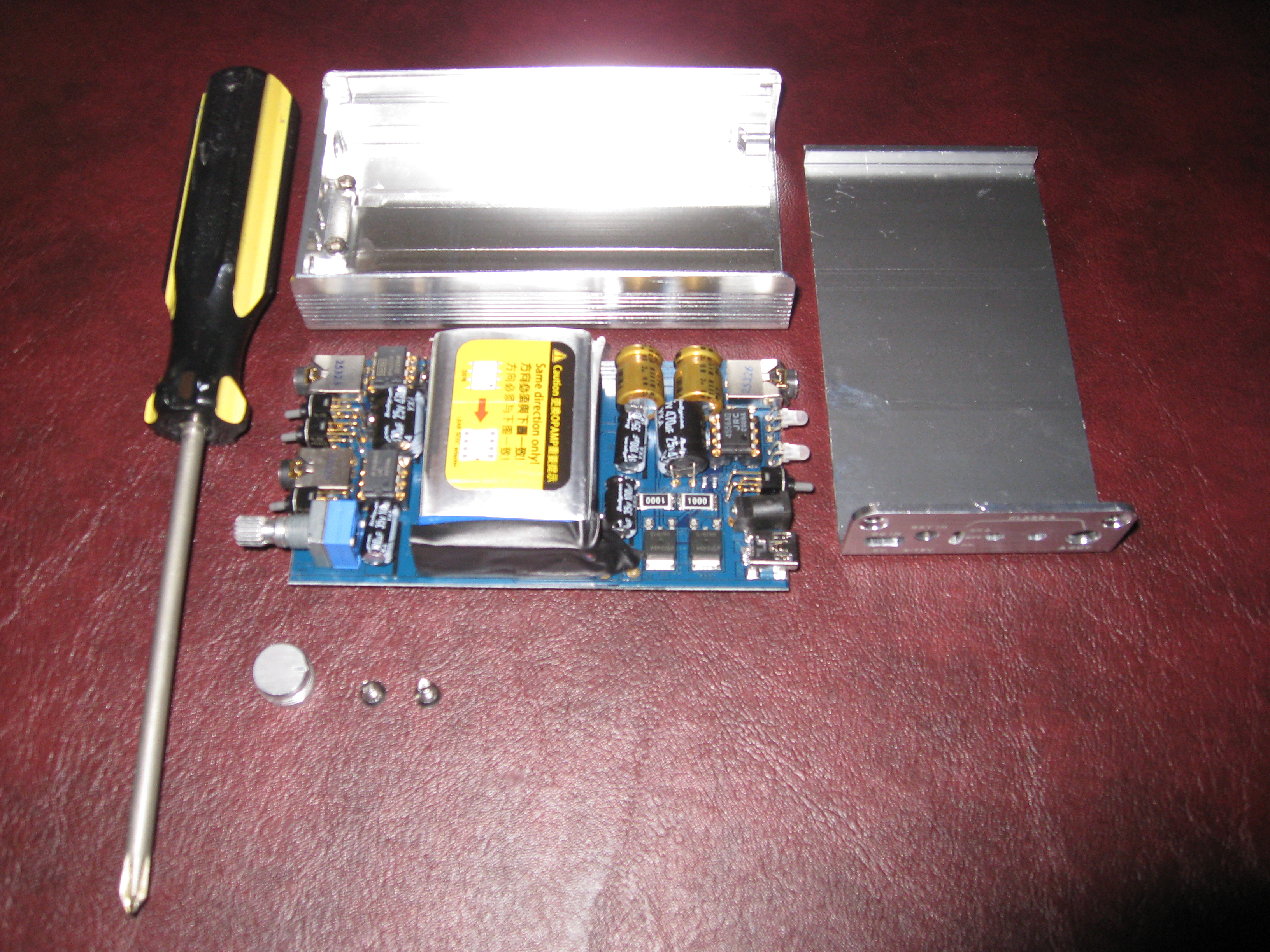
Overview: The O2 was designed by the controversial NwAvGuy who uses measurements as his de facto standard for gear and doesn’t rely on ears. He wanted to make an amp that measures at least as good if not better than high end amps, but at a fraction of the price and make it public domain. The amp was also designed to be used as a portable amp, and what really surprised me when I first saw the amp in person was the large size. Due to the configuration, the amp is more of a transportable amp than a true portable in my opinion, but with the right cable, it can be strapped to a source and used on the go. Just don’t expect it to go into your pocket unless you wear cargo pants.
There is an odd operating issue where the amp develops a cyclical popping when the battery is low due to the protection circuit turning the amp off when the voltage is low which increases the battery voltage, turning the amp back on. And it clicks for every cycle. If you hear that, you know it is time to charge the EHP-O2.
Sound: Upon first listen with a BA CIEM, the O2 sounded quite good. Switching to headphones, the HD600 specifically, I was impressed. The O2 was performing well some issues came to light, especially when I started comparing it with some higher priced amps. Notes are a little soft both on the attack and decay which results in a slightly slower sound with dynamics that aren’t quite up to par with most of the other amps I have. This note thickness and the dynamics have a trickle-down effect on the realism and transparency as the headphones didn’t disappear quite as much as my other amps except the similarly priced Neco. The spaciousness of the O2 is good, better than some more expensive amps, but the imaging is slightly below average (of more expensive amps), which seemed to be due to the attack/decay.
I tried the O2 across a decent sized sampling of headphones, IEMs, and custom IEMs and it performed quite consistently across the spectrum, which is quite a feat. The Neco, for example, can sound excellent with some CIEMs but poor with others, so the consistency is impressive. When using the O2 with the TS842, the bass was quite good, but again, it doesn’t outshine the other amps. With the Pro750, the presentation isn’t as smooth as many of the other amps. BA CIEMs were all handled well and didn’t have issues that some amps can have. On the flip side, the amp didn’t synergize with anything taking it to another level like the other amps can.
The O2 is very transparent to the source, not adding coloration and when amped from a headphone out, it will retain the sound signature. Comparing with the RoCoo BA internal amp*, the O2 performed similarly, but the BA internal amp was more 3D and a bit more musical. But, the O2 sounded a bit better than the RoCoo P. If you use a Clip+, getting the O2 will improve the bass performance a decent amount, but the improvements in the rest of the spectrum aren’t nearly as large. Comparing with the amp in the D1 DAC, the O2 held its own from an authoritative standpoint, but the soundstage was constricted when using the O2.
* Not truly a fair comparison since the internal amp of the BA is fed by a line level input while the O2 was fed by the amp out. I did this to see if the BA could be improved upon with an amp that cost less than the BA for desktop use.
Overall, the performance is about where an amp in this price range should be from a musicality standpoint, and technically it punches above its weight.
Channel Imbalance: At low volumes with high sensitivity IEMs such as the JH16 and AM4 pro.
Hiss: None
Interference: None
Summary: The O2 amp performs well for its price point with some very good qualities including source transparency, the ability to be consistent across a wide range of headphones, and very good soundstage space. It competes technically in driving power and soundstage space with more expensive amps, but due to attack and decay being slightly slow, the musicality isn’t quite on par. It is a versatile amp that will give a consistent experience and is an excellent performer for the price. My comparison with higher priced amps is not really fair, and performance is very similar to the Neco, which is in the price ball park. The size of the O2 isn't ideal for portable use and the orientation of the input/output makes it difficult to attach to my iPod/iPhone. The bottom line is if you want very good, consistent performance across a headphones and IEMs, for desktop/transportable use the EHP-O2 is a great chose at the price point.
[td=rowspan:2]
[td=colspan:6]
[td=rowspan:2]
---------------------------------------
Manufacturer: Headphonia
Model: Headstage Arrow 12HE 4G


Click on an image to enlarge
Price: $299.00
Size/Weight: 8.5mm x 56mm x 98mm (0.33'' x 2.20'' x 3.86''); 75g
Type: Portable amp, slim design
Volume control: Analog wheel
Power connector: USB Mini-b
Battery life: 80 Hours Play Time in Lowest Power Mode (no voltage boost); 30 Hours Play Time in Highest Power Mode (12V) (High-Capacity 1200mAh/4.2V Lithium-Ion Battery)
Features:
- Automatic Power Adaptation with up to 12V Internal Voltage
- Maximal 11V Output Voltage (Peak to Peak)
- Three Selectable Gain Settings (2dB, 9dB, 18dB)
- Bass Boost (0dB, 3dB, 9dB)
- Treble Boost Switch
- Öhmann Crossfeed (Off, Low, High)
- Automatic Power Switch
- Easy Battery Replacement without Soldering
- Symmetric & Short Audio Paths with Low Noise
- Analog Audio Input Jacks on Both Ends
- Two Headphone Jacks
- ALPS Analog Volume Potentiometer
- Low-Battery Indication (Slow and Fast LED Blinking)
- 4-Layer Circuit Board with two Ground Planes for Low Noise
- Black Anodized Aluminium Case with Laser Engraving
- Aluminium End Panels with White Silk Print
Works with 4 pin headphone plugs: Yes
Sound:
IEMs: The 4G performed anywhere from well to satisfactory with my IEMs and custom IEMs as it is overall noticeably better than the 12HE Arrow I own and on par to superior with the Pico Slim, and you can even get the sound signatures to be similar with the treble boost. The amp is on the warmer and thicker side of things with the knobs in the off positions, and when paired with a headphone that changes with the source and track such as the Spiral Ear SE 5-way, the sound is thicker than with other amps. However, while the NT-6 is also source dependent to an extent, there wasn’t any additional thickness due to the Arrow. Detail/resolution of the 4G is close to the competition, but the 4G falls slightly behind the EPH-02 and Cruise in instrument separation.
Headphones: The 4G sounded more open and transparent with the HD600 than the Stepdance, EPH-O2 and about on par with the Neco V2. Overall, the HD600 sounded quite good with the 4G, but the bass wasn’t as tight as with some other amps. When paired with the Pro750, the bass response was quite enhanced as the bass wasn’t as controlled as with some of the other amps such as the Stepdance and O2. The overall presentation was smooth in comparison with the EPH-O2, Neco V2, and Pico Slim while about on par with the Stepdance.
The Arrow has bass boost and treble boost, so you can easily adjust the sound depending on your preferences and headphones you are listening to. The quality of the boost on the first setting is excellent and still good on the second setting, but it does depend on the attached headphones. For example, with the bass boost at II, it is easy for a bass driver to get overloaded and distort, or if your headphones can handle it, you will have a bass monster on your hands! But, the boost is more of a upper bass boost than a deep bass boost. Similarly, with the treble at II, the treble can sound too emphasized and emphasize weaknesses of the treble of the attached headphones/IEMs.
Compared with the 12HE, the 4G performs at a much higher level, but the sound signature is retained. The sound is more refined and transparent with better transparency, detail, and overall note quality. The imbalance of my 4G unit at low volumes is worse than that of the 12HE, and the 12HE is more resistant to interference, but other than that the 4G improves upon the 12HE in every way.
Since both the Pico Slim and Arrow offer exceptional portability, I have decided to compare the two head-to-head. First, the Arrow has many more options than the Pico Slim including bass boost, crossfeed, treble boost, and gain settings. The 4G can drive full sized headphones more cleanly and to louder volumes. With IEMs, the 4G has a wider soundstage with similar depth, a smoother treble, and a more open sound overall due to the larger presentation space. The 4G is also warmer with more bass oomph and focus, but with the treble boost on I, the 4G has a similar treble response, but the treble is still smoother. Detail levels are similar, but the 4G is more effortless and slightly more transparent. The Pico Slim beats the 4G in volume balance, as the 4G has some issues with very high sensitivity IEMs (although Robert can adjust the gain for you and basically eliminate any imbalance), and in interference, as the PS has none while the 4G is affected by the Blackberry and iPhone 4S (but not 3G). The iPhone interference is a killer if you plan on using the 4G with a 4S.
Channel Imbalance: Yes, with high sensitivity IEMs at very low volumes. Robert can adjust the gain for high sensitivity IEMs.
Hiss: None
Interference: Yes, when my Blackberry is within 2 feet of the amp, but there is no interference with my iPhone 3G but there is static interference with the iPhone 4S.
Summary: The Arrow 4G has a great form factor and the best feature set I have come across in an amp including auto power on/off, switches including gain, bass boost, treble boost, and crossfeed, two headphone outputs, USB charging, plus it sounds great. The switches allow you to easily change the sound signature of your headphones/IEMs which is a nice feature. It is a competes and beats the Pico Slim in many ways, however there is a huge issue for on the go use with a phone: interference. The 4G would be an unconditional recommendation due to the size/price/performance if I didn’t have to keep my Blackberry on the other side of my desk to avoid hearing when its radio is on. If you pair it with a device that won’t cause interference, then the Arrow 4G is a winner.
[td=rowspan:2]
---------------------------------------
Manufacturer: Shonyun
Model: 306


[size=9pt]Price[/size][size=9pt]: $180 on ebay[/size]
[size=9pt]Product Overview[/size][size=9pt]: The amp is on the larger side for a portable amp as it is larger than the Neco V2, especially in length, but slightly smaller than the EHP-O2. The body of the unit uses an anodized brushed metal finish that looks nice but does scratch relatively easily. The face plate looks great and is finished much better, and the volume knob is solid. The 306 uses two AD8397ARDZ (with a high slew rate, high-bandwidth), Japan KOA high precision metal film resistors, WIMA capacitors, ELAN fever electrolytic capacitor, KOA metal film SMD resistors, and has five built-in 3.7V lithium batteries to stabilize operating voltage. There is a single input and single output on the front panel.[/size]
[size=9pt]Size/Weight[/size]: 110mm * 70mm * 25mm
[size=9pt]Type[/size][size=9pt]: Portable amp[/size]
[size=9pt]Volume control[/size][size=9pt]: Analog knob[/size]
[size=9pt]Power connector[/size][size=9pt]: Wall adapter, non-standard (24V)[/size]
[size=9pt]Battery life[/size][size=9pt]: Approximately 12 hours[/size]
[size=9pt]Features[/size][size=9pt]:[/size]
[size=9.0pt]- Frequency response:10-100KHz[/size]
[size=9.0pt]- Output power: 120mW[/size]
[size=9.0pt]- Signal to Noise Ratio: 105dB[/size]
[size=9.0pt]- Distortion: <0.005%[/size]
[size=9.0pt]- Charging adapter: 24V-500mA[/size]
[size=9.0pt]- Suitable impedance: 16 ~ 300Ω[/size]
[size=9.0pt]- Input impedance: 47KΩ[/size]
[size=9.0pt]- Output Current: 600mA[/size]
[size=9pt]Works with 4 pin headphone plugs[/size][size=9pt]: Yes[/size]
[size=9pt]Sound[/size][size=9pt]: The 306 is a fairly neutral amp, with a bit less bass weight and a slight bit more treble than the two competing amps I have in the price range, the EHP-O2 and Neco V2. The 306 is typically more natural sounding in the treble region, however the overall performance relative to the other amps does vary with different headphone pairings. One of the largest differences between the 306 and other amps in the price range, including the uHA-120 is the refinement of the presentation, which is quite good for the price. [/size]
[size=9pt]Comparing the amps with headphones, dynamic driver IEMs and the EarPods, the 306 had slightly less control of the bass driver even though the presentation had the least amount of bass in comparison. Moving up from the bass, the 306 was more refined at times depending on the headphone. The 306 has plenty of power to drive headphones, but it doesn’t drive power hungry headphones such as the LCD-2 all that well, which is no different than most portable amps, even those that cost well over double. [/size]
[size=9pt]The better the source, the better the 306 will perform, but it does better with lower quality sources such as the iPhone 4S than the EHP-O2 and most of the time the V2. As you go up the source chain, the 306 can reproduce more detail and present a larger space and has an overall more refined presentation than the other amps.[/size]
[size=9pt]One of the difficult things in comparing amps is performance differs depending on the headphone and source paired with them, making the chain very important. I have included the 306 in the source matching section of several of my CIEM threads, which might help with some reference points.[/size]
[size=9pt]I tested the 306 with the HD600 and AKG K550. With headphones there are is no hiss like there can be with my CIEMs. The 306 does extremely well with both the HD600 and K550, controlling the low end quite well, recreating very good space, and articulating detail. Compared with the uHA-120 (low gain mode), the 306 controls the bass better, which has a trickle-down effect making the rest of the spectrum cleaner, and the soundstage is a bit more expansive. Compared with the O2, the HD600 sounded more dynamic and more forward, but control was similar. With the K550, the bass was equally controlled, but the rest of the spectrum was smoother with the 306. The Stepdance is a bit brighter than the 306, but the treble is also not quite as smooth as that of the 306, however the overall sound from the SD is a bit more natural sounding. Moving to the HD600, the SD is still a bit more natural with more depth to the presentation, but the differences aren’t huge. Note that I had to use an adapter for my 1/4” to 1/8” adapter due to the recessed plugs in the 306.[/size]
[size=9pt]Channel Imbalance[/size][size=9pt]: Yes, with moderate sensitivity IEMs at lower volumes; more severe with higher sensitivity IEMs and at very low volumes.[/size]
[size=9pt]Hiss[/size][size=9pt]: Yes, with high sensitivity IEMs. Hiss increases as the volume is increased.[/size]
[size=9pt]Interference[/size][size=9pt]: None[/size]
[size=9pt]Summary[/size][size=9pt]: The Shonyun 306 is an extremely refined amp for the price range and has a lighter, leaner sound signature. There is a balance across the frequency spectrum, but the bass isn’t quite as prominent as with the Neco V2 or EHP-O2, however the imaging is better than the other two. Depending on the source and headphone matchup, the 306 can be a fantastic performer for the price point. It is larger than many other portable amps, but smaller than the EHP-O2 and slightly larger than the Portaphile 627. The 306 is recommended due to the refinement, smoothness, imaging and natural sound, but be sure you are OK with a slightly lower bass presence than other amps in the price range, slight channel imbalance at low volumes, and hiss with high sensitivity IEMs.[/size]
[size=9pt]When used with headphones, at least the ones I tried, the 306 was quite impressive and is definitely worth the price. The open sound and controlled bass work well and there is plenty of power for headphones. You can do better at higher prices, but the differences with the HD600 and K550 weren’t huge to me.[/size]
[td=rowspan:2]
[td=colspan:6]
[td=rowspan:2]
--------------------------------
Manufacturer: JDS Labs
Model: O2 + ODAC, separate units


[size=9pt]Price[/size][size=9pt]: $139.99 + $149.00[/size]
[size=9pt]Options[/size][size=9pt]: Different amp gain settings; Black or silver cases; RCA output option for ODAC[/size]
[size=9pt]Product notes[/size][size=9pt]: JDS Labs offers the [/size][size=9pt]O2 + ODAC Combo[/size][size=9pt] for $279.99, which is an integrated unit that has both the O2 amp and ODAC DAC, but no battery. It does require external power for the amplifier section. Performance should be very similar to this test setup.[/size]
[size=9pt]Type[/size][size=9pt]: DAC/amp (separate or integrated)[/size]
[size=9pt]Volume control[/size][size=9pt]: Analog[/size]
[size=9pt]Power connector[/size][size=9pt]: DAC: mini USB; amp: custom wall adapter [/size]
[size=9pt]Battery life[/size][size=9pt]: O2 amp - [/size][size=9.0pt]6-8 hours; ODAC - N/A; ODAC + O2 combo – N/A[/size]
[size=9pt]Features[/size][size=9pt]:[/size]
[size=9pt]- Alps Dual Analog Potentiometer[/size]
[size=9pt]- Dual Gain Switch (2.5x and 6.5x)[/size]
[size=9pt]- Opamps: JRC NJM2068D, 2x JRC NJM4556AD[/size]
[size=9pt]- AC Jack - Rechargeable 9V NiMH Batteries[/size]
[size=9pt]Specifications, O2 amp[/size][size=9pt]:[/size]
[size=9.0pt]- Frequency Response: +0.01, -0.01 dB (20Hz-20kHz)[/size]
[size=9.0pt]- THD 1 Khz 150 Ohms: 0.0016%[/size]
[size=9.0pt]- IMD CCIF 15 Ohms: 0.001%[/size]
[size=9.0pt]- IMD SMPTE: 0.002%[/size]
[size=9.0pt]- Noise (ref 400 mV): -105 dB[/size]
[size=9.0pt]- Max Output (33 Ohms): [/size][size=9.0pt]613 mW[/size]
[size=9.0pt]- Output Impedance: 0.54 Ohms[/size]
[size=9.0pt]- Crosstalk (15 ohms): 65 dB[/size]
[size=9.0pt]- Channel Balance (at 50% volume): 0.6 dB[/size]
[size=9.0pt]- Gain: 2.5x and 6.5x[/size]
[size=9.0pt]- Volume Potentiometer Taper: 15A or 3B[/size]
[size=9.0pt]- Case Dimensions (mm): 108.50 x 80.00 x 29.50 (excludes jacks)[/size]
[size=9.0pt]- Case Dimensions (inches) = 4.27 x 3.15 x 1.16" (excludes jacks)[/size]
[size=9.0pt]- Battery Run-time: 6-8 hours[/size]
[size=9.0pt]- Weight: 11 oz, with batteries [/size]
[size=9pt]Specifications, ODAC[/size][size=9pt]:[/size]
[size=9pt]- Frequency Response: +/- 0.1 dB (10 hz – 19 Khz 24/44)[/size]
[size=9pt]- THD+N 100 hz 0 dBFS: 0.0029%[/size]
[size=9pt]- THD+N 20 hz –1 dBFS: 0.003%[/size]
[size=9pt]- THD+N 10 Khz –1 dBFS: 0.003%[/size]
[size=9pt]- IMD CCIF 19/20 Khz –3 dBFS: 0.0011%[/size]
[size=9pt]- IMD SMPTE –1 dBFS: 0.0004% A[/size]
[size=9pt]- Noise A-Weighted dBu 24/44: --102.8 dBu[/size]
[size=9pt]- Dynamic Range: > 110 dB A-Weighted[/size]
[size=9pt]- Linearity Error -90 dBFS 24/44: 0.0 dB[/size]
[size=9pt]- Crosstalk 0 dBFS Line Out 100K: --93.5 dB[/size]
[size=9pt]- USB Jitter 11025 hz J-test 24/44: Excellent[/size]
[size=9pt]- Maximum Output Line Out 100K: 2.0 Vrms[/size]
[size=9pt] -Distortion: < 0.005%[/size]
[size=9pt]- PCB Dimensions: 49.0 x 58.0 mm[/size]
[size=9pt]- Weight: 2oz[/size]
[size=9pt]- Standard Case Dimensions: 53 x 62 x 13mm[/size]
[size=9pt] -RCA Case Dimension: 99 x 63 x 13mm[/size]
[size=9pt]- Audio Formats: 16/44, 16/48, 16/96, 24/44, 24/48, 24/96[/size]
[size=9pt]- Interface: USB, Audio Class 1[/size]
[size=9pt]- Native Driver OS Support: Windows XP & Later, OS X x86, Linux[/size]
[size=9pt]Works with 4 pin headphone plugs[/size][size=9pt]: Yes[/size]
[size=9pt]Sound[/size][size=9pt]:[/size]
[size=9pt]JDS Labs is one of the manufacturers of the NwAvGuy O2 amp and ODAC, which JDS sells both separately and as an integrated unit. I was interested in testing this combo so John agreed to send me both the ODAC, but I thought I should test it with his O2 amp even though I have the Epiphany EHP-O2 amp. Both O2 amps were built to the original specification according to the manufacturers, so this was a good opportunity to look for consistency as well estimate how an integrated unit, called the ODAC + O2 combo, would perform.[/size]
[size=9pt]The ODAC is USB powered with native Windows drivers that allow volume control, which came in handy when I initially tried the ODAC & O2 together in high gain with the HD600 as the output was distorted at 100% volume. Switching to IEMs yielded the same results. After talking a bit with John, there is a known issue with the O2, but it shouldn’t have been as bad as I experienced, and when I tried to replicate it after a full charge, the issue had disappeared. [/size]
[size=9pt]Comparing the two amps provided interesting results, as the JDS amp was louder at the same volume than the EHP on low gain, but the same on high gain with the HD600, but as I used higher and higher sensitivity CIEMs, the volume became closer and closer. With the HD600 the JDS O2 amp was louder by about 1/4th of a turn on the volume knob, as the sensitivity increased, the difference became negligible. The difference was still quite noticeable with the IE800, less with the SM64, even less with the aud-8X, and none with the Fit-Ear PS-5. In high gain mode there were no volume differences and the sonic differences were negligible. [/size]
[size=9pt]Also, they both sounded different when volume matched in low gain with the HD600 as the EHP-O2 had slightly superior imaging while the JDS O2 was more dynamic, slightly more detailed, and the treble was presented a bit more forward. But the differences were dependent upon the headphone [/size][size=9pt]and most IEMs performed similarly. Some of the exceptions included the Spiral Ear SE 5-way Reference, which had much more pronounced deep bass with the JDS O2, and the NT-6 pro, which was brighter, less smooth, and had less bass weight with the EHP-O2. The HD600 sounded more natural in high gain mode than in low gain mode, but the low volume channel imbalance didn’t allow proper testing with my CIEMs with high gain. [/size]
[size=9pt]Talking with the manufacturers, the gains were the same, so I took the amps apart to see if there were any physical differences. There were some differences: the EHP uses 8.4V batteries while the O2 had a battery that said 9V and measured 8.78V after hours of use. John told me the batteries he uses are the best available and better than the [/size][size=9pt]9.6V 230 mAh rechargeable batteries[/size][size=9pt] I inquired about. There are also some differences in resistors as the EHP-O2 didn’t have all the resistor spaces filled while the JDS O2 did. The EHP amp had the chips soldered to the board while the JDS uses IC sockets for the op amps and the main AC coupling capacitors are different brands. After further discussion as to the differences between the amps, John thought it was related to the AC coupling caps.[/size]
[size=9pt]Next, I compared the ODAC + O2 with other portable DAC/amps even though the integrated combo is not portable. My first comparison was with the smaller, similarly priced Leckerton UHA-6S MKII with stock op amp that is very popular and can be used with a computer or Android device. Sonically, the O2 + ODAC combination has a smoother, more organic and spacious sound compared with the more analytical and slightly more detailed Leckerton. The O2 + ODAC paired better to my ears with more analytical IEMs while still offering a more natural, although less clear and concise presentation with warmer and thicker headphones such as the LCD-2 and 5-way reference. Sourcing the Leckerton amp from the ODAC resulted in higher performance than the ODAC combined with the O2, or the Leckerton using its own internal DAC via USB. [/size]
[size=9pt]The ODAC outperformed the HUD-MX1 as it details were more articulated while there was a more dynamic presentation with better imagining, cohesiveness, and a larger space. The ODAC outperformed the UHA-6S MKII internal DAC in spaciousness, instrument separation, and detail levels, and also bested the internal DAC in the Cruise with better resolution, detail, spaciousness, and imaging. I decided to see if this DAC was a true giant killer by comparing it with the Anedio D1 DAC and found the difference much smaller than the price would indicate, although the D1 is more resolving, spacious, clear, and concise. Pairing the ODAC with the Ortofon MHd-Q7 amp showed off the ODAC’s capabilities as the Mhd-Q7 presented a more detailed, spacious, and dynamic sound with accurate PRaT, and the performance improved more with other amps such as the Lear FSM-02 and Portaphile.[/size]
[size=9pt]Using the ODAC + O2 combo on my desktop with many different headphones, IEMs, and CIEMs left me respecting this combo for its ability to pair well with just about everything and never sound fatiguing or harsh. The O2 couldn’t quite do justice to the bass region of the LCD-2, but it still performed well overall. The O2 was able to drive even some of my finicky CIEMs well with complex and/or low impedance curves, which I can’t say about most amps in this price range.[/size]
[size=9pt]Overall, the JDS O2 is a small step up in performance compared to the EHP-O2 previously reviewed and the spacious and organic sound with good dynamics performs well for the price. The sonic weakness is the detail levels of the amp, which aren’t as resolving as some of the other similarly priced amps. The ODAC is an excellent little DAC with excellent performance for the size, and is even more impressive given the price. The negatives of the O2 amp are the same as previously stated: large size with input/output ports that make portable use difficult and non-standard charger. Combining the ODAC in the same chassis and the non-standard power adapter is mandatory to enjoy the excellent sounding combo.[/size]
[size=9pt]Channel Imbalance: Yes, with high sensitivity IEMs at very low volumes.[/size]
[size=9pt]Hiss[/size][size=9pt]: Slight with high sensitivity IEMs; increases as volume knob is turned up.[/size]
[size=9pt]Interference[/size][size=9pt]: None.[/size]
[size=9pt]Noise when turned on/off[/size][size=9pt]:[/size]
[size=9pt]Summary[/size][size=9pt]: With a natural sound that is spacious and dynamic presentation with great imaging, the JDS Labs O2 amp is quite capable with a wide range of headphones and IEMs. Detail levels, while not bad, are bested by some other amps in the price range, but that doesn’t stop the O2 from being a great buy. Form factor is bulky for portable use, but on the desktop the O2 is great for the price. Performance of the ODAC is exceptional for the price, besting the built-in DACs in the portable DAC/amps I have and performing closer than anticipated to the Anedio D1 DAC. The integrated ODAC + O2 combo I simulated is an excellent sounding and performing desktop only solution that can drive just about anything you throw at it. Even though the amp section hold the DAC back a bit, it is still a great value.[/size]
[td=rowspan:2]
[td=colspan:6]
[td=rowspan:2]
[size=9pt]Amps mean different things to different people. It depends on your use, music, source, headphone, and ears to determine if an amp will make a difference, and if so how much. As primarily an IEM guy, I have had mixed results with amps through the years depending on the factors I mentioned, and while this review thread can’t possibly cover all the iterations of product combinations, it will compare the general performance of each amp. I do have more specific amp matching with headphones/sources in my [/size][size=9pt]custom IEM reviews[/size][size=9pt]. My Google+ page.[/size]
click images for full sized picture
[size=9.0pt]Portable amps reviewed:[/size]
[size=9.0pt]- [/size][size=9.0pt]Headphonia Arrow 12 HE[/size]
[size=9.0pt]- [/size][size=9.0pt]Headamp Pico Slim[/size]
[size=9.0pt]- [/size][size=9.0pt]Meier Audio Stepdance (original)[/size]
[size=9.0pt]- [/size][size=9.0pt]Neco Soundlab DUAL AMP portable headphone amplifier – V2[/size]
[size=9pt]- [/size][size=9pt]iQube V2 (with DAC)[/size]
[size=9pt]- [/size][size=9pt]Auzentech i.Fuzen HP-1[/size]
[size=9pt]- [/size][size=9.0pt]Furutech Cruise (with DAC)[/size]
[size=9pt]- [/size][size=9pt]Just Audio uHA-120[/size]
[size=9pt]- Portaphile 627[/size]
[size=9pt]- Epiphany Acoustics EHP-O2[/size]
[size=9pt]- Headphonia Arrow 12HE 4G[/size]
[size=9pt]- Shonyun 306[/size]
[size=9pt]- JDS Labs ODAC, O2, and ODAC + O2 combo (simulated)[/size]
[size=9pt]- Additional amps reviewed in the 2nd post due to the slow response of this post.[/size]
- Pre-review impressions can be found here.
[size=9.0pt]But, before reading further, here are my notes from testing:[/size]
[size=9.0pt]- I primarily review and listen to custom IEMs and some, such as the JH16, LS8, and Infinity X3 are not dependent on the quality of the amp and there are small to minimal differences between the amps to my ears.[/size]
[size=9.0pt]- These amps are fairly close in sound signatures and the differences between the amps is not as large as the difference between headphones/IEMs.[/size]
[size=9.0pt]- The differences between the amps in frequency response is very minimal.[/size]
[size=9.0pt]- A good amp can improve the sound of lower end headphones, but a good headphone from the headphone out of a relatively low end source (Clip+ or iPhone) can sound better. Which is better overall depends on the combo and what you want. I have heard what I consider huge improvements from some combinations such as the Ortofon e-Q7 and the ALO Rx amp or a MEElectronics CC51 and the Meier Audio Stepdance.[/size]
[size=9.0pt]- With lower end DACs the differences between amp performance is less than with higher end DACs such as the Anedio D1 and HiFiMan 801, as would be expect.[/size]
[size=9pt]- Using an amp from the headphone out of a player has marginal improvements for either output impedance mismatch reasons, or internal PMP amp limitations. For example an iPod/iPhone/Fuze sound better to me from a line out than when amping the headphone out.[/size]
Important notes about the charts and ratings: The relative differences between the rating numbers are not all that large. For example a score of an 8 in the bass isn't an overwhelming difference, but is very apparent in comparison with something rated at a 5. While I didn't list synergy with various headphones, some react differently with certain headphones, however the relative sound and technical ability is usually remains the about the same comparatively.
--------------------------------
Manufacturer: Headfonia
Model: Arrow 12 HE
Price:
Product notes: discontinued, replaced by the 3G and soon to be replaced by the G4
Type: portable amp
Volume control: analog, wheel
Power connector: USB (mini B)
Features:
- gain switch [size=9pt](0, I, II)[/size]
[size=9pt]- bass switch [/size][size=9pt](0, I, II) - 0db, 6 dB, 12 dB[/size]
[size=9pt]- crossfeed [/size][size=9pt](0, I, II)[/size]
[size=9pt]- impedance switch [/size][size=9pt](0, I, II) 10 ohm, 70 ohm, 120 ohm[/size]
[size=9pt]- auto power off mode [/size][size=9pt](3 switch positions: on/off/auto - auto turns the amp off after 60 seconds of no input signal)[/size]
[size=9pt]- two input locations [/size]
- slim design
Works with 4 pin headphone plugs: Yes
Sound signature: A spacious and warm presentation that generally adds width to the presentation while not necessarily adding to the depth. The low through mid-bass is slightly elevated but the sub-bass is not. Due to the bass presentation and spaciousness, the midrange seems slightly more laid back and the treble is more neutral/laid back.
Sound quality: The quality of the Arrow 12 HE varies greatly depending on the IEM and headphone due to the high output impedance as with many custom IEMs that have crossovers the sound is on the flatter side while others such as the TS842 (and ER4P) improves quite a bit with the impedance switch turned on, adding smoothness to an edgy and analytical presentation. Overall, the resolution is a step below others such as the Pico Slim and Stepdance, but not always. Driving full sized cans, the Arrow 12 HE does an acceptable job but the slim portable design does show limitations in dynamics compared with something more powerful such as the iQube, Stepdance, or Neco. When paired with dynamic driver IEMs the sound is overall good and other than deep bass roll off for lower impedance headphones/IEMs, there is no effect of the output impedance.
Channel Imbalance: Yes, at very low volumes only with high sensitivity IEMs
Hiss: There is no appreciable hiss with the JH16 on low gain at max volume or below.
Interference: Slight clicking with the iPhone 3G when the phone is connecting to the internet. No interference with the Blackberry Bold.
Summary: The Arrow 12 HE was a great amp when it was released due to the combination of size, shape, performance, and features as well as the amazing driving ability due to the three gain settings. Still OK by today's standards, there have been other amps that have surpassed the performance of the Arrow 12 HE including the prototype G4 that I had a chance to audition. The Arrow 12 HE really is dependent on specific matches with balanced armature IEMs as the output resistor either helps, hurts, or doesn't affect the sound, but you won't know unless you either try or read about it from others. Dynamic driver armatures do respond well however as do lower end headphones.
[size=9pt]Preview: I had the opportunity to try a G4 prototype board and the improvement was anywhere from a decent amount to substantial depending on the headphones used. The G4 has more resolution and is closer to the performance of the Pico Slim and Stepdance and I am looking forward to hearing the G4 when it is ready.[/size]
Bit Depth | Sample Rate | ||||||
Headstage | Arrow 12 HE | $249 | Flat | N/A | N/A | Battery | USB |
[td=rowspan:2]
Manufacturer
[/td] [td=rowspan:2]
Model
[/td] [td=rowspan:2]
Price
[/td] [td=rowspan:2]
Form Factor
[/td] [td=colspan:2]
DAC
[/td] [td=rowspan:2]
Power
[/td] [td=rowspan:2]
Charge
[/td] Deep Bass | Bass | Mid-Bass | Midrange | Upper Mids | Treble | Width | Depth | Imaging | |||
3 | 5 | 7 | 5 | 5 | 4 | 7 | 6 | 6 | 8 | 4 | 4 |
Quantity
[/td] [td=rowspan:2]
Warmth
[/td] [td=rowspan:2]
Note Sustainment
[/td] [td=rowspan:2]
Smoothness
[/td] [td=colspan:3]
Soundstage
[/td] Bass | Mids | Treble | |||||||||
Quality | Quality | Quality | |||||||||
4 | 5 | 5 | 5 | 5 | 7 | 8 | 5.3 | 5.6 | 10.0 | 9.0 | 8.2 |
Transparency
[/td] [td=rowspan:2]
Dynamics
[/td] [td=rowspan:2]
Resolution/ Detail
[/td] [td=rowspan:2]
Clarity
[/td] [td=rowspan:2]
Soundstage Score
[/td] [td=rowspan:2]
Total - Quality
[/td] [td=rowspan:2]
Hiss
[/td] [td=rowspan:2]
Imbalance
[/td] [td=rowspan:2]
Total Quality, High sensitivity IEMs
[/td] Manufacturer: Headamp
Model: Pico Slim
[size=9pt]Price[/size][size=9pt]: $399[/size]
[size=9pt]Product notes[/size][size=9pt]: The Pico Slim is the smallest high performance amp I know of and the size and shape make it perfect for on the go use with a minimal size addition to your source for powering IEMs and easy to drive portable cans.[/size]
[size=9pt]Type[/size][size=9pt]: portable amp[/size]
[size=9pt]Volume control[/size][size=9pt]: digital, knob[/size]
[size=9pt]Power connector[/size][size=9pt]: USB (Micro B)[/size]
[size=9pt]Battery life[/size][size=9pt]:[/size]
[size=9pt]Features[/size][size=9pt]:[/size]
[size=9pt]- Tiny size[/size]
[size=9pt]- On/off switch which allows you to leave the volume where you want it between listening sessions[/size]
[size=9pt]Works with 4 pin headphone plugs[/size][size=9pt]: Yes[/size]
[size=9pt]Sound signature[/size][size=9pt]: The Pico Slim has a very transparent and fairly neutral sound that is on the brighter side of the spectrum. It does not lack deep bass oomph, but the deep bass isn’t quite as accentuated and powerful as other amps such as the Stepdance or Cruise resulting in a slightly thinner sound. Overall the Pico Slim doesn’t add much coloration to the sound and offers very good transparency. The soundstage is on the average side but does offer very good depth and proportion to the sound resulting in a realistic yet somewhat intimate sound.[/size]
[size=9pt]Sound quality[/size][size=9pt]: With exceptional transparency and very high levels of resolution, the Pico Slim performs very well technically. The biggest issue I had with the Pico Slim with BA IEMs is that the notes can become slightly thinner than usual, and with some already thinner sounding BA IEMs this is not my ideal sound. However, overall the results are exceptional. With dynamic driver IEMs the Pico Slim performs quite well, however it doesn't have the bass control of some of the larger amps such as the Stepdance, iQube, and Cruise. The Pico Slim isn't great at driving harder to drive headphones except for fairly low volume listening, and then it is on par with the Arrow 12 HE; good but not great.[/size]
[size=9pt]Channel Imbalance[/size][size=9pt]: No[/size]
[size=9pt]Hiss[/size][size=9pt]: Turning the volume knob up past the halfway point with the JH16 results in audible hiss, however when music is playing that volume level is louder than I would listen. The hiss could be an issue with a low volume source, but I have not come across one that has caused an issue.[/size]
[size=9pt]Interference[/size][size=9pt]: No interference from both my Blackberry Bold and iPhone 3G[/size]
[size=9pt]Summary[/size][size=9pt]: For the size and shape the Pico Slim is a great little amp. It offers exceptional transparency and plays well with custom IEMs, including high sensitivity ones, as well as dynamic driver IEMs. Both the Arrow and Pico Slim are very easy to carry around with my modded iPod and the Pico Slim gives me consistently great sound, although in direct comparison the thinner and brighter sound if the Pico Slim doesn't always match well with brighter and thinner sounding IEMs. With absolutely no imbalance, no interference, and no hiss in my experience the Pico Slim is an excellent choice for high sensitivity custom IEMs. [/size]
Bit Depth | Sample Rate | ||||||
Headamp | Pico Slim | $399 | Mini | N/A | N/A | Battery | USB |
Manufacturer
[/td] [td=rowspan:2]
Model
[/td] [td=rowspan:2]
Price
[/td] [td=rowspan:2]
Form Factor
[/td] [td=colspan:2]
DAC
[/td] [td=rowspan:2]
Power
[/td] [td=rowspan:2]
Charge
[/td] Deep Bass | Bass | Mid-Bass | Midrange | Upper Mids | Treble | Width | Depth | Imaging | |||
4 | 4 | 4 | 5 | 6 | 7 | 4 | 5 | 5 | 4 | 5 | 5 |
Quantity
[/td] [td=rowspan:2]
Warmth
[/td] [td=rowspan:2]
Note Sustainment
[/td] [td=rowspan:2]
Smoothness
[/td] [td=colspan:3]
Soundstage
[/td] Bass | Mids | Treble | |||||||||
Quality | Quality | Quality | |||||||||
8 | 9 | 9 | 10 | 5 | 9 | 7 | 4.7 | 7.4 | 10.0 | 10.0 | 9.1 |
Transparency
[/td] [td=rowspan:2]
Dynamics
[/td] [td=rowspan:2]
Resolution/ Detail
[/td] [td=rowspan:2]
Clarity
[/td] [td=rowspan:2]
Soundstage Score
[/td] [td=rowspan:2]
Total - Quality
[/td] [td=rowspan:2]
Hiss
[/td] [td=rowspan:2]
Imbalance
[/td] [td=rowspan:2]
Total Quality, High sensitivity IEMs
[/td] Manufacturer: Meier Audio
Model: Stepdance
[size=9pt]Price[/size][size=9pt]:
[size=9pt]Product notes[/size][size=9pt]: Discontinued; replaced by the 2stepdance. I have owned the Stepdance for a while and have noticed it is a great performer with a wide range of headphones and IEMs rarely having a poor match.[/size]
[size=9pt]Type[/size][size=9pt]: portable amp[/size]
[size=9pt]Volume control[/size][size=9pt]: digital, knob[/size]
[size=9pt]Power connector[/size][size=9pt]: Non-standard, for power only; unit does not charge battery[/size]
[size=9pt]Battery life[/size][size=9pt]: Up to 8 hours with 600 uHa rechargable in low gain, high current mode, but typically closer to 6[/size]
[size=9pt]Features[/size]:
[size=9pt]- Active ground that simulates balanced in a single ended design[/size]
[size=9pt]- Low and high gain switches[/size]
[size=9pt]- Low and high current switches[/size]
[size=9pt]Works with 4 pin headphone plugs[/size][size=9pt]: Yes[/size]
[size=9pt]Sound Signature[/size][size=9pt]: The sound is on the warm side, but not all that warm, however the deep bass region does have some extra kick to it to go with the superb control. The midrange disappears and is neutral while the upper mids and treble are slightly on the brighter side of neutral. The width of the space scales with better DACs a bit better than average amp I reviewed while the depth and imaging are average.[/size]
[size=9pt]Sound Quality[/size][size=9pt]: Bass control is the first thing that comes to mind when I think about the Stepdance, but it has so much more to offer. I was actually surprised by where the amp rated overall in my scoring system as it really doesn't do anything wrong. Resolution is very good with a slight liquidity to the presentation and better than average smoothness leading to a fairly transparent sound. The Stepdance can drive harder to drive cans quite well and to loud volumes, performing in the top half.[/size]
[size=9pt]Channel Imbalance[/size][size=9pt]: No[/size]
[size=9pt]Hiss[/size][size=9pt]: Hiss is dependent on the volume setting and turning up the volume will result in more hiss. I hear no hiss at normal listening volumes with any headphone/IEM I tried.[/size]
[size=9pt]Interference[/size][size=9pt]: None.[/size]
[size=9pt]Summary[/size][size=9pt]: The Stepdance has impressive sonic performance for the size and price with the ability to drive just about anything. The bass is one of the best I have heard in a portable amp with a combination of control, depth, and punch. This is the only portable amp that requires an external battery charger, but it can accept other external batteries of up to 15V if you choose to carry one. With an overall great performance the Stepdance would be a recommended amp, but now that the 2stepdance is out and uses different op amps I am not 100% sure how that amp performs.[/size]
Bit Depth | Sample Rate | ||||||
Meier Audio | Stepdance | $349 | Portable | N/A | N/A | 9V or wall | N/A |
Manufacturer
[/td] [td=rowspan:2]
Model
[/td] [td=rowspan:2]
Price
[/td] [td=rowspan:2]
Form Factor
[/td] [td=colspan:2]
DAC
[/td] [td=rowspan:2]
Power
[/td] [td=rowspan:2]
Charge
[/td] Deep Bass | Bass | Mid-Bass | Midrange | Upper Mids | Treble | Width | Depth | Imaging | |||
7 | 6 | 6 | 5 | 5 | 5 | 6 | 6 | 8 | 7 | 5 | 5 |
Quantity
[/td] [td=rowspan:2]
Warmth
[/td] [td=rowspan:2]
Note Sustainment
[/td] [td=rowspan:2]
Smoothness
[/td] [td=colspan:3]
Soundstage
[/td] Bass | Mids | Treble | |||||||||
Quality | Quality | Quality | |||||||||
9 | 9 | 8 | 8 | 8 | 9 | 8 | 5.7 | 8.1 | 7.0 | 10.0 | 8.4 |
[td=rowspan:2]
Transparency
[/td] [td=rowspan:2]
Dynamics
[/td] [td=rowspan:2]
Resolution/
Detail
[/td] [td=rowspan:2]
Detail
Clarity
[/td] [td=rowspan:2]
Soundstage Score
[/td] [td=rowspan:2]
Total - Quality
[/td] [td=rowspan:2]
Hiss
[/td] [td=rowspan:2]
Imbalance
[/td] [td=rowspan:2]
Total Quality, High sensitivity IEMs
[/td] --------------------------------
Manufacturer: Neco Soundlab
Model: DUAL AMP portable headphone amplifier – V2
[size=9pt]Price[/size][size=9pt]: $161 ($117 + $23 for AD8610 opamp + $21 for 600 mAH li-ion battery)[/size]
[size=9pt]Product notes[/size][size=9pt]: Neco, the amp designer, is a great guy and will be happy to work with you on your custom needs fot the amp. Thank you Neco! This is the lowest cost amp in this review, therefore it stands alone. I have owned a few amps in the same price range, but none have preformed to the level of my Arrow, yet the V2 does. [/size]
[size=9pt]Type[/size][size=9pt]: portable amp[/size]
[size=9pt]Volume control[/size][size=9pt]: analog, knob, logarithmic[/size]
[size=9pt]Power connector[/size][size=9pt]: Custom connector[/size]
[size=9pt]Battery life[/size][size=9pt]: 24 hours at low volumes[/size]
[size=9pt]Features[/size][size=9pt]:[/size]
[size=9pt]- On/off switch which allows you to leave the volume where you want it between listening sessions.[/size]
[size=9pt]- Logarithmic volume control for less low volume channel imbalance[/size]
[size=9pt]Works with 4 pin headphone plugs[/size][size=9pt]: Yes[/size]
[size=9pt]Sound signature[/size][size=9pt]: The V2 is a fairly neutral across the spectrum with an ever so slight bump in the midrange. If it weren't for the slight bump in the mids, the V2 would be flat. [/size]
[size=9pt]Sound quality[/size][size=9pt]: For the price the V2 performs quite well. While it isn't the best performer, it holds its own and is slightly better than the amp section of the D10 and does best some others in certain categories. It has very good dynamics while the soundstage and imaging are average. The V2 performed about average pushing the LCD-2, which is impressive for the price.[/size]
[size=9pt]Channel Imbalance[/size][size=9pt]: Yes, at low volumes with very high sensitivity custom IEMs such as the JH16. I initially received the amp with a standard volume control and the imbalance was much greater. Let Neco know what you want and he will make an amp specifically for you, including a lower gain if you want to use the amp with high sensitivity custom IEMs.[/size]
[size=9pt]Hiss[/size][size=9pt]: Hiss is dependent on the volume setting and turning up the volume will result in more hiss. I hear no hiss at normal listening volumes with any headphone/IEM I tried.[/size]
[size=9pt]Interference[/size][size=9pt]: None[/size]
[size=9pt]Summary[/size][size=9pt]: With the form factor similar to the Stepdance, an internal 9V battery with an internal charger and better battery life the V2 is a great performer for the price. If you use high sensitivity IEMs make sure to get the logarithmic volume and have Neco set the gain lower (mine is standard gain). For dynamic driver IEMs or headphone this shouldn't be an issue. While the V2 isn't quite a giant killer, it is a giant in its price range. [/size]
Bit Depth | Sample Rate | ||||||
Neco Soundlabs | V2 | $161 | Portable | N/A | N/A | 9V | Wall |
Manufacturer
[/td] [td=rowspan:2]
Model
[/td] [td=rowspan:2]
Price
[/td] [td=rowspan:2]
Form Factor
[/td] [td=colspan:2]
DAC
[/td] [td=rowspan:2]
Power
[/td] [td=rowspan:2]
Charge
[/td] Deep Bass | Bass | Mid-Bass | Midrange | Upper Mids | Treble | Width | Depth | Imaging | |||
6 | 5 | 5 | 6 | 5.5 | 5 | 5 | 5 | 5 | 5 | 5 | 5 |
Quantity
[/td] [td=rowspan:2]
Warmth
[/td] [td=rowspan:2]
Note Sustainment
[/td] [td=rowspan:2]
Smoothness
[/td] [td=colspan:3]
Soundstage
[/td] Bass | Mids | Treble | |||||||||
Quality | Quality | Quality | |||||||||
8 | 8 | 7 | 6 | 7 | 8 | 8 | 5.0 | 6.9 | 8.0 | 9.0 | 8.0 |
Transparency
[/td] [td=rowspan:2]
Dynamics
[/td] [td=rowspan:2]
Resolution/ Detail
[/td] [td=rowspan:2]
Clarity
[/td] [td=rowspan:2]
Soundstage Score
[/td] [td=rowspan:2]
Total - Quality
[/td] [td=rowspan:2]
Hiss
[/td] [td=rowspan:2]
Imbalance
[/td] [td=rowspan:2]
Total Quality, High sensitivity IEMs
[/td] Manufacturer: Quables
Model: iQube V2
[size=9pt]Price[/size][size=9pt]: $699[/size]
[size=9pt]Product notes[/size][size=9pt]: Class D amplifier[/size]
[size=9pt]Type[/size][size=9pt]: Portable DAC/amp[/size]
[size=9pt]Volume control[/size][size=9pt]: Analog, knob[/size]
[size=9pt]Power connector[/size][size=9pt]: USB (mini B)[/size]
[size=9pt]Battery life[/size][size=9pt]: (4 AAA batteries) [/size][size=9pt]Unfortunately I didn't have the opportunity to run the iQube until the batteries ran out, but I did use it for several hours for over more than a week before the battery needed a recharge driving IEMs. [/size][size=9pt]Per the manufacturer the iQube V2 should last between 10 and 20 hours depending on the headphone/volume used, however I think I got more time out if the iQube than 20 hours.[/size]
[size=9pt]Features/Information[/size][size=9pt]:[/size]
[size=9pt]- 16 bit, 32 / 44.1 / 48K sample rates[/size]
[size=9pt]- CS4344, 24 bit delta sigma DAC[/size]
[size=9pt]- Gain switch (low gain = 2, high gain = 7)[/size]
[size=9pt]Works with 4 pin headphone plugs[/size][size=9pt]: Yes[/size]
[size=9pt]Sound signature[/size][size=9pt]: [/size][size=9pt]The iQube V2 is neutral through the midrange and treble with an emphasis in the bass region resulting in a warmer presentation. Recreating a spacious and 3D soundstage, the transparency is very good letting the rest of the chain impart the sonic signature on the presentation more so than the iQube, which is what you want in your amp! The DAC section is also very transparent and doesn't change the sound signature of the iQube.[/size]
[size=9pt]Sound quality[/size][size=9pt]: [/size][size=9pt]The overall quality of the iQube was very good with just about everything I threw at it from the K701 to all of my custom IEMs to various dynamic driver IEMs/ear buds I have lying around. There is no lack of power in the bass region, but with the bit of enhancement the iQube sounded a little less controlled in comparison with amps such as the Stepdance and Cruise. Dynamics are good and near the top of the performance curve, but not the best both as an amp and as a DAC. Resolution and clarity were also very good, but not at the top of the performance curve. [/size]
[size=9pt]Paired with my high sensitivity custom IEMs, lead by the JH16 and LS8, the iQube did a good job but there is hiss and a slight channel imbalance at lower volumes. Pairing is dependent on the sound signature of the custom IEM, but in general there were no bad matches and the iQube was at or near the top of the performance heap.[/size]
[size=9pt]When coupled with the LCD-2 v1 the iQube did a good job, but not great, however no portable amp compared with the Anedio D1 desktop DAC/amp. The K701 sounded spacious and had plenty of bass with good control, resulting in a musical combination the combines the strengths of both the amp and the headphone. Combining the what the iQube does well it performs quite well overall as both an amp and a DAC.[/size]
[size=9pt]Note: After my listening I read other reviews of the iQube V2 and for some reason I seem to hear the V2 differently than other reviewers as the bass was more emphasized and in comparison with the other amps in this review, specifically the Stepdance, D10, Cruise, uHA-120, and Pico Slim, the iQube sounded on the warmer side of neutral and didn't have quite the bass speed or control. The differences were smaller with lower resolution headphones, but still there to an extent. [/size]
[size=9pt]Channel Imbalance[/size][size=9pt]: Yes, with the JH16 at low volume levels[/size][size=9pt], but not an issue with the majority of my custom IEMs and not an issue with headphones.[/size]
[size=9pt]Hiss[/size][size=9pt]: There is slight hiss with the JH16, and the hiss is constant and does not change with the volume.[/size]
[size=9pt]Interference[/size][size=9pt]: Setting my Blackberry on the amp or within about 8 inches resulted in some noise. My iPhone 3G did have interference when connecting via wi-fi, but that was reduce a good deal when I switched to 3G service. The iPhone didn't interfere with the amp when it was 1.5" or further away.[/size]
[size=9pt]Summary: [/size][size=9pt]The iQube is a very nice amp that does many things right and nothing really wrong. The combination of amp and DAC come with a space premium resulting in a portable amp that isn't all that portable, or at least pocketable. But if you do want to bring it along with you the results will be great sound from either a computer or another source. The amp section is very good but not the top performer despite the highest price, although not technically that far off. The DAC section is high quality and does not alter the performance of the amp vs. when used via line-in from higher performing DACs such as the 801 or D1, although the DAC doesn't have the resolution of those two, but depending on the headphone used, track, and bit depth, the DAC differences are not very large. [/size]
[size=9pt]Taking into account the overall performance of the iQube vs. the competition, it is a very strong performer.[/size]
Bit Depth | Sample Rate | ||||||
iQube | V2 | $699 | Portable | 16 | | Battery | USB |
[td=rowspan:2]
Manufacturer
[/td] [td=rowspan:2]
Model
[/td] [td=rowspan:2]
Price
[/td] [td=rowspan:2]
Form Factor
[/td] [td=colspan:2]
DAC
[/td] [td=rowspan:2]
Power
[/td] [td=rowspan:2]
Charge
[/td] Deep Bass | Bass | Mid-Bass | Midrange | Upper Mids | Treble | Width | Depth | Imaging | |||
3 | 5 | 7 | 5 | 5 | 4 | 7 | 6 | 6 | 8 | 4 | 4 |
[td=colspan:6]
Quantity
[/td] [td=rowspan:2]
Warmth
[/td] [td=rowspan:2]
Note Sustainment
[/td] [td=rowspan:2]
Smoothness
[/td] [td=colspan:3]
Soundstage
[/td] Bass | Mids | Treble | |||||||||
Quality | Quality | Quality | |||||||||
8 | 9 | 9 | 9 | 7 | 9 | 8 | 5.3 | 7.8 | 9.0 | 9.0 | 8.6 |
Transparency
[/td] [td=rowspan:2]
Dynamics
[/td] [td=rowspan:2]
Resolution/Detail
[/td] [td=rowspan:2]
Clarity
[/td] [td=rowspan:2]
Soundstage Score
[/td] [td=rowspan:2]
Total - Quality
[/td] [td=rowspan:2]
Hiss
[/td] [td=rowspan:2]
Imbalance
[/td] [td=rowspan:2]
Total Quality, High sensitivity IEMs
[/td] --------------------------------
Auzentech i.Fuzen HP-1 iPhone 4/4S amp case
Manufacturer: Auzentech
Model: i.Fuzen HP-1
[size=9pt]Price[/size][size=9pt]: $129[/size]
[size=9pt]Product notes[/size][size=9pt]: iPhone 4 & 4S case amp with built in battery[/size]
[size=9pt]Type[/size][size=9pt]: iPhone 4/4S case amp[/size]
[size=9pt]Volume control[/size][size=9pt]: digital, touch buttons[/size]
[size=9pt]Power connector[/size][size=9pt]: USB (mini B)[/size]
[size=9pt]Battery life[/size][size=9pt]: Using the battery for the amp, the i.Fuzen easily outlasts the iPhone. If used as a backup battery the i.Fuzen was able to maintain the iPhone charge and play for at least 8 hours while still having 2 to 3 bars of power left, depending on how much data/voice was used. [/size]
[size=9pt]Features[/size][size=9pt]:[/size]
[size=9pt]- Low and high gain 3.5mm output jacks[/size]
[size=9pt]- Can be used as a battery for the iPhone[/size]
[size=9pt]Works with 4 pin headphone plugs[/size][size=9pt]: Yes[/size]
[size=9pt]Sound signature[/size][size=9pt]: More laid back than the iPhone 4S headphone out with a more spacious presentation that doesn’t lose the presentation depth. Due to the more spacious sound, the imaging and apparent detail levels are higher.[/size]
[size=9pt]Sound quality: Depending on the headphone used, the technical improvements vs. the iPhone 4S range from small to significant. The 4S sounds good, but lacks resolution and doesn’t control the drivers all that well when there is lots of bass. While the i.Fuzen has a higher resolution with the 4S, the difference isn’t all that large, but what does improve is the control and clarity of the presentation. It is due to the improved control, larger space, and laid back in comparison presentation making the details stand out more with better articulation. It is difficult to compare with my other portable amps due to the form factor except with an iPhone, but the i.Fuzen keeps up with more expensive amps. One potential issue is the digital volume steps with ultra sensitive custom IEMs as the JH16 on the lowest volume setting was quite, but not as quite as I would listen to if I wanted to fall asleep with the JH16. But that is not a big issue for on the go since there is usually always background noise.[/size]
[size=9pt]I used the high gain headphone jack (the one with two dots) with the K701 with very good results. First, the K701 sounds very bass light from the headphone out while the i.Fuzen adds a good amount of body and depth to the bass. Dynamics and depth of the presentation are improved resulting in a more natural and open sound. During my testing I was distracted and after a bit I was thinking the sound was pretty disappointing and I noticed I was connected to the iPhone HPO and when I switched to the i.Fuzen I immediately noticed the quality improvement. The i.Fuzen can drive the 701 much much louder than the HPO from the high gain jack as the first step up in volume is equivalent to about 45% volume from the iPhone HPO.[/size]
[size=9pt]I also had a short audition with the iPhone 4 and the i.Fuzen HP-1 with a similar result of hearing an improvement, however the improvement was different. While it was short, it sounded like the resolution was higher with the i.Fuzen and of course there was much more driving power and a slightly fuller, warmer sound.[/size]
[size=9pt]Channel Imbalance[/size][size=9pt]: No[/size]
[size=9pt]Hiss[/size][size=9pt]: None[/size]
[size=9pt]Interference[/size][size=9pt]: None[/size]
[size=9pt]Summary[/size][size=9pt]: The i.Fuzen is a great design and to my knowledge, the first amp built into a phone case. The case doesn’t add much bulk to the iPhone 4/4S and is surprisingly light, but it the length it does add can be an issue for those with small pockets. The added battery helps with iPhone life while powering the amp. With performance that is an improvement with both headphones and IEMs, the i.Fuzen could turn your iPhone 4/4S into a high performing player both on the go and at home. With a size increase that is much smaller than even the Pico Slim, the i.Fuzen offers a very strong performance for the size, and combining the price, it also excels in that area. I have seen beefier cases and cases that provide less protection for the iPhone and the i.Fuzen does offer good protection and should prevent damage from most drops. Overall with all things considered, Auzentech did a great job bringing this product to market, giving iPhone users something they can use to boost audio quality without adding too much bulk or wallet drain.[/size]
--------------------------------
Manufacturer: Furutech/ADL
Model: Cruise
[size=9pt]Price[/size][size=9pt]: $475[/size]
[size=9pt]Product notes[/size][size=9pt]: The Stride is available without the carbon fiber for $350. Had issues with the fit of a Via Blue connector on an interconnect cable as the plug was nearly too large to fit in the jack.[/size]
[size=9pt]Type[/size][size=9pt]: portable DAC/amp[/size]
[size=9pt]Volume control[/size][size=9pt]: analog, dial[/size]
[size=9pt]Power connector[/size][size=9pt]: USB (mini B)[/size]
[size=9pt]Battery life[/size][size=9pt]: 80 hours (manufacturer spec). I never ran out of battery life while using the Cruise.[/size]
[size=9pt]Features[/size][size=9pt]:[/size]
[size=9pt]- Auto-circuit disconnect when the headphone is not plugged in resulting in no audible noise and a 2 second delay before music starts playing[/size]
[size=9pt]- Internal DAC, 24/96 USB[/size]
[size=9pt]Works with 4 pin headphone plugs[/size][size=9pt]: Yes[/size]
[size=9pt]Sound[/size][size=9pt]: With a very dynamic sound, the Cruise is spacious, punchy and exciting with a great sense of speed. The brighter sound along with a slightly thinner note than the competition brings with it great detail and resolution as well as excellent imaging and transparency. While the Cruise is on the brighter side in comparison with the amps reviewed here, it still has excellent deep bass and seems to slightly enhance the lowest octaves of the music. With genres such as psy-trance and speed metal the Cruise has a speed advantage over other amps, and with genres such as live instrumental performances the Cruise can really bring out the details in the instruments and show top notch imaging. [/size]
[size=9pt]The Cruise isn’t the be-all end-all amp however as the hiss is noticeable upon first listen with many of my high sensitivity IEMs, however after a bit of time I don’t notice the hiss, well, unless I am focusing on the music and there is a gap between tracks or a quiet area of a song. I was expecting a black background, but even though it doesn’t have one I still want to listen to the Cruise because of the rest of the presentation. The most annoying thing for me, however, is if my phone is too close to the Cruise I will hear static and noise when the phone radio turns on. [/size]
[size=9pt]Powering full sized headphones such as the LCD-2 and K701, the Cruise does well with plenty of power even though there is no gain switch. Of course, none of the portable amps I have heard can make the LCD-2 sound as good as a desktop amp, but it does rank in the upper performance levels with the LCD-2 for a portable amp, and without the hiss issue. The K701 sounds excellent from the Cruise with great detail, air and space.[/size]
[size=9pt]Channel Imbalance[/size][size=9pt]: Yes, but barely audible with high sensitivity IEMs[/size]
[size=9pt]Hiss[/size][size=9pt]: Yes, there is a continuous low level hiss with high sensitivity IEMs. [/size]
[size=9pt]Interference[/size][size=9pt]: Yes, some clicking with the iPhone 3G and some static/noise on the right channel with my Blackberry. Phones must be 6” or further from the Cruise. ** Now fixed per Furutech.[/size]
[size=9pt]Summary[/size][size=9pt]: While the shape isn't typical, it can still easily be strapped to your device and the carbon fiber finish of the Cruise looks stunning; it is the best looking amp I have seen (my pictures don't really show just how great it looks). From a sound perspective it is difficult to fault the Cruise, but be prepared for a brighter sound to go with oodles of dynamics that lead to a punchy and fast sound. The DAC section is as nice as the amp is, comparing similarly as to how the amp section performs. Unfortunately with higher sensitivity custom IEMs there is a hiss present at all times, although it is not at a high level. [/size]
Bit Depth | Sample Rate | ||||||
Furutec | Cruise | $450 | Portable | 24 | 96K | Battery | USB |
Manufacturer
[/td] [td=rowspan:2]
Model
[/td] [td=rowspan:2]
Price
[/td] [td=rowspan:2]
Form Factor
[/td] [td=colspan:2]
DAC
[/td] [td=rowspan:2]
Power
[/td] [td=rowspan:2]
Charge
[/td] Deep Bass | Bass | Mid-Bass | Midrange | Upper Mids | Treble | Width | Depth | Imaging | |||
6 | 5 | 5 | 5 | 6 | 6 | 5 | 5 | 8 | 7 | 6 | 8 |
Quantity
[/td] [td=rowspan:2]
Warmth
[/td] [td=rowspan:2]
Note Sustainment
[/td] [td=rowspan:2]
Smoothness
[/td] [td=colspan:3]
Soundstage
[/td] Bass | Mids | Treble | |||||||||
Quality | Quality | Quality | |||||||||
10 | 9 | 9 | 9 | 10 | 10 | 10 | 7.0 | 9.1 | 4.0 | 8.0 | 7.0 |
Transparency
[/td] [td=rowspan:2]
Dynamics
[/td] [td=rowspan:2]
Resolution/ Detail
[/td] [td=rowspan:2]
Clarity
[/td] [td=rowspan:2]
Soundstage Score
[/td] [td=rowspan:2]
Total - Quality
[/td] [td=rowspan:2]
Hiss
[/td] [td=rowspan:2]
Imbalance
[/td] [td=rowspan:2]
Total Quality, High sensitivity IEMs
[/td] --------------------------------
Manufacturer: Just Audio
Model: uHA-120
[size=9pt]Price[/size][size=9pt]: £199.86[/size]
[size=9pt]Product notes[/size][size=9pt]: AHA-120 is the class A variant; Justin owns Just Audio and is not only personable, but very meticulous about his products. [/size]
[size=9pt]Type[/size][size=9pt]: portable amp[/size]
[size=9pt]Volume control[/size][size=9pt]: analog, knob. There is a volume pot upgrade that is more balanced at low volumes. [/size] Justin has improved the grading for the standard volume pots which will give better balance results.
[size=9pt]Power connector[/size][size=9pt]: USB[/size]
[size=9pt]Battery life[/size][size=9pt]: Up to 24 hours per the manufacturer[/size]
[size=9pt]Features[/size][size=9pt]:[/size]
[size=9pt]- Normal or fast charging - normal is for lower powered USB ports[/size]
[size=9pt]- APSS (auto or battery) - when set to USB, the uHA will take power from the USB input vs. the battery, with more power output (28 mW @ 300 Ohms vs. 16 mW @ 300 Ohms when set to battery[/size]
[size=9pt]- Adjustable gain via internal jumpers: 12 dB or 6 dB; tool and instructions included and Justin made a program that allows you to calculate the power output.[/size]
Includes: Tool to open the uHA-120 so you can change the gain
[size=9pt]Specifications[/size][size=9pt]:[/size]
[size=9pt]Maximum Continuous Power output:[/size]
[size=9pt] 60 mWrms/channel into 32 ohm load (120mWrms total);[/size]
[size=9pt] 28 mWrms/channel into 300 ohm load;[/size]
[size=9pt]Distortion (THD+N): < 0.005% @ 1KHz (-16dBu to 5dBu output level)[1];[/size]
[size=9pt]Dynamic range (dBA): 110dB[/size]
[size=9pt]Bandwidth (-1dB): 10Hz-40kHz[/size]
[size=9pt]Output impedance: < 1 ohm [2][/size]
[size=9pt]Output current limit: ~= +/-80mA per channel[/size]
[size=9pt]Maximum Gain (REV B): 12dB || 6dB (based on jumper setting);[/size]
[size=9pt]Battery recharge time (max): 2.5 hour fast charge; 6 hour normal charge;[/size]
[size=9pt]Dimensions (approx): height=23mm; width=52mm; length=85mm[/size]
[size=9pt]Weight = 125g +/-1g[/size]
[size=9pt]Notes[/size]
[size=7pt][1] Tested using Beyerdynamic DT-311 (32 ohm) headphones;[/size]
[size=7pt][2] Actual measured output impedance < 0.1ohm; BW = 10Hz-40kHz with 2R2 load (100mV test level).[/size]
[size=9pt]You can go to the specifications on the Just Audio site for charts.[/size]
[size=9pt]Works with 4 pin headphone plugs[/size][size=9pt]: No[/size]
[size=9pt]Form Factor[/size][size=9pt]: The uHA-120 uses a similar form factor to the Stepdance and Neco amps.[/size]
[size=9pt]Sound Signature[/size][size=9pt]: I have spent much time thinking of what to write here, unsuccessfully and realized that the uHA rather just disappears. It is very neutral and unobtrusive in sound, imparting less of a sonic signature on the music than just about all the other amps I have tested. There is still a slight bump in the bass and treble with a little touch of warmth and a smooth presentation, but overall the uHA-120 is very neutral.[/size]
[size=9pt]Sound Quality[/size][size=9pt]: The uHA stacks up well in the comparison, not giving the best performance, but not being outclassed with an overall sound quality score that is in line with the Pico Slim. With great clarity, good resolution, and very good transparency delivered with a smooth and very enjoyable presentation I often forget about the uHA and just focus on the music I am listening to or headphone I am reviewing. While I do forget about the amp, it doesn't give the liveliest presentation and is a bit below many of the other amps I have tested in soundstage width.[/size]
[size=9pt]With headphones, the uHA has the least amount of headroom, however I did not adjust the internal gain, so the ability to play loud will improve. However, the uHA did hold its own with headphones at volume levels I would listen at, which isn't all that loud. The biggest issue is with high sensitivity IEMs, especially my custom IEMs as the uHA I have for review does have a fairly significant channel imbalance, not allowing me to listen at my typical quiet volumes except with a source that has its own volume control. And the uHA doesn't pair well with every source, as with my modded iPod the uHA doesn't seem to perform as well as from the line out of the 801 or TTD V2.[/size]
[size=9pt]Channel Imbalance[/size][size=9pt]: Yes, fairly significant with high sensitivity IEMs and mild with lower sensitivity IEMs. No problem with most headphones.[/size]
[size=9pt]Hiss[/size][size=9pt]: Not for typical use as there is hiss as the volume increases, and with the JH16 it was only evident at levels that are much too loud for any extended period of time. [/size]
[size=9pt]Interference[/size][size=9pt]: No interference from both my Blackberry and my iPhone[/size]
[size=9pt]Summary[/size][size=9pt]: The uHA is a capable performer that doesn't add anything to the signal path other than what it should: more power and control. The transparency is very good as the uHA disappears and isn't noticed like other amps are, but the other amps get noticed for adding dynamics and punch, or giving a brighter or warmer sound, or even adding space. The biggest issue with the uHA was the imbalance with high sensitivity IEMs, even on low gain. There is an option for an upgraded volume pot, and I would like to hear that option some day. I did often forget that the jack is not 4 pin compatible when used with something such as the Fabs. All in all, if the balance issue was not present, the uHA would be a great amp for the price for IEMs. As it stands, it is a very nice amp for headphones and a great, neutral choice that will allow you to experience your other equipment without concern of your amp adding its signature to the chain.[/size]
Bit Depth | Sample Rate | ||||||
Just Audio | uHA-120 | $310 | Portable | N/A | N/A | Battery | USB |
Manufacturer
[/td] [td=rowspan:2]
Model
[/td] [td=rowspan:2]
Price
[/td] [td=rowspan:2]
Form Factor
[/td] [td=colspan:2]
DAC
[/td] [td=rowspan:2]
Power
[/td] [td=rowspan:2]
Charge
[/td] Deep Bass | Bass | Mid-Bass | Midrange | Upper Mids | Treble | Width | Depth | Imaging | |||
6 | 6 | 6 | 6 | 6 | 6 | 6 | 5 | 8 | 5 | 5 | 5 |
Quantity
[/td] [td=rowspan:2]
Warmth
[/td] [td=rowspan:2]
Note Sustainment
[/td] [td=rowspan:2]
Smoothness
[/td] [td=colspan:3]
Soundstage
[/td] Bass | Mids | Treble | |||||||||
Quality | Quality | Quality | |||||||||
8 | 8 | 8 | 8 | 6 | 8 | 9 | 5.0 | 7.6 | 10.0 | 2.0 | 6.5 |
Transparency
[/td] [td=rowspan:2]
Dynamics
[/td] [td=rowspan:2]
Resolution/ Detail
[/td] [td=rowspan:2]
Clarity
[/td] [td=rowspan:2]
Soundstage Score
[/td] [td=rowspan:2]
Total - Quality
[/td] [td=rowspan:2]
Hiss
[/td] [td=rowspan:2]
Imbalance
[/td] [td=rowspan:2]
Total Quality, High sensitivity IEMs
[/td] ---------------------------------
Manufacturer: Portaphile
Model: 627
Click on an image to enlarge
Price: $550 + $10 US shipping and $25 international shipping
Size: 2.824' x 3.19" x .748"
Product notes: There is an audible noise when you turn the amp on and off.
Type: Portable amp
Volume control: Analog, knob
Power connector: Power Adaptor/Charger Included (5V), non-standard
Battery life: Powered by Single 3.7V Lithium Ion (Included, Rated for 500 Charges), Runs 4 Hours on a full charge, Battery charges in 2.5 Hours when Ampliifer is charged while off
Features:
- Three Channel Design, Isolated Output Ground, Four Layer PCB with 3 x OPA627 and 6xBUF634's, Jung Multiloop Topology, Elna Cerafine Caps
- External Hi/Low Gain Switch (7/2)
Works with 4 pin headphone plugs: Yes
Sound: The 627 was designed for sound quality first and foremost, and it shows. The entire spectrum has a ‘naturalness’ to it, and a recreation of space with more layers and detail than any other amp I have heard in addition to being larger in all directions compared with any other portable amp I have heard to date. It even improves upon the internal amp of the Anedio D1! The bass control is the best I have heard, conveying a greater sense of power with more weight for bass heavy tracks, but it doesn’t sound enhanced, just more true to the recording. Background bass lines are presented with excellent definition and the right amount of power, yet still remain in the background resulting in better realism. While some BA driver IEMs don’t have great low volume bass performance, the 627 gives more oomph at lower volumes than other amps giving a better low volume listening experience. But the 627 isn’t all about the bass; the midrange and treble are also extremely natural and effortless. Space recreation within the midrange is exceptional with resolution that is a step above the competition. When a headphone is capable of performing at a high level, the 627 will push the performance level further.
The 627 has no problem driving any of my custom IEMs, however with my ultra-sensitive CIEMs such as the DUNU DC4 I noticed all the noise that various players have which my other amps seem to not pass along. This includes an electrical noise from my modded iPod 5.5G and hiss from the iPhone, but the 801 and DX100 are quite clean. The 627 increases the soundstage size while improving the presentation focus along with better dynamics resulting in a more transparent and dynamic sound overall. Testing with the HD600, Pro750, and LCD-2 V1, the 627 handled all quite well with very good control and enough power to drive even the LCD-2 without a problem. While the 627 pushes the HD600 and Pro750 to higher levels than the other amps, the improvement isn’t as much as with the LCD-2. Overall, clarity is noticeably improved for the headphones I tried to go with more impactful and prominent bass, but within the scope of the music.
Don’t expect to hook the 627 up to a low end headphone and get significantly better results. When I paired it with an iPhone 4S I was rather disappointed in comparison with higher end sources, but when sourced from my modded iPod or something better driving a high end headphone the results were exceptional.
Channel Imbalance: Essentially none unless you listen at extremely low volume levels to very high sensitivity IEMs
Hiss: The hiss that is present is the type that increases as you turn the volume up to dangerous levels, so it isn’t a factor for music playback unless you feed it a weak signal or ultra-quiet tracks you really need to turn up.
Interference: Slight (only audible between songs) with a Blackberry Bold sitting on top of the amp loading a web page
Summary: The Portabile 627 is simply the best portable amp I have heard to date period. It can drive CIEMs to a higher level of performance and is the first portable that makes the LCD-2 sound as good as my desktop Anedio D1, and every other headphone/IEM I have thrown at also sounds great. The 627 offers a very natural, layered, spacious, and controlled sound that is a pleasure to listen to. It improves upon amp circuits in the DX100 and the 801 GAME card and outperformed other amps such as the Cruise, Stepdance, and Pico Slim in a convincing way when sourced well and feeding high end headphones/CIEMs. The negatives are that the battery life is relatively short at around 4 hours, and the size, while not huge, is on the larger side of the spectrum. You can use the 627 as a desktop amp with the included wall power adapter, and that might be a great idea for those that want both a portable and desktop amp!
Bit Depth | Sample Rate | ||||||
Portaphile | 627 | $550 | Portable | N/A | N/A | Battery | Wall |
Manufacturer
[/td] [td=rowspan:2]
Model
[/td] [td=rowspan:2]
Price
[/td] [td=rowspan:2]
Form Factor
[/td] [td=colspan:2]
DAC
[/td] [td=rowspan:2]
Power
[/td] [td=rowspan:2]
Charge
[/td] Deep Bass | Bass | Mid-Bass | Midrange | Upper Mids | Treble | Width | Depth | Imaging | |||
6 | 5 | 5 | 5 | 5 | 5 | 5 | 5 | 9 | 9 | 9 | 10 |
[td=colspan:6]
Quantity
[/td] [td=rowspan:2]
Warmth
[/td] [td=rowspan:2]
Note Sustainment
[/td] [td=rowspan:2]
Smoothness
[/td] [td=colspan:3]
Soundstage
[/td] Bass | Mids | Treble | |||||||||
Quality | Quality | Quality | |||||||||
10 | 10 | 10 | 10 | 10 | 10 | 10 | 9.3 | 9.8 | 4.0 | 10.0 | 7.9 |
Transparency
[/td] [td=rowspan:2]
Dynamics
[/td] [td=rowspan:2]
Resolution/ Detail
[/td] [td=rowspan:2]
Clarity
[/td] [td=rowspan:2]
Soundstage Score
[/td] [td=rowspan:2]
Total - Quality
[/td] [td=rowspan:2]
Hiss
[/td] [td=rowspan:2]
Imbalance
[/td] [td=rowspan:2]
Total Quality, High sensitivity IEMs
[/td] ---------------------------------------
Manufacturer: Epiphany Acoustics
Model: EHP-O2
Click on an image to enlarge
Price: £99.99 (~$157)
Size: 1 1/8” H X 4” D (with volume knob) X 4 1/4” W
Product notes: Based on the NwAvGuy O2 amp design
Type: Portable amp
Volume control: Analog knob
Power connector: Wall adapter, non-standard
Battery life: 8 hours
Gain: Adjustable 1, 2.5
Specifications:
- THD @ 1kHz: 0.0017%
- Noise level (ref 400mV): -105dB
- IMD: 0.001%
- Power output @ 33Ω : 641mW
- Crosstalk: 65dB
- Channel balance 0.6dB
Works with 4 pin headphone plugs: Yes
Overview: The O2 was designed by the controversial NwAvGuy who uses measurements as his de facto standard for gear and doesn’t rely on ears. He wanted to make an amp that measures at least as good if not better than high end amps, but at a fraction of the price and make it public domain. The amp was also designed to be used as a portable amp, and what really surprised me when I first saw the amp in person was the large size. Due to the configuration, the amp is more of a transportable amp than a true portable in my opinion, but with the right cable, it can be strapped to a source and used on the go. Just don’t expect it to go into your pocket unless you wear cargo pants.
There is an odd operating issue where the amp develops a cyclical popping when the battery is low due to the protection circuit turning the amp off when the voltage is low which increases the battery voltage, turning the amp back on. And it clicks for every cycle. If you hear that, you know it is time to charge the EHP-O2.
Sound: Upon first listen with a BA CIEM, the O2 sounded quite good. Switching to headphones, the HD600 specifically, I was impressed. The O2 was performing well some issues came to light, especially when I started comparing it with some higher priced amps. Notes are a little soft both on the attack and decay which results in a slightly slower sound with dynamics that aren’t quite up to par with most of the other amps I have. This note thickness and the dynamics have a trickle-down effect on the realism and transparency as the headphones didn’t disappear quite as much as my other amps except the similarly priced Neco. The spaciousness of the O2 is good, better than some more expensive amps, but the imaging is slightly below average (of more expensive amps), which seemed to be due to the attack/decay.
I tried the O2 across a decent sized sampling of headphones, IEMs, and custom IEMs and it performed quite consistently across the spectrum, which is quite a feat. The Neco, for example, can sound excellent with some CIEMs but poor with others, so the consistency is impressive. When using the O2 with the TS842, the bass was quite good, but again, it doesn’t outshine the other amps. With the Pro750, the presentation isn’t as smooth as many of the other amps. BA CIEMs were all handled well and didn’t have issues that some amps can have. On the flip side, the amp didn’t synergize with anything taking it to another level like the other amps can.
The O2 is very transparent to the source, not adding coloration and when amped from a headphone out, it will retain the sound signature. Comparing with the RoCoo BA internal amp*, the O2 performed similarly, but the BA internal amp was more 3D and a bit more musical. But, the O2 sounded a bit better than the RoCoo P. If you use a Clip+, getting the O2 will improve the bass performance a decent amount, but the improvements in the rest of the spectrum aren’t nearly as large. Comparing with the amp in the D1 DAC, the O2 held its own from an authoritative standpoint, but the soundstage was constricted when using the O2.
* Not truly a fair comparison since the internal amp of the BA is fed by a line level input while the O2 was fed by the amp out. I did this to see if the BA could be improved upon with an amp that cost less than the BA for desktop use.
Overall, the performance is about where an amp in this price range should be from a musicality standpoint, and technically it punches above its weight.
Channel Imbalance: At low volumes with high sensitivity IEMs such as the JH16 and AM4 pro.
Hiss: None
Interference: None
Summary: The O2 amp performs well for its price point with some very good qualities including source transparency, the ability to be consistent across a wide range of headphones, and very good soundstage space. It competes technically in driving power and soundstage space with more expensive amps, but due to attack and decay being slightly slow, the musicality isn’t quite on par. It is a versatile amp that will give a consistent experience and is an excellent performer for the price. My comparison with higher priced amps is not really fair, and performance is very similar to the Neco, which is in the price ball park. The size of the O2 isn't ideal for portable use and the orientation of the input/output makes it difficult to attach to my iPod/iPhone. The bottom line is if you want very good, consistent performance across a headphones and IEMs, for desktop/transportable use the EHP-O2 is a great chose at the price point.
Bit Depth | Sample Rate | ||||||
Epiphany | EHP-02 | $160 | Portable | N/A | N/A | Battery | Wall |
Manufacturer
[/td] [td=rowspan:2]
Model
[/td] [td=rowspan:2]
Price
[/td] [td=rowspan:2]
Form Factor
[/td] [td=colspan:2]
DAC
[/td] [td=rowspan:2]
Power
[/td] [td=rowspan:2]
Charge
[/td] Deep Bass | Bass | Mid-Bass | Midrange | Upper Mids | Treble | Width | Depth | Imaging | |||
6 | 5 | 5 | 5 | 5 | 5 | 5 | 4 | 7 | 7 | 5 | 4.5 |
Quantity
[/td] [td=rowspan:2]
Warmth
[/td] [td=rowspan:2]
Note Sustainment
[/td] [td=rowspan:2]
Smoothness
[/td] [td=colspan:3]
Soundstage
[/td] Bass | Mids | Treble | |||||||||
Quality | Quality | Quality | |||||||||
8 | 8 | 7 | 6 | 6 | 7 | 7 | 5.5 | 6.8 | 10.0 | 10.0 | 8.9 |
Transparency
[/td] [td=rowspan:2]
Dynamics
[/td] [td=rowspan:2]
Resolution/ Detail
[/td] [td=rowspan:2]
Clarity
[/td] [td=rowspan:2]
Soundstage Score
[/td] [td=rowspan:2]
Total - Quality
[/td] [td=rowspan:2]
Hiss
[/td] [td=rowspan:2]
Imbalance
[/td] [td=rowspan:2]
Total Quality, High sensitivity IEMs
[/td] ---------------------------------------
Manufacturer: Headphonia
Model: Headstage Arrow 12HE 4G
Click on an image to enlarge
Price: $299.00
Size/Weight: 8.5mm x 56mm x 98mm (0.33'' x 2.20'' x 3.86''); 75g
Type: Portable amp, slim design
Volume control: Analog wheel
Power connector: USB Mini-b
Battery life: 80 Hours Play Time in Lowest Power Mode (no voltage boost); 30 Hours Play Time in Highest Power Mode (12V) (High-Capacity 1200mAh/4.2V Lithium-Ion Battery)
Features:
- Automatic Power Adaptation with up to 12V Internal Voltage
- Maximal 11V Output Voltage (Peak to Peak)
- Three Selectable Gain Settings (2dB, 9dB, 18dB)
- Bass Boost (0dB, 3dB, 9dB)
- Treble Boost Switch
- Öhmann Crossfeed (Off, Low, High)
- Automatic Power Switch
- Easy Battery Replacement without Soldering
- Symmetric & Short Audio Paths with Low Noise
- Analog Audio Input Jacks on Both Ends
- Two Headphone Jacks
- ALPS Analog Volume Potentiometer
- Low-Battery Indication (Slow and Fast LED Blinking)
- 4-Layer Circuit Board with two Ground Planes for Low Noise
- Black Anodized Aluminium Case with Laser Engraving
- Aluminium End Panels with White Silk Print
Works with 4 pin headphone plugs: Yes
Sound:
IEMs: The 4G performed anywhere from well to satisfactory with my IEMs and custom IEMs as it is overall noticeably better than the 12HE Arrow I own and on par to superior with the Pico Slim, and you can even get the sound signatures to be similar with the treble boost. The amp is on the warmer and thicker side of things with the knobs in the off positions, and when paired with a headphone that changes with the source and track such as the Spiral Ear SE 5-way, the sound is thicker than with other amps. However, while the NT-6 is also source dependent to an extent, there wasn’t any additional thickness due to the Arrow. Detail/resolution of the 4G is close to the competition, but the 4G falls slightly behind the EPH-02 and Cruise in instrument separation.
Headphones: The 4G sounded more open and transparent with the HD600 than the Stepdance, EPH-O2 and about on par with the Neco V2. Overall, the HD600 sounded quite good with the 4G, but the bass wasn’t as tight as with some other amps. When paired with the Pro750, the bass response was quite enhanced as the bass wasn’t as controlled as with some of the other amps such as the Stepdance and O2. The overall presentation was smooth in comparison with the EPH-O2, Neco V2, and Pico Slim while about on par with the Stepdance.
The Arrow has bass boost and treble boost, so you can easily adjust the sound depending on your preferences and headphones you are listening to. The quality of the boost on the first setting is excellent and still good on the second setting, but it does depend on the attached headphones. For example, with the bass boost at II, it is easy for a bass driver to get overloaded and distort, or if your headphones can handle it, you will have a bass monster on your hands! But, the boost is more of a upper bass boost than a deep bass boost. Similarly, with the treble at II, the treble can sound too emphasized and emphasize weaknesses of the treble of the attached headphones/IEMs.
Compared with the 12HE, the 4G performs at a much higher level, but the sound signature is retained. The sound is more refined and transparent with better transparency, detail, and overall note quality. The imbalance of my 4G unit at low volumes is worse than that of the 12HE, and the 12HE is more resistant to interference, but other than that the 4G improves upon the 12HE in every way.
Since both the Pico Slim and Arrow offer exceptional portability, I have decided to compare the two head-to-head. First, the Arrow has many more options than the Pico Slim including bass boost, crossfeed, treble boost, and gain settings. The 4G can drive full sized headphones more cleanly and to louder volumes. With IEMs, the 4G has a wider soundstage with similar depth, a smoother treble, and a more open sound overall due to the larger presentation space. The 4G is also warmer with more bass oomph and focus, but with the treble boost on I, the 4G has a similar treble response, but the treble is still smoother. Detail levels are similar, but the 4G is more effortless and slightly more transparent. The Pico Slim beats the 4G in volume balance, as the 4G has some issues with very high sensitivity IEMs (although Robert can adjust the gain for you and basically eliminate any imbalance), and in interference, as the PS has none while the 4G is affected by the Blackberry and iPhone 4S (but not 3G). The iPhone interference is a killer if you plan on using the 4G with a 4S.
Channel Imbalance: Yes, with high sensitivity IEMs at very low volumes. Robert can adjust the gain for high sensitivity IEMs.
Hiss: None
Interference: Yes, when my Blackberry is within 2 feet of the amp, but there is no interference with my iPhone 3G but there is static interference with the iPhone 4S.
Summary: The Arrow 4G has a great form factor and the best feature set I have come across in an amp including auto power on/off, switches including gain, bass boost, treble boost, and crossfeed, two headphone outputs, USB charging, plus it sounds great. The switches allow you to easily change the sound signature of your headphones/IEMs which is a nice feature. It is a competes and beats the Pico Slim in many ways, however there is a huge issue for on the go use with a phone: interference. The 4G would be an unconditional recommendation due to the size/price/performance if I didn’t have to keep my Blackberry on the other side of my desk to avoid hearing when its radio is on. If you pair it with a device that won’t cause interference, then the Arrow 4G is a winner.
Bit Depth | Sample Rate | ||||||
Headstage | Arrow 4G | | Flat | N/A | N/A | Battery | USB |
Manufacturer
[/td] [td=rowspan:2]
Model
[/td] [td=rowspan:2]
Price
[/td] [td=rowspan:2]
Form Factor
[/td] [td=colspan:2]
DAC
[/td] [td=rowspan:2]
Power
[/td] [td=rowspan:2]
Charge
[/td] Deep Bass | Bass | Mid-Bass | Midrange | Upper Mids | Treble | Width | Depth | Imaging | |||
5.5 | 6 | 6 | 5 | 5 | 5 | 6 | 6 | 7 | 8 | 5 | 4.5 |
[td=colspan:6]
Quantity
[/td] [td=rowspan:2]
Warmth
[/td] [td=rowspan:2]
Note Sustainment
[/td] [td=rowspan:2]
Smoothness
[/td] [td=colspan:3]
Soundstage
[/td] Bass | Mids | Treble | |||||||||
Quality | Quality | Quality | |||||||||
8 | 8 | 8 | 8 | 8 | 9 | 8 | 6.2 | 7.8 | 10.0 | 7.0 | 8.3 |
[td=rowspan:2]
Transparency
[/td] [td=rowspan:2]
Dynamics
[/td] [td=rowspan:2]
Resolution/ Detail
[/td] [td=rowspan:2]
Clarity
[/td] [td=rowspan:2]
Soundstage Score
[/td] [td=rowspan:2]
Total - Quality
[/td] [td=rowspan:2]
Hiss
[/td] [td=rowspan:2]
Imbalance
[/td] [td=rowspan:2]
Total Quality, High sensitivity IEMs
[/td] ---------------------------------------
Manufacturer: Shonyun
Model: 306
[size=9pt]Price[/size][size=9pt]: $180 on ebay[/size]
[size=9pt]Product Overview[/size][size=9pt]: The amp is on the larger side for a portable amp as it is larger than the Neco V2, especially in length, but slightly smaller than the EHP-O2. The body of the unit uses an anodized brushed metal finish that looks nice but does scratch relatively easily. The face plate looks great and is finished much better, and the volume knob is solid. The 306 uses two AD8397ARDZ (with a high slew rate, high-bandwidth), Japan KOA high precision metal film resistors, WIMA capacitors, ELAN fever electrolytic capacitor, KOA metal film SMD resistors, and has five built-in 3.7V lithium batteries to stabilize operating voltage. There is a single input and single output on the front panel.[/size]
[size=9pt]Size/Weight[/size]: 110mm * 70mm * 25mm
[size=9pt]Type[/size][size=9pt]: Portable amp[/size]
[size=9pt]Volume control[/size][size=9pt]: Analog knob[/size]
[size=9pt]Power connector[/size][size=9pt]: Wall adapter, non-standard (24V)[/size]
[size=9pt]Battery life[/size][size=9pt]: Approximately 12 hours[/size]
[size=9pt]Features[/size][size=9pt]:[/size]
[size=9.0pt]- Frequency response:10-100KHz[/size]
[size=9.0pt]- Output power: 120mW[/size]
[size=9.0pt]- Signal to Noise Ratio: 105dB[/size]
[size=9.0pt]- Distortion: <0.005%[/size]
[size=9.0pt]- Charging adapter: 24V-500mA[/size]
[size=9.0pt]- Suitable impedance: 16 ~ 300Ω[/size]
[size=9.0pt]- Input impedance: 47KΩ[/size]
[size=9.0pt]- Output Current: 600mA[/size]
[size=9pt]Works with 4 pin headphone plugs[/size][size=9pt]: Yes[/size]
[size=9pt]Sound[/size][size=9pt]: The 306 is a fairly neutral amp, with a bit less bass weight and a slight bit more treble than the two competing amps I have in the price range, the EHP-O2 and Neco V2. The 306 is typically more natural sounding in the treble region, however the overall performance relative to the other amps does vary with different headphone pairings. One of the largest differences between the 306 and other amps in the price range, including the uHA-120 is the refinement of the presentation, which is quite good for the price. [/size]
[size=9pt]Comparing the amps with headphones, dynamic driver IEMs and the EarPods, the 306 had slightly less control of the bass driver even though the presentation had the least amount of bass in comparison. Moving up from the bass, the 306 was more refined at times depending on the headphone. The 306 has plenty of power to drive headphones, but it doesn’t drive power hungry headphones such as the LCD-2 all that well, which is no different than most portable amps, even those that cost well over double. [/size]
[size=9pt]The better the source, the better the 306 will perform, but it does better with lower quality sources such as the iPhone 4S than the EHP-O2 and most of the time the V2. As you go up the source chain, the 306 can reproduce more detail and present a larger space and has an overall more refined presentation than the other amps.[/size]
[size=9pt]One of the difficult things in comparing amps is performance differs depending on the headphone and source paired with them, making the chain very important. I have included the 306 in the source matching section of several of my CIEM threads, which might help with some reference points.[/size]
[size=9pt]I tested the 306 with the HD600 and AKG K550. With headphones there are is no hiss like there can be with my CIEMs. The 306 does extremely well with both the HD600 and K550, controlling the low end quite well, recreating very good space, and articulating detail. Compared with the uHA-120 (low gain mode), the 306 controls the bass better, which has a trickle-down effect making the rest of the spectrum cleaner, and the soundstage is a bit more expansive. Compared with the O2, the HD600 sounded more dynamic and more forward, but control was similar. With the K550, the bass was equally controlled, but the rest of the spectrum was smoother with the 306. The Stepdance is a bit brighter than the 306, but the treble is also not quite as smooth as that of the 306, however the overall sound from the SD is a bit more natural sounding. Moving to the HD600, the SD is still a bit more natural with more depth to the presentation, but the differences aren’t huge. Note that I had to use an adapter for my 1/4” to 1/8” adapter due to the recessed plugs in the 306.[/size]
[size=9pt]Channel Imbalance[/size][size=9pt]: Yes, with moderate sensitivity IEMs at lower volumes; more severe with higher sensitivity IEMs and at very low volumes.[/size]
[size=9pt]Hiss[/size][size=9pt]: Yes, with high sensitivity IEMs. Hiss increases as the volume is increased.[/size]
[size=9pt]Interference[/size][size=9pt]: None[/size]
[size=9pt]Summary[/size][size=9pt]: The Shonyun 306 is an extremely refined amp for the price range and has a lighter, leaner sound signature. There is a balance across the frequency spectrum, but the bass isn’t quite as prominent as with the Neco V2 or EHP-O2, however the imaging is better than the other two. Depending on the source and headphone matchup, the 306 can be a fantastic performer for the price point. It is larger than many other portable amps, but smaller than the EHP-O2 and slightly larger than the Portaphile 627. The 306 is recommended due to the refinement, smoothness, imaging and natural sound, but be sure you are OK with a slightly lower bass presence than other amps in the price range, slight channel imbalance at low volumes, and hiss with high sensitivity IEMs.[/size]
[size=9pt]When used with headphones, at least the ones I tried, the 306 was quite impressive and is definitely worth the price. The open sound and controlled bass work well and there is plenty of power for headphones. You can do better at higher prices, but the differences with the HD600 and K550 weren’t huge to me.[/size]
| Bit Depth | Sample Rate | ||||||
Shonyun | 306 | $180 | Portable | N/A | N/A | Battery | Wall |
Manufacturer
[/td] [td=rowspan:2]
Model
[/td] [td=rowspan:2]
Price
[/td] [td=rowspan:2]
Form Factor
[/td] [td=colspan:2]
DAC
[/td] [td=rowspan:2]
Power
[/td] [td=rowspan:2]
Charge
[/td] Deep Bass | Bass | Mid-Bass | Midrange | Upper Mids | Treble | Width | Depth | Imaging | |||
5 | 5 | 5 | 5 | 5 | 5 | 5 | 5 | 6 | 6.5 | 5 | 5 |
Quantity
[/td] [td=rowspan:2]
Warmth
[/td] [td=rowspan:2]
Note Sustainment
[/td] [td=rowspan:2]
Smoothness
[/td] [td=colspan:3]
Soundstage
[/td] Bass | Mids | Treble | ||||||||||
Quality | Quality | Quality | ||||||||||
7.5 | 8 | 8 | 6 | 7 | 8 | 8 | 5.5 | 7.1 | 6.0 | 6.0 | 3.0 | 5.5 |
Transparency
[/td] [td=rowspan:2]
Dynamics
[/td] [td=rowspan:2]
Resolution/Detail
[/td] [td=rowspan:2]
Clarity
[/td] [td=rowspan:2]
Soundstage Score
[/td] [td=rowspan:2]
Total - Quality
[/td] [td=rowspan:2]
Hiss
[/td] [td=rowspan:2]
Imbalance
[/td] [td=rowspan:2]
Size/ Portability
[/td] [td=rowspan:2]
Total Quality, High sensitivity IEMs
[/td] --------------------------------
Manufacturer: JDS Labs
Model: O2 + ODAC, separate units
[size=9pt]Price[/size][size=9pt]: $139.99 + $149.00[/size]
[size=9pt]Options[/size][size=9pt]: Different amp gain settings; Black or silver cases; RCA output option for ODAC[/size]
[size=9pt]Product notes[/size][size=9pt]: JDS Labs offers the [/size][size=9pt]O2 + ODAC Combo[/size][size=9pt] for $279.99, which is an integrated unit that has both the O2 amp and ODAC DAC, but no battery. It does require external power for the amplifier section. Performance should be very similar to this test setup.[/size]
[size=9pt]Type[/size][size=9pt]: DAC/amp (separate or integrated)[/size]
[size=9pt]Volume control[/size][size=9pt]: Analog[/size]
[size=9pt]Power connector[/size][size=9pt]: DAC: mini USB; amp: custom wall adapter [/size]
[size=9pt]Battery life[/size][size=9pt]: O2 amp - [/size][size=9.0pt]6-8 hours; ODAC - N/A; ODAC + O2 combo – N/A[/size]
[size=9pt]Features[/size][size=9pt]:[/size]
[size=9pt]- Alps Dual Analog Potentiometer[/size]
[size=9pt]- Dual Gain Switch (2.5x and 6.5x)[/size]
[size=9pt]- Opamps: JRC NJM2068D, 2x JRC NJM4556AD[/size]
[size=9pt]- AC Jack - Rechargeable 9V NiMH Batteries[/size]
[size=9pt]Specifications, O2 amp[/size][size=9pt]:[/size]
[size=9.0pt]- Frequency Response: +0.01, -0.01 dB (20Hz-20kHz)[/size]
[size=9.0pt]- THD 1 Khz 150 Ohms: 0.0016%[/size]
[size=9.0pt]- IMD CCIF 15 Ohms: 0.001%[/size]
[size=9.0pt]- IMD SMPTE: 0.002%[/size]
[size=9.0pt]- Noise (ref 400 mV): -105 dB[/size]
[size=9.0pt]- Max Output (33 Ohms): [/size][size=9.0pt]613 mW[/size]
[size=9.0pt]- Output Impedance: 0.54 Ohms[/size]
[size=9.0pt]- Crosstalk (15 ohms): 65 dB[/size]
[size=9.0pt]- Channel Balance (at 50% volume): 0.6 dB[/size]
[size=9.0pt]- Gain: 2.5x and 6.5x[/size]
[size=9.0pt]- Volume Potentiometer Taper: 15A or 3B[/size]
[size=9.0pt]- Case Dimensions (mm): 108.50 x 80.00 x 29.50 (excludes jacks)[/size]
[size=9.0pt]- Case Dimensions (inches) = 4.27 x 3.15 x 1.16" (excludes jacks)[/size]
[size=9.0pt]- Battery Run-time: 6-8 hours[/size]
[size=9.0pt]- Weight: 11 oz, with batteries [/size]
[size=9pt]Specifications, ODAC[/size][size=9pt]:[/size]
[size=9pt]- Frequency Response: +/- 0.1 dB (10 hz – 19 Khz 24/44)[/size]
[size=9pt]- THD+N 100 hz 0 dBFS: 0.0029%[/size]
[size=9pt]- THD+N 20 hz –1 dBFS: 0.003%[/size]
[size=9pt]- THD+N 10 Khz –1 dBFS: 0.003%[/size]
[size=9pt]- IMD CCIF 19/20 Khz –3 dBFS: 0.0011%[/size]
[size=9pt]- IMD SMPTE –1 dBFS: 0.0004% A[/size]
[size=9pt]- Noise A-Weighted dBu 24/44: --102.8 dBu[/size]
[size=9pt]- Dynamic Range: > 110 dB A-Weighted[/size]
[size=9pt]- Linearity Error -90 dBFS 24/44: 0.0 dB[/size]
[size=9pt]- Crosstalk 0 dBFS Line Out 100K: --93.5 dB[/size]
[size=9pt]- USB Jitter 11025 hz J-test 24/44: Excellent[/size]
[size=9pt]- Maximum Output Line Out 100K: 2.0 Vrms[/size]
[size=9pt] -Distortion: < 0.005%[/size]
[size=9pt]- PCB Dimensions: 49.0 x 58.0 mm[/size]
[size=9pt]- Weight: 2oz[/size]
[size=9pt]- Standard Case Dimensions: 53 x 62 x 13mm[/size]
[size=9pt] -RCA Case Dimension: 99 x 63 x 13mm[/size]
[size=9pt]- Audio Formats: 16/44, 16/48, 16/96, 24/44, 24/48, 24/96[/size]
[size=9pt]- Interface: USB, Audio Class 1[/size]
[size=9pt]- Native Driver OS Support: Windows XP & Later, OS X x86, Linux[/size]
[size=9pt]Works with 4 pin headphone plugs[/size][size=9pt]: Yes[/size]
[size=9pt]Sound[/size][size=9pt]:[/size]
[size=9pt]JDS Labs is one of the manufacturers of the NwAvGuy O2 amp and ODAC, which JDS sells both separately and as an integrated unit. I was interested in testing this combo so John agreed to send me both the ODAC, but I thought I should test it with his O2 amp even though I have the Epiphany EHP-O2 amp. Both O2 amps were built to the original specification according to the manufacturers, so this was a good opportunity to look for consistency as well estimate how an integrated unit, called the ODAC + O2 combo, would perform.[/size]
[size=9pt]The ODAC is USB powered with native Windows drivers that allow volume control, which came in handy when I initially tried the ODAC & O2 together in high gain with the HD600 as the output was distorted at 100% volume. Switching to IEMs yielded the same results. After talking a bit with John, there is a known issue with the O2, but it shouldn’t have been as bad as I experienced, and when I tried to replicate it after a full charge, the issue had disappeared. [/size]
[size=9pt]Comparing the two amps provided interesting results, as the JDS amp was louder at the same volume than the EHP on low gain, but the same on high gain with the HD600, but as I used higher and higher sensitivity CIEMs, the volume became closer and closer. With the HD600 the JDS O2 amp was louder by about 1/4th of a turn on the volume knob, as the sensitivity increased, the difference became negligible. The difference was still quite noticeable with the IE800, less with the SM64, even less with the aud-8X, and none with the Fit-Ear PS-5. In high gain mode there were no volume differences and the sonic differences were negligible. [/size]
[size=9pt]Also, they both sounded different when volume matched in low gain with the HD600 as the EHP-O2 had slightly superior imaging while the JDS O2 was more dynamic, slightly more detailed, and the treble was presented a bit more forward. But the differences were dependent upon the headphone [/size][size=9pt]and most IEMs performed similarly. Some of the exceptions included the Spiral Ear SE 5-way Reference, which had much more pronounced deep bass with the JDS O2, and the NT-6 pro, which was brighter, less smooth, and had less bass weight with the EHP-O2. The HD600 sounded more natural in high gain mode than in low gain mode, but the low volume channel imbalance didn’t allow proper testing with my CIEMs with high gain. [/size]
[size=9pt]Talking with the manufacturers, the gains were the same, so I took the amps apart to see if there were any physical differences. There were some differences: the EHP uses 8.4V batteries while the O2 had a battery that said 9V and measured 8.78V after hours of use. John told me the batteries he uses are the best available and better than the [/size][size=9pt]9.6V 230 mAh rechargeable batteries[/size][size=9pt] I inquired about. There are also some differences in resistors as the EHP-O2 didn’t have all the resistor spaces filled while the JDS O2 did. The EHP amp had the chips soldered to the board while the JDS uses IC sockets for the op amps and the main AC coupling capacitors are different brands. After further discussion as to the differences between the amps, John thought it was related to the AC coupling caps.[/size]
[size=9pt]Next, I compared the ODAC + O2 with other portable DAC/amps even though the integrated combo is not portable. My first comparison was with the smaller, similarly priced Leckerton UHA-6S MKII with stock op amp that is very popular and can be used with a computer or Android device. Sonically, the O2 + ODAC combination has a smoother, more organic and spacious sound compared with the more analytical and slightly more detailed Leckerton. The O2 + ODAC paired better to my ears with more analytical IEMs while still offering a more natural, although less clear and concise presentation with warmer and thicker headphones such as the LCD-2 and 5-way reference. Sourcing the Leckerton amp from the ODAC resulted in higher performance than the ODAC combined with the O2, or the Leckerton using its own internal DAC via USB. [/size]
[size=9pt]The ODAC outperformed the HUD-MX1 as it details were more articulated while there was a more dynamic presentation with better imagining, cohesiveness, and a larger space. The ODAC outperformed the UHA-6S MKII internal DAC in spaciousness, instrument separation, and detail levels, and also bested the internal DAC in the Cruise with better resolution, detail, spaciousness, and imaging. I decided to see if this DAC was a true giant killer by comparing it with the Anedio D1 DAC and found the difference much smaller than the price would indicate, although the D1 is more resolving, spacious, clear, and concise. Pairing the ODAC with the Ortofon MHd-Q7 amp showed off the ODAC’s capabilities as the Mhd-Q7 presented a more detailed, spacious, and dynamic sound with accurate PRaT, and the performance improved more with other amps such as the Lear FSM-02 and Portaphile.[/size]
[size=9pt]Using the ODAC + O2 combo on my desktop with many different headphones, IEMs, and CIEMs left me respecting this combo for its ability to pair well with just about everything and never sound fatiguing or harsh. The O2 couldn’t quite do justice to the bass region of the LCD-2, but it still performed well overall. The O2 was able to drive even some of my finicky CIEMs well with complex and/or low impedance curves, which I can’t say about most amps in this price range.[/size]
[size=9pt]Overall, the JDS O2 is a small step up in performance compared to the EHP-O2 previously reviewed and the spacious and organic sound with good dynamics performs well for the price. The sonic weakness is the detail levels of the amp, which aren’t as resolving as some of the other similarly priced amps. The ODAC is an excellent little DAC with excellent performance for the size, and is even more impressive given the price. The negatives of the O2 amp are the same as previously stated: large size with input/output ports that make portable use difficult and non-standard charger. Combining the ODAC in the same chassis and the non-standard power adapter is mandatory to enjoy the excellent sounding combo.[/size]
[size=9pt]Channel Imbalance: Yes, with high sensitivity IEMs at very low volumes.[/size]
[size=9pt]Hiss[/size][size=9pt]: Slight with high sensitivity IEMs; increases as volume knob is turned up.[/size]
[size=9pt]Interference[/size][size=9pt]: None.[/size]
[size=9pt]Noise when turned on/off[/size][size=9pt]:[/size]
[size=9pt]Summary[/size][size=9pt]: With a natural sound that is spacious and dynamic presentation with great imaging, the JDS Labs O2 amp is quite capable with a wide range of headphones and IEMs. Detail levels, while not bad, are bested by some other amps in the price range, but that doesn’t stop the O2 from being a great buy. Form factor is bulky for portable use, but on the desktop the O2 is great for the price. Performance of the ODAC is exceptional for the price, besting the built-in DACs in the portable DAC/amps I have and performing closer than anticipated to the Anedio D1 DAC. The integrated ODAC + O2 combo I simulated is an excellent sounding and performing desktop only solution that can drive just about anything you throw at it. Even though the amp section hold the DAC back a bit, it is still a great value.[/size]
Bit Depth | Sample Rate | ||||||
JDS Labs | O2 | $140 | Portable | N/A | N/A | Battery | Wall |
JDS Labs | ODAC | $179 | Portable DAC | 24 | 96K | USB | N/A |
JDS Labs | ODAC + O2 combo | $280 | Desktop | 24 | 96K | Wall/USB | N/A |
Manufacturer
[/td] [td=rowspan:2]
Model
[/td] [td=rowspan:2]
Price
[/td] [td=rowspan:2]
Form Factor
[/td] [td=colspan:2]
DAC
[/td] [td=rowspan:2]
Power
[/td] [td=rowspan:2]
Charge
[/td] Deep Bass | Bass | Mid-Bass | Midrange | Upper Mids | Treble | Width | Depth | Imaging | |||
6.5 | 5 | 5 | 5 | 5 | 5 | 5 | 6 | 7 | 7 | 5.5 | 6.5 |
5 | 5 | 5 | 5 | 5 | 5 | 5 | 5 | 9 | 8 | 8 | 9 |
6 | 5 | 5 | 5 | 5 | 5 | 5 | 6 | 7 | 7 | 5.5 | 6.5 |
Quantity
[/td] [td=rowspan:2]
Warmth
[/td] [td=rowspan:2]
Note Sustainment
[/td] [td=rowspan:2]
Smoothness
[/td] [td=colspan:3]
Soundstage
[/td] Bass | Mids | Treble | ||||||||||
Quality | Quality | Quality | ||||||||||
8 | 8 | 8 | 7 | 7 | 7 | 7.5 | 6.3 | 7.3 | 8.5 | 8.0 | 2.0 | 6.5 |
9.5 | 10 | 9 | 10 | 9.5 | 9.5 | 9 | 8.3 | 9.3 | N/A | N/A | 10 | N/A |
8 | 8 | 8 | 7 | 7 | 7 | 7.5 | 6.3 | 7.3 | 8.5 | 8.0 | N/A | N/A |
Transparency
[/td] [td=rowspan:2]
Dynamics
[/td] [td=rowspan:2]
Resolution/Detail
[/td] [td=rowspan:2]
Clarity
[/td] [td=rowspan:2]
Soundstage Score
[/td] [td=rowspan:2]
Total - Quality
[/td] [td=rowspan:2]
Hiss
[/td] [td=rowspan:2]
Imbalance
[/td] [td=rowspan:2]
Size/ Portability
[/td] [td=rowspan:2]
Total Quality, High sensitivity IEMs
[/td]