Featured Stories
Topics Discussed
- itemAudeze LCD2 Planar Magnetic Headphones
- itemFostex T50RP Closed Ear Stereo Headphones
- itemGrado Head Fi Series HF2 Headphones
- itemGrado HP 1000
- itemGrado SR80i Headphones
- categoryHeadphones
- itemKoss ESP 950 Electrostatic Stereophone
- categoryOver Ear
- itemSennheiser HD 800 Headphones
- itemStax SR 009 Electrostatic Headphones
Related Forum Threads
- Comfortable headband for Grado PS1000 Last post on 9/5/11 at 12:48am in Headphones (full-size)
- Summit-Fi headphones? Last post on 10/23/12 at 11:27pm in High-end Audio Forum
- ++RECOMMENDATIONS THREAD For High-end Audio (headphone) ++ i.e. Don't start a new thread:... Last post on 9/16/12 at 5:01am in High-end Audio Forum
- Something has got to be wrong with my system, please help me solve it! Last post on 9/10/12 at 11:24pm in Headphones (full-size)
- Anyone found their headphone nirvana yet? Last post on 3/28/13 at 3:57pm in High-end Audio Forum
Related Articles
-
2012 Head-Fi Holiday Gift Guide (Summit-Fi)
Edited on 12/28/12
- Comparing headphones: Sennheiser's HD 800, HD 600, HD 25-1 and...
Edited on 5/27/12- Comparisons of LCD-2 Rev. 1 and Rev. 2
Edited on 9/19/11- Grado Modification Overview
Edited on 9/27/11- Headphone Impedance
Edited on 8/18/12Related Head Gear
Recent Reviews
-
Upon initial listening with these buds, I was rather unimpressed as I heard the rather familiar bloated mid-bass, sharp highs, and lack of mids that SKDY's old line carried. Then I realized that...
-
The VSD1 is the latest in a rather long line of budget in ear monitors including the VC02, GR99, GR02 and others that promises high quality sound for around $50 or so. While I haven’t had...
-
I tried a few Grado's —didn't like the Grado house sound—, a few Senn's —HD650 left a good impression—, a few lower-end AT's —I thought the AD700 were impressive for the price— and after reading...
-
In my recent quest for a new set of cans, I took a slight detour into the land of flashy prosumer headphones, in the form of the HK CL. The only reason I tried a pair was the price: half off,...
-
The Creative Aurvana Live! solved a major problem for me—how to listen to good audio while walking the dog at night. I live near a commercial and bar district in Center City, Philadelphia and I'm...
Headphone CSD waterfall plots - Page 9
Gear mentioned in this thread:
post #122 of 9329/7/11 at 12:07amQuote:Originally Posted by Anaxilus
Hmm, still something looks off about the DJ100. I wonder if it's not sealing w/ those angled pads because they should have more present and impactful bass than the HD558. Unless I had some odd gear synergy w/ them. Honestly they should sound better than the low end Grados. I'll need to have a listen to them again and see whats up.
RX300 pads? For me, those sounded as good as the M30/V6 pads (if not better) and I didn't notice any loss of bass, but it's possible. I'd be curious if the stock pads gave better measurements, but maybe not.
Not sure how the bass of the HD-558 compares to the 598, but the DJ100's bass (with my setup) makes my 598 seem almost bass light in comparison. Love the bass on the DJ100 with good pads (and a good seal). I've also never had a headphone's sound change so much with pad swaps as I have with the DJ100. Sometimes it's hard to figure out why this is. It seems like the more open the pads are, the more I get an impression of more treble. Very strange.
I bet every single pad would probably measure completely different with this headphone

post #123 of 9329/7/11 at 11:13am- Reticuli2
- Trader Feedback: +2
-
- offline
- 496 Posts. Joined 12/2007
- Location: USA
- Select All Posts By This User
Right, I get that insufficient damping will cause oscillations and ringing, but assuming two headphones have proportionally (to each's initial impulse breadth) the same amount of oscillation and ringing and seems to take about the same amount of time to settle, is it possible for one of their initial impulses to be too high (even cleanly in the correct direction... up, obviously) than optimal? Is bigger always better, or are we talking here just about frequency response being responsible for how big or little the initial impulse actually shows up as and is therefore unimportant; i.e., it's the proportion of oscillation and time to settle that are important. ??? In other words, I get that we should be looking at how clean the initial impulse is, how much oscillation there is, and the importance of time to settle. But how do you know how tall the initial impulse should be and is there such a thing as overshoot on the initial impulse and is that a bad thing, even if oscillation does not increase? Say, comparing the Q701 & HD800 to the T1 & DT880, which have much taller impulses on Tyll's measurements. And then at the other extreme you have very (seemingly) damped impulses like the Shure 535.
Quote:- purrin
- Trader Feedback: +9
- Always plotting
-
- offline
- 3,880 Posts. Joined 8/2008
- Location: Orange County, CA
- Select All Posts By This User
You can overlay the measured square wave or step response to the original signal and compare. This is the only way you will know how much you are off. In almost all most cases, you are going to see overshoot with the initial rise. Overshoot is not necessarily bad. It's a limitation of mechanical devices trying to simulate what is not found in nature. This is what I'm getting at when I say I'm wary of square waves that look too nice.
Quote:Originally Posted by Reticuli2

... is it possible for one of their initial impulses to be too high (even cleanly in the correct direction... up, obviously) than optimal? Is bigger always better, or are we talking here just about frequency response being responsible for how big or little the initial impulse actually shows up as and is therefore unimportant; i.e., it's the proportion of oscillation and time to settle that are important.
Yes, it's called an HE-6. Sounds etched as hell and I don't even need to look at impulse response to know that. So you know what I mean when I say it's subjective?All other aspects of the step response don't interest me because either I haven't been able to correlate them with with any other sonic properties, or there are better measurements out there. Step responses only interest me when I'm designing a crossover and trying to align the phase (that's another long story.) For single driver headphones, square waves are only a passing curiosity and last in my box of tools to use.
- purrin
- Trader Feedback: +9
- Always plotting
-
- offline
- 3,880 Posts. Joined 8/2008
- Location: Orange County, CA
- Select All Posts By This User
Quote:Originally Posted by tdockweiler
RX300 pads? For me, those sounded as good as the M30/V6 pads (if not better) and I didn't notice any loss of bass, but it's possible. I'd be curious if the stock pads gave better measurements, but maybe not.
Not sure how the bass of the HD-558 compares to the 598, but the DJ100's bass (with my setup) makes my 598 seem almost bass light in comparison. Love the bass on the DJ100 with good pads (and a good seal). I've also never had a headphone's sound change so much with pad swaps as I have with the DJ100. Sometimes it's hard to figure out why this is. It seems like the more open the pads are, the more I get an impression of more treble. Very strange.
I bet every single pad would probably measure completely different with this headphone

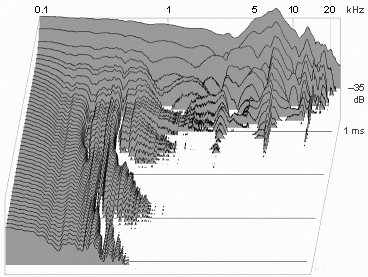
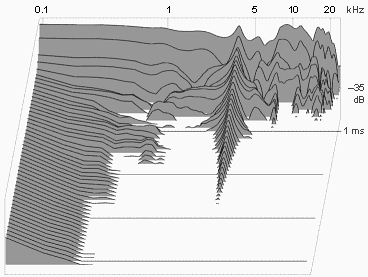
Just to give everyone some background, and Arnaud hinted at this too: I employ an open measurement method that seeks to take the head-cup / enclosure out of the equation as much as possible. To this end, I am only partially successful (the only way to be completely successful would be to remove the driver, as I had done with the "liberated SR80i driver" measurement.) So we can still see some enclosure effects on my data.So for this test, I decided to use another method here where I could achieve a tight seal on the DJ100. This tight seal measurement method gives us more accurate bass FR response for headphones that are more closed or have big pads. The downside to this method is that tends to record wierd cancellation nodes and resonance peaks (that our ears and brain are able to filter.) But anyways, here it is with some comparisons:
DJ100 Tight Seal Measurement Method
Normalized with original measurement. You can see the effects of the cups emphasized and some funky peaks and cancellation nodes in the treble.
DJ100 open method measurement
HD558 / 598mod
For reference.
Edited by purrin - 9/7/11 at 12:38pm- purrin
- Trader Feedback: +9
- Always plotting
-
- offline
- 3,880 Posts. Joined 8/2008
- Location: Orange County, CA
- Select All Posts By This User
Darth Beyer V3
Bass heads take note. Mainly for historical interest. I don't think these are as popular as they used to be.
One bass port open, one closed with electrical tape. It doesn't matter much because I am using my standard measurement technique to minimize effect of head-cups.
Here is with a tight seal measurement for only up to 1ms. The intent here is to show FR @ t=0. Both bass ports are open.
Edited by purrin - 11/4/11 at 8:07ampost #127 of 9329/7/11 at 4:44pm- Reticuli2
- Trader Feedback: +2
-
- offline
- 496 Posts. Joined 12/2007
- Location: USA
- Select All Posts By This User
So I assume you'd only know how high the initial impulse should be by seeing the raw electrical signal, right? And I assume the Koss is supposed to be inverted like that?
- purrin
- Trader Feedback: +9
- Always plotting
-
- offline
- 3,880 Posts. Joined 8/2008
- Location: Orange County, CA
- Select All Posts By This User
Quote:Yup, we should be able to get a very good approximation from knowing the electrical output, sensitivity of the drivers, and sensitivity of the measurement microphone. The impulse response of the Koss is inverted. It's possible the amps I used invert the signal (this is not uncommon), or I was just retarded and clicked the invert signal toggle switch on the measurement software.
- purrin
- Trader Feedback: +9
- Always plotting
-
- offline
- 3,880 Posts. Joined 8/2008
- Location: Orange County, CA
- Select All Posts By This User
Quote:Yup, we should be able to get a very good approximation from knowing the electrical output, sensitivity of the driver, and sensitivity of the measurement microphone. The impulse response of the Koss is inverted. It's possible the amps I used invert the signal (this is not uncommon), or I was just retarded and clicked the invert signal toggle switch on the measurement software.
Whether you can hear inverted signals is a matter of debate. My DAC and Joe Grado HP1000/HP1s have toggles to invert the signal.
Edited by purrin - 9/7/11 at 7:19pmpost #130 of 9329/7/11 at 7:33pm- 200poundsofamp
- Trader Feedback: +9
-
- offline
- 358 Posts. Joined 6/2011
- Location: Oregon
- Select All Posts By This User
Quote:
Thanks!Quote:Originally Posted by rhythmdevils
Purrin, I'd love to see the SRH840 and SRH940 compared this way. My suspicion from patterns I've noticed on head-fi, and backed up by how similar Tyll's measurements are of the two cans except for different FR, is that the 940 is basically an 840 with more treble and less bass. It would be interesting to see more measurements because it could be a great example of how simple changes in FR affect the perception of every other quality- speed, accuracy, detail, distortion, etc. From Tyll's measurements, the 840 actually measures better AFAIK, but the 940 is compared to the HD800...
I think it would be interesting anyways.

I'd love to see this too. If anyone has a 940 I can send an 840 in.
Edited by 200poundsofamp - 9/7/11 at 8:56pmpost #131 of 9329/7/11 at 8:04pmPlease excuse my ignorance, but can someone explain or point to me a good link on how to read these plots? I'm interested in furthering my knowledge of understanding audio measurements so I can better make informed choices on head phones, being a relative newcomer to quality headphones (at one time, I too used to think Bose was king).
- purrin
- Trader Feedback: +9
- Always plotting
-
- offline
- 3,880 Posts. Joined 8/2008
- Location: Orange County, CA
- Select All Posts By This User
Quote:Originally Posted by ohmyheadfi
Please excuse my ignorance, but can someone explain or point to me a good link on how to read these plots? I'm interested in furthering my knowledge of understanding audio measurements so I can better make informed choices on head phones, being a relative newcomer to quality headphones (at one time, I too used to think Bose was king).
http://www.parts-express.com/pdf/OmniMic/hs17.htmhttp://www.head-fi.org/t/566929/headphone-csd-waterfall-plots/60#post_7730765
- purrin
- Trader Feedback: +9
- Always plotting
-
- offline
- 3,880 Posts. Joined 8/2008
- Location: Orange County, CA
- Select All Posts By This User
Quote:Originally Posted by dw1narso
Good stuffs, Purrin... One of the most useful thread in Head-Fi, I believe...
Would it be possible for you to measure the multi-order Harmonic Distortions plots as well? (such as this driver )
I thought CSD + knowing which order of harmonic distortion is dominant, would make it much easier to "guess" how a driver (or phone in this case) would sound...

Non-linear Distortion
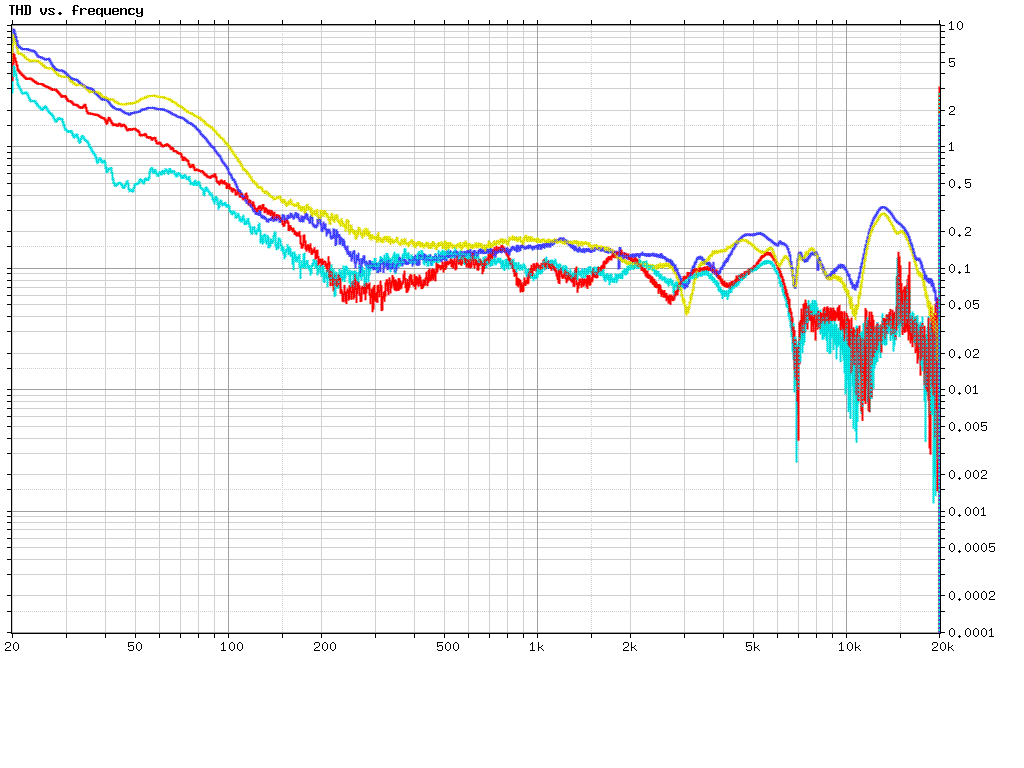
Here are a few non linear distortion measurements. My place is fairly noisy, so the noise floor, especially in the bass is high. There is natural spike at 120Hz - probably computer PS noise. There appears to another at 150Hz too (I have no idea about that one, maybe the CPU bus?) The 0db point is 95dbSPL on the graphs. These graphs will show both HD and IMD.HD800 and HP1000 at 50Hz
- Note the 120Hz spike - that's part of the environment.
- You can see the HD800 has it's 2nd harmonic (100Hz) about 45db down, and it's 3rd harmonic (150Hz) 35db down from the fundamental. The 3rd harmonic is definitely hearable. There is a little spike at the 5th harmonic too (250Hz). Overall extremely clean with a light touch of odd order harmonics.
- The HP1000 has a large 2nd harmonic contribution at only 20db down. This probably has a large part of the HP1000s reinforced, organic sounding bass. It's 3rd harmonic is way way down.
HD800 and HP1000 at 200Hz and 2200Hz (two tones)
- The HD800 is cleaner than the HP1000 with the exception of the small 3d harmonic (600Hz) spike from the 200Hz tone.
- The HP1000 is ~10db higher than the HD800 on the 2nd order distortion from the two test tones.
- The HP1000 has more IMD intermodulation distortion. This is the more nasty stuff. You see higher more 10+db higher peaks at 2000Hz (2200-200), and 2400Hz (2200+220) including their 2nd order harmonics (4000Hz and 4800Hz).
Edited by purrin - 9/10/11 at 3:00pm- purrin
- Trader Feedback: +9
- Always plotting
-
- offline
- 3,880 Posts. Joined 8/2008
- Location: Orange County, CA
- Select All Posts By This User
ESP950 50Hz
2nd harmonic is 25db down, a little bit better than HP1000, but not as good as HD800. The 3rd harmonic is better than HD800 and almost as good as HP1000.
ESP950 200+2200Hz Tones
Very similar to HD800. Higher noise floor - could be amp (SRM323) differences. Very clean.
Edited by purrin - 9/10/11 at 2:14pm- purrin
- Trader Feedback: +9
- Always plotting
-
- offline
- 3,880 Posts. Joined 8/2008
- Location: Orange County, CA
- Select All Posts By This User
HP1000, H800, ESP950 non-linear distortion graphs - 3500Hz and 3850Hz tones
HP1000 < HD800 ~ ESP950. It's all very close though. Much cleaner than speaker drivers.
Edited by purrin - 9/10/11 at 2:35pmReturn HomeBack to Forum: Headphones (full-size)- Headphone CSD waterfall plots
Gear mentioned in this thread:
- Comparing headphones: Sennheiser's HD 800, HD 600, HD 25-1 and...
Recent Discussions
- › Pictures of your computer rigs! Post them here! 41 seconds ago
- › Heir Audio - The Appreciation Thread 4 minutes ago
- › 7th Annual ChiUniFi - June 22nd 7 minutes ago
- › Ocharaku 音茶楽 appreciation thread 7 minutes ago
- › Need help for a beginner 8 minutes ago
- › Yulong's new DA8 8 minutes ago
- › Ipod touch 16GB or Sandisk sansa clip+ 10 minutes ago
- › T-PEOS H-200 - new triple hybrid IEM - Appreciation thread 10 minutes ago
- › Best Possible Headphones With Best AMP For My PC 10 minutes ago
- › The diary entries of a little girl who is now 30! ~ Part 2 11 minutes ago
Recent Reviews
- › Skullcandy S2SYDA-008 Merge Earbud Headphones - Black/Chrome by KodaO
- › VSONIC VSD1 by TheGame21x
- › Audio Technica W5000 by the wizard of oz
- › Harmon Kardon Classic On-Ear Headphones by imagic
- › Creative Aurvana Live! Headphones by imagic
- › JBL J33 Premium In-Ear Headphones - Black by Aakash
- › Hisoundaudio Wooduo 2 by iern
- › Apple iPod classic 160 GB Silver (7th Generation) NEWEST MODEL by jensy
- › Sony MDR-V55/BR DJ style Headphones by dietcoke2am
- › Creative Sound Blaster Tactic 3D Sigma USB Gaming Headset by imagic
New Articles
- › Syncing music and making playlists work with... by Currawong
- › Mac OS X Music Players - alternatives to iTunes by miceblue
- › STAX SR-007 (Omega II) ... A Review After 4... by Currawong
- › List of lossless and high-res music (FLAC,... by ffivaz
- › Beware of the following scams and people... by Currawong
- › Sennheiser 449 Mod Possibly 4 8 Mod by hernan604
- › 2012 Head-Fi Holiday Gift Guide (Computer Audio) by joe
- › 2012 Head-Fi Holiday Gift Guide (Portable... by joe
- › 2012 Head-Fi Holiday Gift Guide (Desktop Audio) by joe
- › 2012 Head-Fi Holiday Gift Guide (Headphone... by joe
About Head-Fi.org | Join the Community | Advertise
© 2013 Head-Fi.org is powered by Huddler Tech | FAQ | Support | Privacy/TOS | Site Map