
Head-Fi.org › Forums › Misc.-Category Forums › DIY (Do-It-Yourself) Discussions › 2 or 3 Channel, Single Ended Class "A" Design Thread
New Posts  All Forums:Forum Nav:

2 or 3 Channel, Single Ended Class "A" Design Thread

post #1 of 87
Thread Starter 

Here is my contribution to the DIY community.

You can use this on it's own as a Buffer or integrate

it into a larger design.

I'm open to improvements but wish to keep the design very simple.

The three channel layout has a high PSRR so you don't need

an elaborate power supply. I just use a simple full wave bridge

and caps. You can power from a center tap transformer or use

a TLE2426 to generate ground.


3 Channel Szekeres.bmp


The trim pots let you zero out any DC offset but you should still try

and match components as close as you can.

post #2 of 87
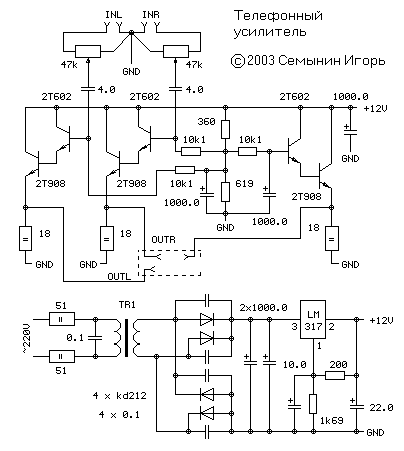
Lm317 is not good for sound - try use the second mosfet as CCS. Try this one, as for me, it's a best SE headphone buffer.

 Ushi1.gif

It also work with mje3055, 2sc5200 and bd139 transistors.

post #3 of 87
Thread Starter 

In the schematic you are using a simple resistor as your current sink. That

is fine to do but less efficient and not  necessarily better sound than LM317

current source/sink. I can see you have it tuned for low impedance headphones.

I have seen this done with MOSFET current sink and I may post a version

of that too if people want to try it. Also, with such a high PSRR you don't

really need a regulated power supply but it doesn't hurt either.
 

Quote:
Originally Posted by Ant1Xr1st View Post

Lm317 is not good for sound - try use the second mosfet as CCS. Try this one, as for me, it's a best SE headphone buffer.

 Ushi1.gif

It also work with mje3055, 2sc5200 and bd139 transistors.


Edited by Avro_Arrow - 5/21/10 at 1:38pm
post #4 of 87

I want to try different current sources. Can you show a current source with BD139 or BD140 and resistor?


post #5 of 87
Thread Starter 


I will try, but I would rather, like Ant1Xr1st did, people submit some of their ideas too...

What you are looking for in a good current source/sink is low noise and flat response.

Ring of two transistors are OK, LED biased transistor better, FET cascode, LED biased

transistor even better and FET/FET best. I know there are more but I'm not trying to be an

encyclopedia.


Quote:
Originally Posted by Spacehead View Post

I want to try different current sources. Can you show a current source with BD139 or BD140 and resistor?


post #6 of 87

I don't know how to simulate this frequency response:


Szekeres VE
 

Quote:
Originally Posted by Avro_Arrow View Post


I will try, but I would rather, like Ant1Xr1st did, people submit some of their ideas too...

What you are looking for in a good current source/sink is low noise and flat response.

post #7 of 87


Quote:
I can see you have it tuned for low impedance headphones.

No. The bias is tuned for maximum transistor's linearity.


Quote:
with such a high PSRR you don't really need a regulated power supply but it doesn't hurt either

Such psu will be ok, but you will need C-R(or L)-C filter anyway. you may use a 7812 - it doesn't needed any extra resistors.


Quote:
simulate this frequency response

The simulation will not be correct because of simplified lm317 model.


Here is one more intresting schematic.

HA-1-sch-3.png


Edited by Ant1Xr1st - 5/21/10 at 4:10pm
post #8 of 87

Avro_Arrow, I have always liked the look of the 'active ground' (or whatever you call it) circuit since I first saw the scheme on the RJM site. However, as the Gate of the FET is ground referenced the Source must be at some negative voltage (about -1 to -3 Volts I guess, depending upon standing current). What then happens if the channel output is accidentally shorted to real (0 Volt) ground? Can the FET withstand the short, or will it pop?


Ant1Xr1st, thank you for showing these circuits. Regarding the last schematic, can the BSP129 be replaced by a FET with a lower internal impedance, to lower the output impedance? (Which type ?)


(I hope other people join in, because this can become an interesting thread...)

post #9 of 87
Thread Starter 

The source sits at Vgs below ground (or virtual ground). In my example, Vgs was 3.65.

Right now I am using a 24 volt unregulated supply.

My outputs sit about 8 volts above V-.

Current through the device is limited by the current source to (in my case) 152.2 mA.

I don't think a short to either V+ or V- would cause it to pop. That is not to say that there

is no way to pop it, it just might take some "creative shorting".

Maybe I will try it with one of my "less well" matched IRF510s.

My IRFs are match to .01 volts.

They are all mounted on the same heat sink as well to combat thermal drift.

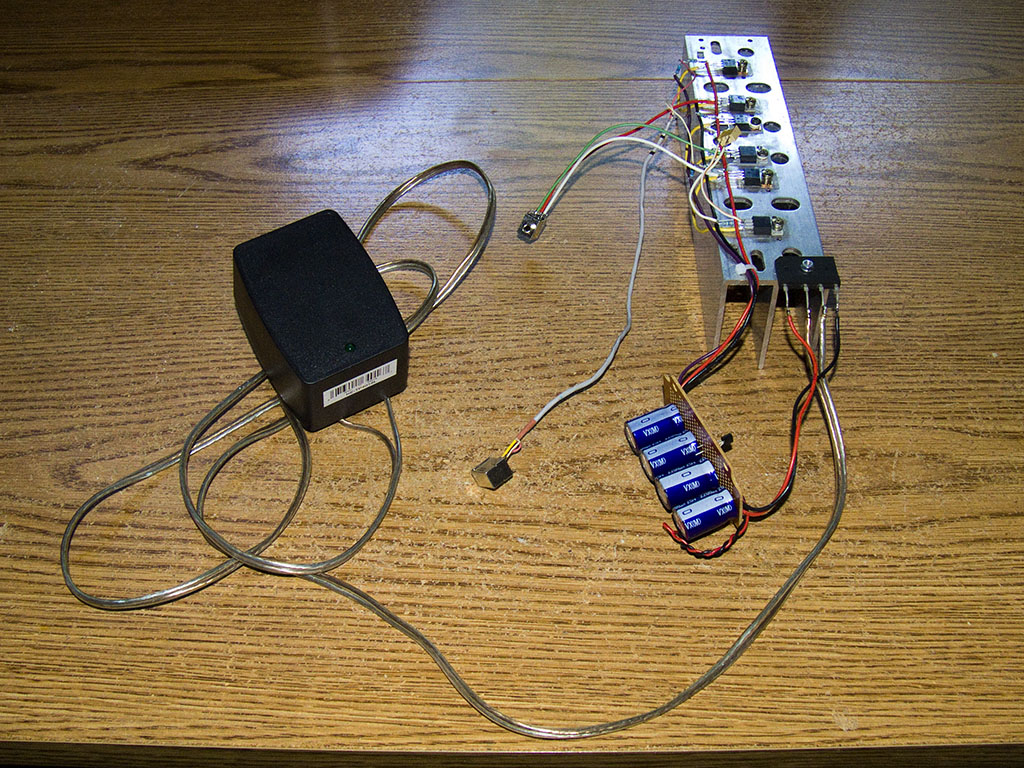
There is a picture of this amp in my Album or in the "pictures of your builds" thread.
 

Quote:
Originally Posted by Leny View Post

Avro_Arrow, I have always liked the look of the 'active ground' (or whatever you call it) circuit since I first saw the scheme on the RJM site. However, as the Gate of the FET is ground referenced the Source must be at some negative voltage (about -1 to -3 Volts I guess, depending upon standing current). What then happens if the channel output is accidentally shorted to real (0 Volt) ground? Can the FET withstand the short, or will it pop?


Ant1Xr1st, thank you for showing these circuits. Regarding the last schematic, can the BSP129 be replaced by a FET with a lower internal impedance, to lower the output impedance? (Which type ?)


(I hope other people join in, because this can become an interesting thread...)


Edited by Avro_Arrow - 5/21/10 at 5:48pm
post #10 of 87
post #11 of 87

I don't know if this works: 


szekeresve2.png

post #12 of 87
Thread Starter 

Your LED bias is not done right.

LED goes to ground through a limiting resistor,

not directly to ground.


on second thought..it just all wrong...sorry


Quote:
Originally Posted by Spacehead View Post

I don't know if this works: 


szekeresve2.png


Edited by Avro_Arrow - 5/21/10 at 6:08pm
post #13 of 87

I am trying to understand these biasing circuits. I would love to see a working example with transistor ccs. 


http://rapidshare.com/files/390160713/szekeresve.asc.html ltspice file


Edited by Spacehead - 5/21/10 at 6:19pm
post #14 of 87

Look here http://en.wikipedia.org/wiki/Current_source

67.png


Edited by Ant1Xr1st - 5/21/10 at 6:24pm
post #15 of 87
Thread Starter 

Try this one


I do not have component value...this is just an example

of how it's made.


Current Sink.bmp

New Posts  All Forums:Forum Nav:
  Return Home
Head-Fi.org › Forums › Misc.-Category Forums › DIY (Do-It-Yourself) Discussions › 2 or 3 Channel, Single Ended Class "A" Design Thread