Head-Fi.org › Forums › Equipment Forums › Sound Science › A visual comparison of mp3 320k, 192k, and FLAC
New Posts  All Forums:Forum Nav:

A visual comparison of mp3 320k, 192k, and FLAC

post #1 of 24
Thread Starter 
So just to give a visual comparison of the different lossy formats and lossless (FLAC):


FLAC:
ImageShack - Hosting :: flacvv2.png

320k MP3 (LAME CODEC):
ImageShack - Hosting :: 320lamelg3.png

192k MP3 (LAME CODEC):
ImageShack - Hosting :: 192lamejs9.png

128k MP3 (aka crappy):
ImageShack - Hosting :: 128lamewl3.png

Note how audio information is lost as you move along... not only is their clipping at higher frequencies (with 320k mp3 clipping frequency to 20khz and 128k clipping almost 4000hz of frequency down to 16000hz) but the "bars" become thinner as more and more gaps are created.
post #2 of 24
Why don't we just hotlink the pics eh?

FLAC:


320 kbps mp3 (LAME):


192 kbps MP3 (LAME):


128 kbps mp3 (LAME):


Anyway, can you give us a VBR (e.g. vbr -v0 LAME) comparision also as that would be interesting as well
EDIT: Why isn't the FLAC one to scale?
post #3 of 24
post #4 of 24
Those bars losing time-domain detail are interesting. Would be good to have matched graphs tho.
post #5 of 24
Yeah, its quite obvious that audio data get lost during lossy encoding.
Hence I stick with lossless!
post #6 of 24
Quote:
Originally Posted by johnation33 View Post
Note how audio information is lost as you move along... not only is their clipping at higher frequencies (with 320k mp3 clipping frequency to 20khz and 128k clipping almost 4000hz of frequency down to 16000hz) but the "bars" become thinner as more and more gaps are created.
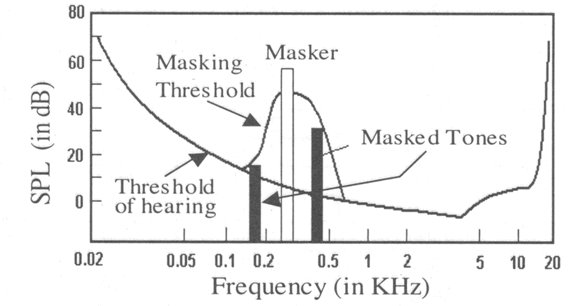
It is not really clipping, what you are seeing is the effect of the lowpass filter, this filter is at different levels for different MP3 settings , but you can actually override it to some extent. The gaps is a result of the psychoacoustic phenomenon of masking which is used in the codec algorithms to decide which frequencies will be least missed, if you have two very close frequencies and one is a few db higher than the other then the other will be (almost) inaudible (masked).

The impact of low pass filters is interesting, late 1970s research[1] suggests that the insertion of low pass filters at 20K, 18K and even 16K is quite difficult to detect reliably, even when using music with high levels of 20K + frequencies and transducers capable of reproducing it. Only when you set the low pass to 14K does it become easy to detect it.


1. Sampling-Frequency Considerations in Digital Audio
TERUO MURAOKA, YOSHlHlKO YAMADA, AND MASAMI YAMAZAKI
post #7 of 24
Now post sound samples of BMP, PNG and JPEG image files at different compression levels. It basically amounts to the same thing.
post #8 of 24
Quote:
Originally Posted by nick_charles View Post
The gaps is a result of the psychoacoustic phenomenon of masking which is used in the codec algorithms to decide which frequencies will be least missed, if you have two very close frequencies and one is a few db higher than the other then the other will be (almost) inaudible (masked).
The gaps are along the x-axis, and hence are time-domain, not frequency domain as you suggest.
post #9 of 24
Quote:
Originally Posted by Alleyman View Post
Now post sound samples of BMP, PNG and JPEG image files at different compression levels. It basically amounts to the same thing.
Yeah, sound samples would be nice.
There are no question that there are data loss during lossy compression. If its audible is a different matter
post #10 of 24
I did something very similar about 3 years ago. You can see the images in there two blog posts (a blog I long abandoned):

Brad’s Audio Blog » Affects of data compression on frequency content

Brad’s Audio Blog » More compression spectrum analysis
post #11 of 24
Thanks for the information here, will stick to lossless just for safe.
post #12 of 24
Quote:
Originally Posted by b0dhi View Post
The gaps are along the x-axis, and hence are time-domain, not frequency domain as you suggest.
Doh !, you are of course completely right, I am being silly.

here is masking

post #13 of 24
Quote:
Originally Posted by frank99 View Post
Thanks for the information here, will stick to lossless just for safe.
Great choice!
post #14 of 24
Adobe Audition ftw! I see them used everywhere.
post #15 of 24
where people can't hear the difference, those graph become useful to show them there is one.

ihmo those graph are pretty meaning less, considering that in blind test you wont head difference in band restitution, what are most likely to pick up on the other hand are the "distortion artefact" in low bit rate compression.
When freq band restitution is audible in mp3 compression it's the result of poor encoding method and excessive use of low and high pass filter.
New Posts  All Forums:Forum Nav:
  Return Home
  Back to Forum: Sound Science
Head-Fi.org › Forums › Equipment Forums › Sound Science › A visual comparison of mp3 320k, 192k, and FLAC