I'm startled, pleasantly, that we have so many replies already; I'd originally aimed this thread at the very small minority of headphone users who'd owned Yamaha Orthodynamics and wondered what the other models were like.
Quote:
Originally Posted by Frank M
If the technology was so good as to compete with even electrostatics in some fields, as you say, then why are they not still in production?
|
Fostex still makes isodynamic 'phones for the pro audio market-- as far as I know they're the only true believers left, and the only company to attempt isodynamic headphones using modern magnetic materials. But they've turned their backs on the audiophile market. Not that they didn't try-- they came up with a stat-killer back in 1978, the T50. It was marketed poorly and failed.
Sounds like an opportunity, doesn't it.
Your question raises another question that takes us back to the late '70s in the US home-audio market: Would most people have chosen electrostatic headphones if they could have afforded them? Not that many people recognized electrostatic 'phones as anything but screechy, lacking in bass and outrageously expensive. Far from the near-ideal status they enjoy today. So telling someone that the Yamahas were poor-man's electrostats would have gone over with a dull thud.
Besides, the Yamahas didn't sound 'statlike: they had much more bass, much less treble, and thus presented a sound that most people were used to and therefore would like. This may be the reason, over which I agonize again and again in this thread, why Yamaha didn't apply ten cents' worth of mechanical damping to their Orthodynamic drivers, but I'm getting ahead of my story.
Quote:
Originally Posted by SaturnNyne
I didn't realize that was actually something beyond just their seventies marketing, I'm curious to hear more.
|
I remember seeing those outputs on '70s Yamaha receivers and wondered if they'd actually optimized the outputs for the impedance and efficiency of the Orthodynamics. Not that they really had to: like Magneplanar speakers, the Yamas present an essentially resistive load to the amp. That is, this type of headphone is the easiest kind of load, nearly pure resistance, able to be driven properly by any amp with enough power, and unaffected by the varying stray inductance and capacitance of exotic cables and boutique amps.
So while there was no need to "optimize" the headphone outs on those Yamaha receivers, and there
was some marketing involved, I like to think Yamaha was proud of their Orthodynamics back then (they seem to have forgotten about them today-- see below) and made sure that the headphone outs were more than just afterthoughts.
Quote:
Originally Posted by Setmenu
Here's another planar headphone, the Wharfedale isodynamic, circa 1975.

|
Thanks for bringing up an important point about the isodynamic type. You don't need superstrong magnets and you don't need exotic materials and you don't [always] need great precision in manufacture-- the drive principle inherently takes care of many of the rigidity and resonance problems that dog moving-coil designs.
Note: the Wharfedale turns out to have been the first isodynamic headphone in the world to reach market, in 1972. At £
20, it was also one of the most affordable. After earpad restoration it still sounds great today. UK readers should rush out and save languishing examples of this valiant veteran and brilliant example of British engineering.
FOOL DISCLOSURE
Two words about the equipment I'm using: Old and nothing special. I have a couple of surprisingly good/cheap old receivers (the Realistic STA-2200 and the Kyocera R-851) with MOSFET amps, a couple of Sony and Yamaha VFET amps (well, I guess that's a little special), a bunch of late-'70s to mid '80s preamps from Hafler, Nikko, Sanyo, Yamaha and Sherwood, a collection of Hitachi's, Sanyo's and Sherwood's MOSFET power amps from the same period, and a couple of basic Chu Moy (aka CMoy) portable amps. The All of these are available (when they
are available) at reasonable prices through online auction sites.
However, much of this old (say "vintage") gear is not typical of what young-type persons are using today, so taking Newform Research's
recommendation of the Panasonic digital-amp receivers to heart, I obtained not one but several of them, finding them both readily available and affordable online. This has changed my characterization of a few individual headphones' frequency responses but hasn't fundamentally altered my evaluation of their capabilities. Being able to feed the Panasonic's amp digitally cuts down on a few variables and makes testing easier and more repeatable and thus reliable.
[size=xx-small]Also lying about are a couple of copies of one of the Yamahas' direct competitors, the Audio-Technica-built Realistic Pro 30 isodynamic. In the interest of
full fool disclosure, I also own a Sennheiser HD 600, an AKG K501, a Stax Lambda Signature (1-micron diaphragm) and a Stax Lambda Nova Basic (2 microns) with an SRM-1 Mk 2 Pro amp; a Grado SR-80 with flats/HD414 pads; Sony EX71 earbuds, and several Koss KTX Pros. Oh yes, there's also a motley collection of old electret-electrostatic 'phones: the Sony ECR-500 (5 microns), a Stax SR-30 Pro (4 microns), and a Signet TK33 (2 microns).[/size]
[size=xx-small]
Past 'phones include the watershed Sennheiser HD 414 (ca. 1973), the HD 424 (ca.'76) and the bizarre HD 44. There were also the Stax SR-X Mk2, Beyer ET1000 and Superex PEP-79 electrostatics and my first isodynamic, the oddball 1978 Audio-Technica ATH-1, aka the Gram Cracker (sic). It was this 'phone, with its so-right-yet-somehow-wrong sound, that made me rip it apart in frustration and stuff fibrous material into it.[/size]
FORM FACTOR
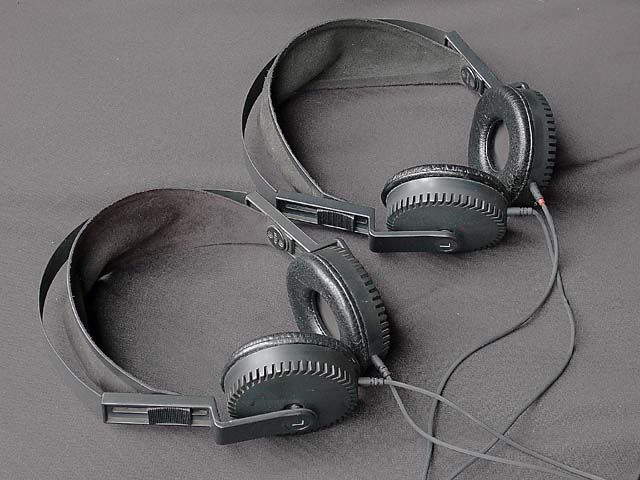
Here are the original HP-1 and the follow-on YH-1, both top of their respective lines. Can you tell them apart?
That's the HP-1 on the left.
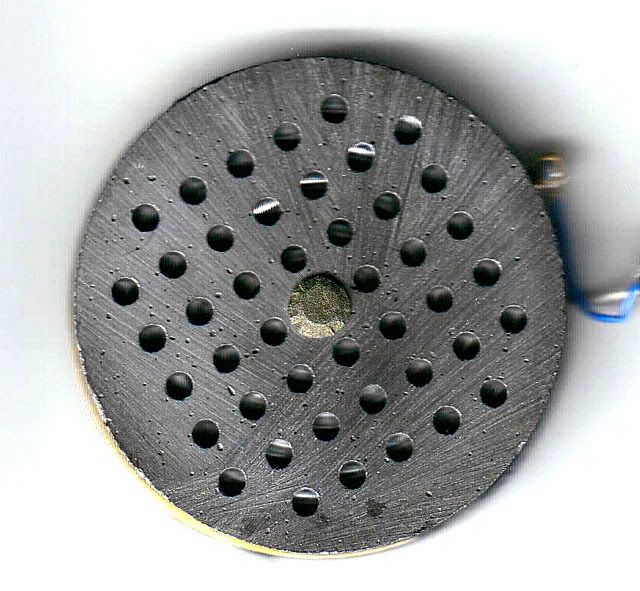
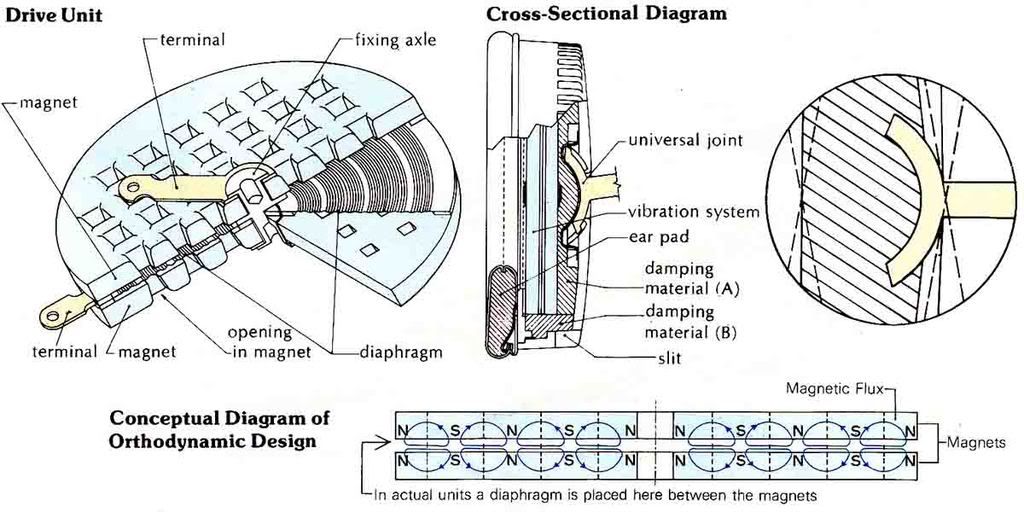
This was more or less the form taken by the most expensive of each generation of Orthodynamics until the YHD series of the mid/late '80s. Inside each earcup is a sandwich of two perforated ferrite disc magnets about 2 inches in diameter with a nontensioned corrugated or pleated diaphragm between them carrying a printed aluminum spiral voice coil (see below). This assembly is called the
driver. Here's a closeup of the driver from a YH-1. The roughly machined surface of the ferrite magnet is exaggerated a little in this photo. You can see some of the turns of the shiny aluminum spiral voice coil through the holes.
A good closeup of the later YH-100-style driver, which is essentially the same but with metal plates covering the outer faces of the magnets:
http://home.hccnet.nl/joop.nijenhuis...1/RHP1P005.jpg
SO WHAT'S THE BIG IDEA?
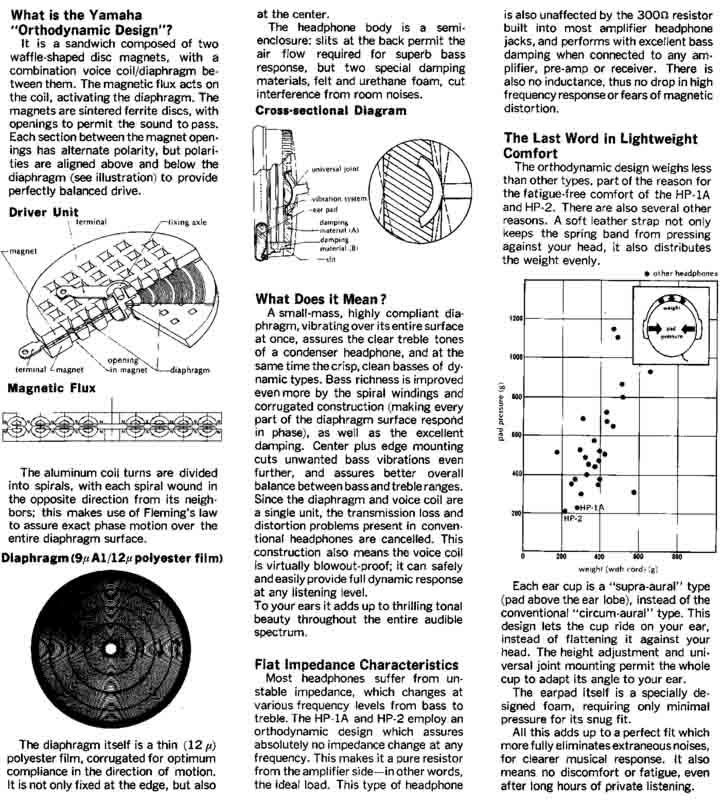
The bright idea proffered by the isodynamic headphone (a Yamaha Orthodynamic is a type of isodynamic) is the happy combining of the simplicity and power of the magnetic drive used in moving-coil dynamic 'phones with the light, filmy, driven-over-its-entire-surface diaphragm of an electrostatic.
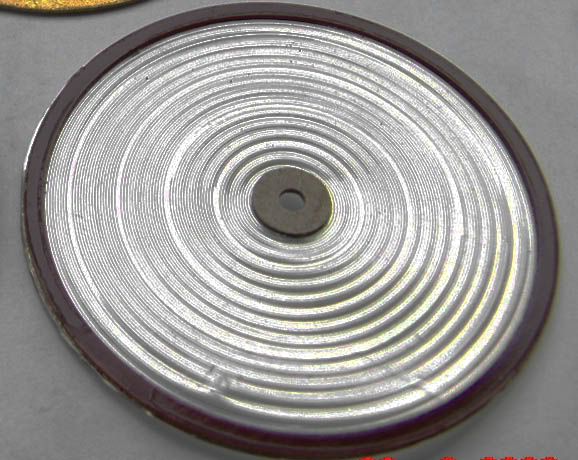
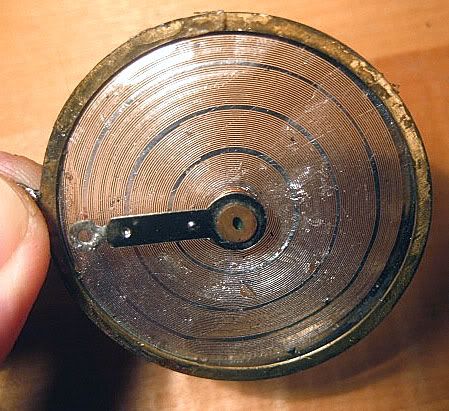
So imagine taking a coil of superfine aluminum wire and hammering it flat until it forms a thin, floppy spiral. Press this onto a circle of 2" wide clear packing tape, slap it between two perforated magnetic discs which are trying to repel one another, and you'll have the basic idea. Refine the idea by using photo-etching; make the packing tape Mylar, then pleat the diaphragm to give it compliance axially (in the direction of motion) and stiffness laterally (so that it tends to move as a disc). This combination, in the Yamaha driver, looks something like this:
[size=xx-small]
PEERLESS PMB 100 DIAPHRAGM[/size].................................................. ...........................................[size=xx-small]
YAMAHA HP-50 DIAPHRAGM[/size]
The above left photo is a diaphragm from a Peerless PMB 100, kindly supplied to us on Head-Fi by member
torrid ear (in real life MB Quart's
Willi Presutti), showing the corrugations Yamaha used for their drivers' diaphragms up to the YHD series. HF member dBel84's closeup of a diaphragm taken from a well-used HP-50 shows how delicate it is and how much punishment it took out in the real world. The diaphragm is held in a frame but the corrugation removes the need for that frame to hold the diaphragm in tension. The corrugated diaphragm is thicker than a tensioned one, but it's self-supporting and supplies its own restoring force.
Note that the center voicecoil electrode, and thus the center of the diaphragm, is clamped inside the magnet structure, so the driver acts as a vibrating ring, very much like the driver in the Sennheiser HD 800.
By using magnetic drive we eliminate the need to generate high signal and bias voltages as well as the amplifier problems that arise when we try to drive a headphone that's basically a small capacitor, which is what an electrostatic driver is. In fact, an isodynamic driver is less reactive (that is, less like an inductor or capacitor) than a normal dynamic driver. Amplifiers simply love 'em.
A typical dynamic headphone driver's diaphragm must be mechanically rigid because it's driven only in a ring around the base of its central dome by a small, hopefully lightweight, coil. The undriven part of the dome has the thankless job of trying to follow the driven part as it vibrates 15,000 times a second. Rigidity, all other things being equal, requires extra material, which means extra mass. That extra mass
should also keep the diaphragm of a dynamic driver from rippling, rocking, ringing, et cetera, but as the SPL climbs, increasingly it does not. Still, getting a heavy diaphragm moving isn't a tough engineering problem; if we want something heavy to accelerate rapidly, we hit it with a strong force. We hit it with a strong signal and use a powerful magnet. The tougher problem is getting that diaphragm to
stop moving.
But-- if a diaphragm didn't have to be rigid, it could be made very thin and lightweight, easy both to accelerate and to stop. In an isodynamic driver, the uniformity and the simultaneity of the driving force makes the diaphragm
effectively rigid, since the same force is being applied at each point over its surface (thus the term isodynamic)-- in theory, at least, and to a good approximation in real life. The penalties of high mass and the accompanying problems of stored energy and delayed release of that energy are thus reduced.
Having arrived at this point conceptually and having noted the success of isodynamic speaker designs like Jim Winey's Magneplanars, in 1976 Yamaha announced the HP-1. Its cardinal virtue was smoothness-- it may not have been flat, but cranking in a mild smiley on the graphic EQ gave a sound that, if it fell short of electrostatic clarity was at least reminiscent. Smoothness of response lends a 'phone clarity and the ability to listen "into" the music. It delays the onset of listener fatigue. It also indicates that nearly everything has pretty much been done right electromechanically. An astonishing (to me) number of HP-1s were sold for the then-princely sum of
$200 (a 1976 Stax SR-X Mk3 cost about $300). There must have been a reason. Owners have repeatedly used the word "natural" to describe their sound.
Note: owners who bought their HP-1s in 1977 and later report a lower price, about $95.
By the way, Yamaha Japan has put a nice but brief look back at the HP-1 on its domestic website:
HP-1 | DESIGN | ƒ„ƒ}ƒnŠ”Ž®‰ïŽÐ . If someone would like to translate the good parts for us, I'd be obliged. ..Aside from this, the usually helpful Yamaha site mentions nothing about their Orthodynamic headphones, almost as if the whole enterprise were an awful family secret too painful to remember. Because of this...
SPECS for the some Orthodynamics have been tough to come by, but the HP-1's look like this:
Magnet size: 55mm diameter. This remains true for the top-of-the-line Orthodynamics (except for the YH-1000) until the YHD series.
Effective diameter (ie, the diameter over which the diaphragm is actually able to deliver sound through the holes in the magnets) is about 48mm. The less expensive HP-2 and HP-3 achieved their cost savings in part by using 46mm diameter drivers.
Impedance: 150 ohms. This is a function of both the length and thickness of the spiral aluminum track (its DC resistance) and its inductance (nearly negligible).
Diaphragm thickness: 12 microns of polyester, with the aluminum voice coil plated (or glued) 9mm thick on top of that. This compares to the Stax SR-40 electret electrostatics' 6 microns and the first Stax Lambda's 2 microns. So right away we know the diaphragm's not going to be as light as an electrostatic's, since it has to carry its own weight plus the weight of the voice coil. Right away we can also see a design problem coming: Just as with an electrostatic, there's no shock absorber function supplied by the driving elements as there is in a moving-coil driver, where the voice coil and the magnet work against one another to damp excessive motion of the diaphragm (primarily overshoot due to inertia). In an electrostat, you make the diaphragm light enough and big enough so the air load it sees can damp resonances that lurk in any diaphragm, whether under tension or not. The Orthodynamic diaphragm is far too massive and small in area for the air load to have an appreciable effect, so if nothing is done, the generic isodynamic driver will be characterized by one very broad but very audible resonance the location of which depends on diaphragm tension (in the case of electrostats and the YHD Orthodynamics, described later) or compliance, and mass. Therein lies a tale.
Sensitivity (efficiency): 94 dB/mW (102 dB/V). Fairly low, about 10dB below current dynamic models. This figure is printed on the US market HP-1 box. A German language brochure cites it as 96 dB/mW. We discovered an HP-1 variant (comes in a black, not silver, box) with "keeper" plates on the magnets that the box calls
anisotropic, and a 96 dB/mW sensitivity, but still called HP-1.
Looks just like a YH-100 driver, but isn't the same. Different versions for different markets? Could be. We've called this one the HP-1 Anisotropic.
Rated input: 3W. Pretty high. A good sign, given the low sensitivity.
Max input: 10W. Impressive. You could take this thing out of the headphone and use it for a tweeter, as Fostex did.
COST, COMFORT, AND THE DEVIL IN THE DETAILS
Variations in the thickness or width of the voice coil's spiral aluminum track would jeopardize that high power handling; a tiny nick somewhere in the track would turn the voice coil into a big expensive fuse. It's possible that a high initial reject rate of diaphragms as they fought to make the aluminum deposit perfectly uniform in thickness and width was a major part of the high cost of the HP-1, and that the lower cost of later models was made possible by Yamaha finally getting good yields of consistently-etched tracks.
The Mario Bellini headset design, revolutionary for its day, really was as comfortable as it looked, which explains why so many headsets have used a similar arch-and-strap design in the decades since. The magnets could have been twice as big and heavy (one can only imagine the bass output) and the phones would still have felt good. It's difficult today to imagine how much more comfortable the HP-1 was than the massive, head-clamping competition. There are, however, a couple of small mechanical problems: (1) the ball-joint earcup pivot connects to the headband via a small-diameter plastic strut. If the 'phones are dropped and this strut breaks, the 'phones are done for. (2) that ball joint pivots in a small, loosefitting
metal socket inside the earcup and makes loud, annoying clicking and clunking sounds as the 'phones are settled on the listener's head. The sounds are carried through the entire structure; it's a sensation not unlike flicking a plastic ruler held clenched in the teeth. Not a problem if the listener holds still, but disconcerting, especially at first.
After some time spent listening to the HP-1, some owners began to notice a slight hollow,
"plasticky" sort of quality to the sound, most noticeable during playback of the typical LPs of the time. Phonograph playback in the '70s wasn't the Platonic ideal of pristine sound reproduction many today would have you believe. Clean records, clean by today's standards, were hardly a given. So there was plenty of what's called impulse noise, ultra-brief needle-like (pun intended) spikes of sound, sometimes so frequent and continuous it was called "crackle". This was simply accepted BITD (back in the day)-- when you played an LP, the stylus would encounter little pockmarks and bits of gravel in the groove and play them. Result:
tic! tic-tic! TIC!
Ideal waveform, as it turns out, for testing a headphone.
On the HP-1, LP impulse noises that used to be
tic! were now coming out as
thokkhh!. It was so unexpected that it was hard to know what to blame.
Some attributed it to the closed back of the earcups (when tapped, they sound hollow, though they're really not) or the "sound" of the plastic diaphragm. While the character of the 'phone, its smoothness and naturalness, dominated, at the same time there was definitely something not quite right about the sound. Eventually this good/bad quality drove some owners to put aside their Orthodynamics and look elsewhere for good headphone sound.
CAUSES, POSSIBLE CURES
What caused this? Let's look
inside. For acoustic treatment, the interior of the HP-1's earcup contains only a thin, lightweight acoustically-transparent
opencell foam pad just behind the driver, and although there are felt pads which cover the vents and fill the space around the edge of the driver, sound comes out of the back of the driver, passes right through the [useless?] little foam pad and smacks right into a smooth, reflective concave plastic wall. Yes, the cup
is vented, but the vents are located around the cup's circumference (as you can see in the photo above) rather than directly behind the driver. What were they thinking? a labyrinth effect to delay the bass from the backwave? Perhaps. But what about treble reflections inside the cup? And could this be the source of the problem?
My working hypothesis throughout this series of posts is that while the reflective earcup certainly isn't helping anything except possibly to shore up a sagging treble, Yamaha's diaphragm is simply too massive for its oscillations to be damped by the acoustic resistance supplied by the little foam pad-- imagine a heavy jumper on a trampoline "damped" by nothing but a big fluffy layer of meringue on the trampoline's underside. This is why in other threads I've advocated applying discs of dense felt to the back of the driver. As the diaphragm tries to push air through the felt, it meets resistance that damps out overzealous (ie, due to resonance) motion, just like a shock absorber in a car. This, it turns out, makes all the difference.
When applied to the back of the driver in an Orthodynamic headphone, a damping pad's primary effect is to drastically flatten the response curve, depressing the broad lower-midrange resonance hump and effectively bringing up the formerly weak bottom and top ends. It also has the salutary effect of greatly tightening up the bass, making the HP-1s behave as they were presumably meant to 30+ years ago, maybe better. Bass becomes percussive, tactile, almost speakerlike. A damping pad also soaks up some of the treble backwave, keeping it from ricocheting around the cup.
It also makes the 'phones even less efficient.
You'll notice that most high-quality dynamic drivers also use either damping pads or tiny pinholes in their frames or baskets to perform the same shock-absorber function. For example, you can see the holes method used on the back of the Koss KTX and KSC drivers. You can easily see a white damping pad under the mesh grilles of Sennheiser's HD-600 and -650. A black strip of porous material is visible on the back of Grado's drivers.
Why didn't Yamaha do the same for the HP-1? Would that have raised the price to $200.10?
ONE MAN'S RESULTS
The first Head-Fi member to try damping his Orthodynamic 'phone based on the above recommendations, back in Feb '05, was
Bias. His comments (from
this thread) are reproduced here in their entirety:
"I modded my old Yamaha HP-1's earlier tonight as per Wualta's recommendations. The result is exactly what Wualta predicted: the addition of extra damping materials in the transducer housing (in this case a piece of round felt directly behind the driver across it's entire diameter) flattens the freq response by smoothing a low frequency resonance hump. This results in better perceived high frequencies and a better differentiation of lower bass extension from, say, the mid-bass area. Sonic characteristics (the amazingly smooth, non-fatiguing presentation, etc) remain intact. I never fully perceived the so-called 'orthodynamic thunk' so it's hard to say whether or not this has been lessened... but thanks for the tip Wualta. I must say, as a recording engineer, I've listened to many different types of headphones and monitor speakers. These Yamaha's now remind me very msuc of the vaunted Yamaha NS-1000's whose freq response was amazingly flat and accurate. I can now do final mixing and mastering on these headphones with this improvement. But who wants to do that...i'd rather just listen to great music all night long with these incredible cans. Team Ortho-fantastic!"
Bias' results encouraged me to begin this thread.