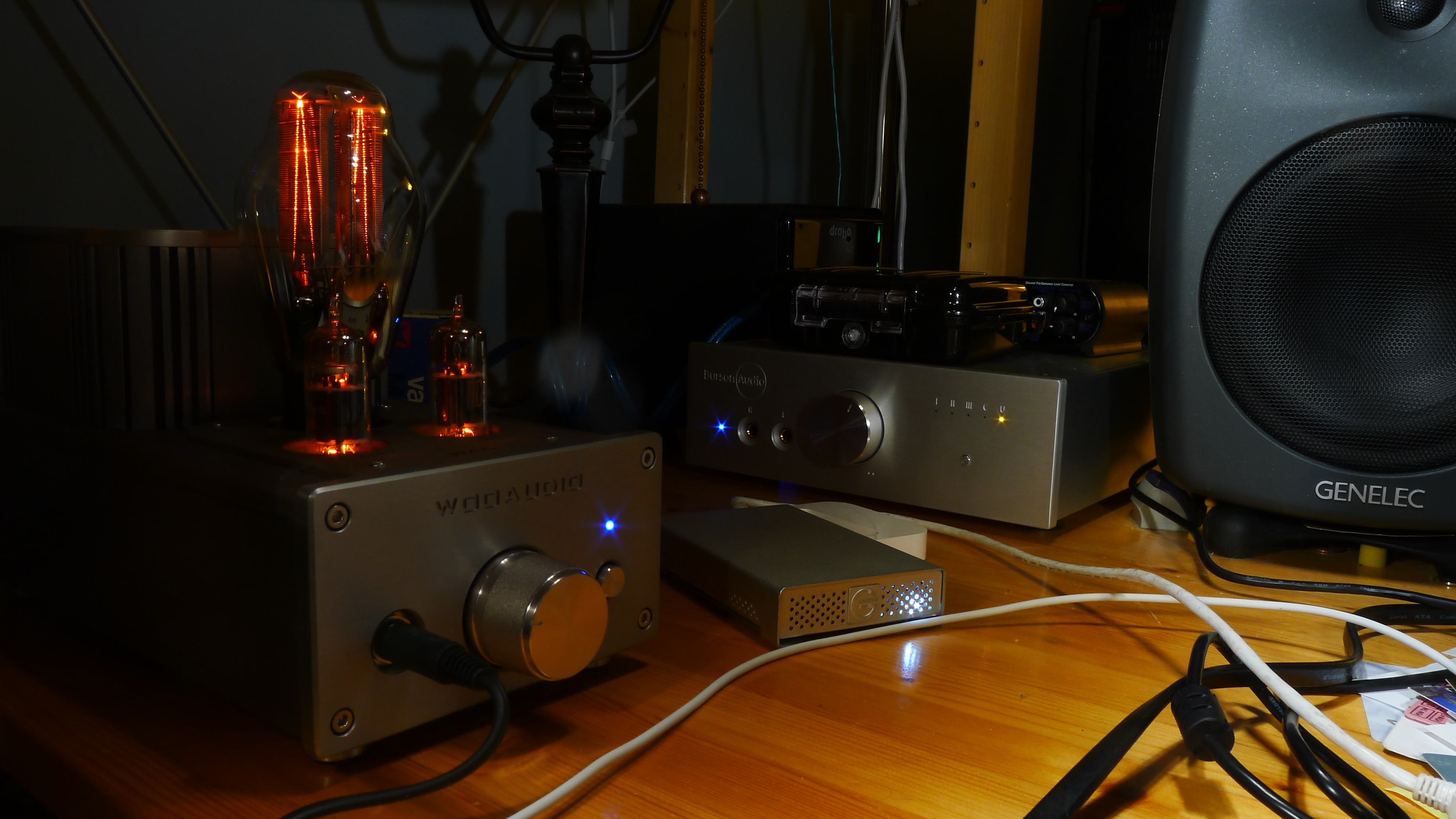
I'm a relative newbie to the headphone game.
My reference system (at the time of writing) is a Burson 160D, and having a good reference is essential when you're comparing tubes.
My reference headphone (at the time of writing) is the Sennheiser HD 650, which are known for their veil until you put great amplification with them. I also own UERMs, which aren't appropriate for this type of listening analysis.
First out of the box I was quite unimpressed. The soundstage was decent, but not exactly impressive. The bass was muddy and shallow. More disturbing, is what happened to passages with a lot of reverb. The decay would clamp down hard, and you'd lose a lot of transients. I found myself running back to the Burson, wondering what I was thinking dropping $550 bucks on an experiment.

The photos on the web site of the Princess Sophia tube had me drooling, and I ordered soon. The upgrade piqued my interest as the WA6 began performing. It wasn't audio nirvana, but the soundstage improved and the bass opened up a bit. The Woo WA6 wasn't winning, but at least it was in the game. My trips back to the Burson were suddenly less frequent.
Reading another review here on Head-Fi, I read a lot of praise for a stubby, unattractive tube called the GZ34 made by Mullard. It appears the older you go, the better the sound becomes, so says the pricing and reviews on these short tubes. I found one on eBay for $120. A 1958, standard base NOS, and the WA6 was suddenly a force to be reckoned with.
The GZ34 launched the WA6 into orbit. I've yet to find a tube that can compete-- but if you're looking for a cheaper substitute, check out the CV593. They're lacking a little on the bottom, but match the GZ34 in most respects, and it's a much prettier tube, to boot.
UPDATE: I've located a 1957 metal base GZ34-- and indeed the sound did improve a bit (not earth-shattering-- but a bit better bottom end and openness.) I've also received a tip that the Western Electric 422a 274B, if you can find one, is a step ahead of the GZ34. I haven't tested or found one yet that was affordable. I've also been auditioning a Telefunken GZ32 rectifier-- and have been quite pleased with its overall presentation. It is worth noting that all of these tubes mentioned are a quantum leap in sound ahead of the Sophia Princess or stock 5AR4 tubes.
On the drive side, tube after tube after tube sent me back to the stock RCA 6DE7. I still haven't found any worthy upgrade, though I'm currently testing a 6SN7 that's showing some promise. Woo claims the 6GL7 is the premiere tube for power on the unit, I couldn't disagree more, and I was sorry I flushed the $110 down the drain. While adding more drive, the GL7s added some distortion and crunch, and reminded me of an FM radio sound circa 1977. The lesson here is the rectifier tube makes a greater impact on the tonal quality than the drivers, so put your money in a good rectifier and be happy with the stock 6DE7s.
UPDATE: When I moved from the HD650 to the HD800-- here's where the power tubes came into play. The 6DE7 was no longer enough to drive the power hungry HD800. The GL7 still lacked a bit in clarity for my taste-- so I tried the legendary 6SN7 tubes-- and the pairing is now quite impressive.
For intense listening, the WA6 now outperforms the Burson 160D. That's saying a lot. However I've spent hundreds and hundreds in tubes to get here. The Burson excels at everything and gives you a DAC converter and pre-amp to boot. It's a better buy.
If you like tweaking and hunting-- the WA6 can provide that rare audio nirvana we seek. But it's going to cost you and be prepared to roll through a lot of tubes before you find that ideal match.
A final word on fit and finish-- this unit is just beautiful to look at and built like a tank.
FINAL UPDATE: Eventually I was using the Burson 160D so little for actual amplification-- I sold it and moved to the Wyred4Sound DAC2. The amp stage on the Burson was simply no match for the Woo with upgraded tubes. I sold the WA6 in the fall of 2012 after a WA5LE (yes, I'm officially a Woo addict) came available on eBay for a huge discount. I couldn't pass on the deal. What the WA5LE revealed is that the WA6 doesn't have a lot of power to drive demanding headphones. While the WA6 drove the HD800 fine with the upgraded driver, it didn't have enough power to really open up the HD800 to their full potential. This is not to say the WA6 isn't a good amp, it's a terrific amp. But know that by moving up in the Woo line, you do get better sound (deeper bass, better soundstage, etc). If you're spending more on a pair of high-end cans-- you have to plan on spending more on an amp to bring the most out of your expensive purchase.



 ,
,